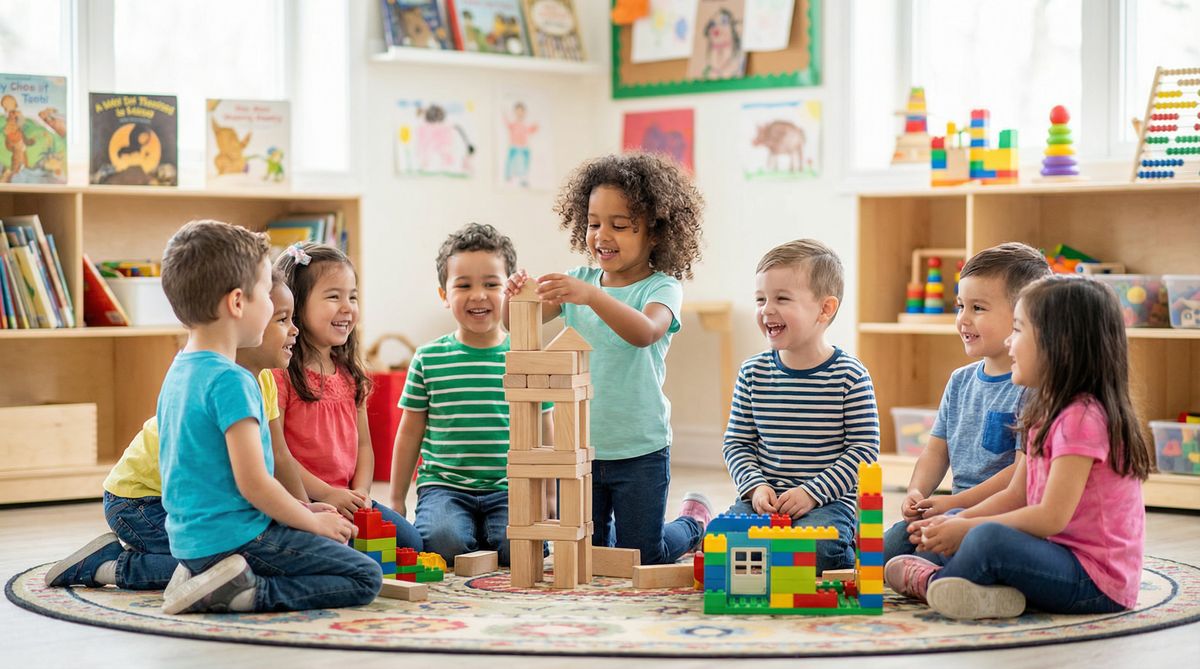
Growing up in New York City means exposure to dozens of languages and cultures. For many families, bilingual daycare isn't just a convenient option, it's a meaningful way to preserve heritage, develop cognitive skills, and prepare children for a multilingual world. But what does bilingual education actually offer your child, and how does it work in a daycare setting?
## What is Bilingual Daycare?
Bilingual daycare programs integrate two languages into daily instruction and interaction. Models vary: some programs use one language during certain times and another language during other times. Others use both languages throughout the day, with teachers fluent in both. Some programs focus on minority language preservation (like Mandarin, Spanish, or Korean), while others pair English with another language.
The goal is not just to teach children two languages, but to maintain both languages in a way that supports cognitive development, cultural connection, and long-term bilingual competence.
## Cognitive Benefits of Bilingualism
One of the most compelling reasons parents choose bilingual education is the cognitive advantage. Extensive research shows that bilingual children develop stronger executive function, which includes working memory, cognitive flexibility, and inhibitory control.
When a child speaks two languages, their brain constantly manages switching between languages, determining which language to use with which person, and holding two linguistic systems in mind simultaneously. This mental workout strengthens the neural circuits responsible for problem-solving and multitasking.
Bilingual children often perform better on tasks requiring mental flexibility and perspective-taking. They're also more likely to demonstrate enhanced metalinguistic awareness, meaning they understand language structure at a deeper level. A bilingual child might more easily recognize that "cat," "gato," and "chat" are all the same animal, for example.
Studies suggest these cognitive advantages persist into adulthood and may provide some protection against cognitive decline in older age.
## Language Development and Fluency
A common parental concern is whether two languages will confuse a young child or delay language development. Current research is reassuring: bilingual children do not experience language delays. Instead, their total vocabulary across both languages is typically comparable to monolingual peers, though vocabulary in each individual language might develop at different rates.
A bilingual three-year-old might know 500 words in English and 400 words in Spanish, for a total of 900 words, compared to a monolingual peer who knows 900 words in English. But they can communicate effectively in both languages.
In bilingual daycare, trained teachers support language development in both languages. They use both languages intentionally, provide rich language input through storytelling, songs, and conversation, and create opportunities for children to practice both languages meaningfully.
The earliest years, from infancy through age five, are a critical window for language acquisition. Children exposed to languages during this period acquire them naturally, without conscious effort or "lessons." Bilingual daycare takes advantage of this window.
## Cultural Connection and Identity
For families maintaining heritage languages and cultural traditions, bilingual daycare helps children stay connected to that culture. A child learning Mandarin at daycare can communicate with grandparents, understand family stories and traditions, and maintain connection to ancestral culture.
This cultural continuity is significant for identity development. Children who grow up fluent in their heritage language have stronger connections to family, community, and cultural identity. This is not incidental to their development, it's protective and enriching.
In a diverse city like New York, bilingual daycare also exposes children to multiple cultures within a single classroom. They learn that multiple ways of doing things are normal. They develop cross-cultural competence that will serve them throughout life.
## Social-Emotional Benefits
Bilingual children in quality bilingual programs benefit from peer relationships across language groups. They learn to communicate with children from varied backgrounds. They develop empathy and perspective-taking skills as they navigate understanding and being understood across language differences.
Children in bilingual settings also often demonstrate increased confidence and willingness to take risks in communication. They're used to experimenting with language and learn that not knowing something is okay; they can ask, learn, and try again.
## Academic Advantages
Research consistently shows that bilingual children perform at least as well as monolingual peers academically, and often better. Reading skills in one language support reading skills in another language, even if the languages use different scripts. Phonemic awareness, comprehension strategies, and other reading skills transfer across languages.
Math and science learning is not language-dependent in the way literacy is, so bilingual children typically excel in these subjects when they have access to quality instruction in either language.
By the time bilingual children enter elementary school, they often demonstrate advantages in reading, writing, and problem-solving compared to monolingual peers.
## Preparing for a Multilingual World
In an increasingly global economy, multilingual skills are valuable. Adults who are fluent in multiple languages have more career opportunities and earning potential. They can access more information, literature, and cultural expression.
Starting bilingual education in early childhood is the most efficient way to develop true fluency. Children who learn languages after age five or six, when the critical period narrows, typically need explicit instruction and effort to achieve fluency. Children in bilingual daycare develop multiple languages naturally.
## What to Look for in a Bilingual Daycare Program
**Qualified Teachers**: Teachers should be native or near-native speakers of both languages with training in early childhood education. They should be intentional about language development in both languages.
**Language Separation Strategy**: Understand the program's approach. Does one teacher speak one language? Do they use languages at different times? The clearest input comes when language use is structured clearly.
**Balanced Exposure**: Ideally, children get roughly equal exposure to both languages, though this isn't always possible or necessary. More important is consistent, quality input in both languages.
**Family Communication**: The program should communicate with families about language development in both languages and support language use at home.
**Cultural Inclusion**: Quality bilingual programs celebrate the cultures associated with both languages through food, holidays, stories, and community connections.
**Developmentally Appropriate Practices**: Bilingualism should be embedded within a quality, play-based, developmentally appropriate early childhood program, not an isolated language-focused curriculum.
## Supporting Bilingualism at Home
If your child attends a bilingual daycare, consistency helps. Supporting the minority language (the one less spoken in the broader community) at home strengthens bilingual development.
Read books in both languages. Use both languages in daily routines. Encourage relatives and family friends to interact with your child in the home language. Celebrate both cultures through food, holidays, and traditions.
Resist the urge to correct your child's language mixing or code-switching. Bilingual children naturally blend their languages early on, and this is a sign of developing bilingual competence, not confusion.
## Making the Choice
Bilingual daycare is not necessary for your child's development. Monolingual, quality early childhood programs absolutely support healthy development. However, for families who speak multiple languages or value multilingualism, bilingual daycare offers real cognitive, social, and cultural benefits.
The decision ultimately depends on your family values, your child's exposure to multiple languages at home, and the quality of available programs. The most important factor is choosing a daycare with warm, qualified teachers, good teacher-child ratios, and developmentally appropriate practices.
If bilingual education aligns with your family's goals, the early years of daycare are an ideal time to invest in language development. Your child's brain is primed for language learning, and the benefits extend far beyond childhood.
---
About Sunshine Learning Centers
Sunshine Learning Centers offers child-centered daycare and preschool for children ages 6 weeks to 5 years at 8 NYC locations. Schedule a tour and apply today.
Helpful Links:
Enroll at Sunshine Learning Centers — https://www.sunshinenewyork.com/enroll
Our Curriculum — https://www.sunshinenewyork.com/curriculum
Find a Location Near You — https://www.sunshinenewyork.com/locations
Infant Care (6 weeks - 12 months) — https://www.sunshinenewyork.com/curriculum/infants
%201.png)