What Is the Creative Curriculum? A Parent's Guide to How Your Child Actually Learns

DATE
March 31, 2026
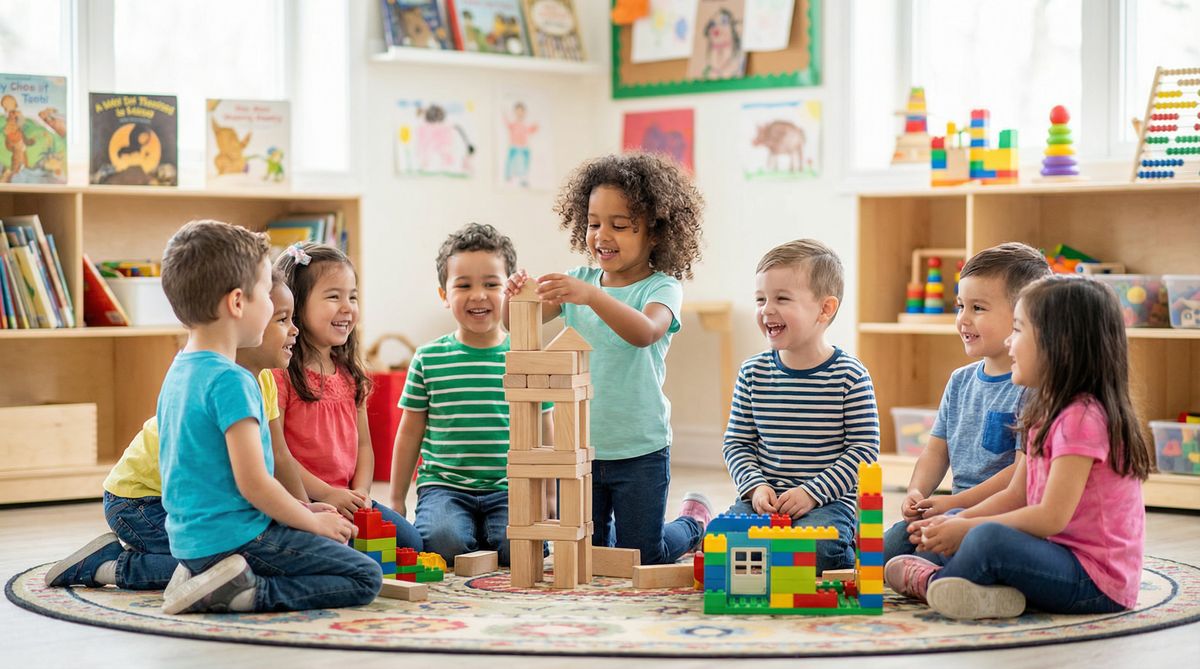
Preschool children building with colorful blocks during a Creative Curriculum activity

You're reading through daycare brochures and one keeps mentioning something called "the Creative Curriculum." Sounds nice. But what does it actually mean for your kid's day? What are they doing at 10 AM on a Tuesday — and why?

Here's the straightforward version: what the Creative Curriculum is, how it works in real classrooms, and why thousands of preschool and daycare programs across the country (including plenty right here in NYC) use it.

The Creative Curriculum in 60 Seconds

The Creative Curriculum is a research-based framework for early childhood education, developed by Teaching Strategies. It covers children from birth through age five and gives teachers a structured way to plan activities that match where each child actually is developmentally — not where a textbook says they should be.

It's built around one core idea: young children learn best through exploration and play, guided by teachers who know what to look for and how to nudge things forward.

That probably sounds obvious. But the difference between "we let kids play" and "we use intentional, observation-based play to build specific skills" is enormous. The Creative Curriculum is the second one.

How It Actually Works in the Classroom

Walk into a Creative Curriculum classroom and you'll notice something right away: interest areas. Instead of rows of desks (this isn't elementary school), the room is divided into defined spaces — a block area, a dramatic play corner, an art station, a library nook, a discovery table, a sand and water area.

Each area is deliberately set up with materials that invite specific kinds of learning. The block area isn't just blocks — it's spatial reasoning, physics, cooperation, and early math. The dramatic play corner isn't just dress-up — it's language development, social skills, and emotional regulation.

Teachers rotate materials based on what they call "studies" — deep dives into topics that emerge from what kids are curious about. If the class is fascinated by construction trucks they saw on Lexington Ave, the teacher might build a whole study around buildings and construction. Blocks become skyscrapers. Art becomes blueprints. Books become stories about architects and builders.

The Daily Flow

A typical day in a Creative Curriculum classroom follows a predictable routine — and that predictability is intentional. Young kids feel safer when they know what's coming next. A morning might look like:

  • Morning meeting: Songs, calendar, discussing the day's plan
  • Choice time: Children pick which interest areas to explore (this is the big block — usually 45-60 minutes)
  • Small group: Teacher-led activity targeting specific skills with 4-5 kids
  • Outdoor play: Gross motor, fresh air, social interaction
  • Read-aloud: Book connected to the current study
  • Meals and rest: Built into the rhythm naturally

The magic is in choice time. Kids aren't told "today we're doing blocks." They choose. And that choice — that sense of agency — is a huge part of how they develop motivation and self-regulation.

The 38 Objectives: What Teachers Are Actually Tracking

Behind the scenes, Creative Curriculum teachers are observing like hawks. The framework includes 38 objectives for development and learning, organized into areas like:

  • Social-emotional: Manages feelings, follows limits, makes friends
  • Physical: Travels around obstacles, uses writing tools, coordinates hand movements
  • Language: Listens and understands, uses expanding vocabulary, tells stories
  • Cognitive: Solves problems, thinks symbolically, connects new experiences to prior knowledge
  • Literacy: Recognizes letters, engages with books, writes name
  • Math: Counts, compares quantities, recognizes shapes and patterns

Teachers document what they see — photos, notes, work samples — and use a platform called GOLD to track each child's progress along these objectives. It's not grading. It's mapping. Where is this child right now, and what's the next step?

This is where the Creative Curriculum earns its reputation. A teacher might notice that Marcus can sort objects by color but not by size yet. So she'll set up a small-group activity with different-sized containers at the water table. It's targeted, it's play-based, and Marcus has no idea he's being taught — he just thinks he's pouring water.

Why Play-Based Doesn't Mean Unstructured

This is the biggest misconception parents have. "Play-based" doesn't mean kids are just messing around for six hours while teachers scroll their phones. (If that's what you see on a tour, leave.)

In a well-implemented Creative Curriculum classroom, every material is placed with intention. Every teacher interaction during play has a purpose. When a teacher sits down in the block area and asks, "How many more blocks do you think you'll need to make it as tall as you?" — that's math instruction. When she says, "Tell me about what you're building" — that's language development.

The research backs this up consistently. The National Institute for Early Education Research has found that high-quality play-based programs produce better outcomes in literacy, math, and social skills than direct-instruction programs — especially for children from lower-income families. Kids don't just learn more; they retain more, because they built the knowledge themselves instead of having it poured in.

How This Compares to Other Approaches

NYC parents shopping for preschool will run into several curriculum names. Here's how they stack up:

Montessori emphasizes individual work with specific materials in a mixed-age classroom. It's more self-directed and less teacher-guided than Creative Curriculum. Beautiful method, but some kids (especially very social ones) thrive more with the collaborative, project-based structure of CC.

Reggio Emilia is project-based and child-led, with heavy emphasis on documentation and the arts. It shares DNA with Creative Curriculum but is less standardized — how it looks depends entirely on the school.

HighScope is the closest cousin to Creative Curriculum. Both are research-based, both use plan-do-review cycles, both track developmental indicators. The main difference is implementation: Creative Curriculum is more widely adopted in community-based programs and Head Start centers.

Academic/direct instruction programs focus on worksheets, letter drills, and sit-down learning. Research consistently shows these produce short-term gains that fade by first grade, while also increasing anxiety in young children. For three- and four-year-olds, this approach asks them to do things their brains aren't wired for yet.

What to Ask When a Daycare Says "We Use the Creative Curriculum"

Here's the catch: saying you use the Creative Curriculum and actually implementing it well are two different things. Some programs buy the books and hang a poster. Others invest in training, coaching, and fidelity checks.

When you tour a center that claims to use CC, ask:

  • "Can you show me your current study?" Teachers should be able to tell you what topic the class is exploring and why.
  • "How do you use GOLD?" If they're using Creative Curriculum properly, they're using the GOLD assessment tool. Ask how often they update it.
  • "What does choice time look like?" If kids don't get meaningful free-choice periods, the curriculum isn't being followed.
  • "How do you handle kids at different levels?" The whole point of CC is individualization. Teachers should describe how they differentiate.
  • "Can I see the interest areas?" Walk the room. Are the areas well-defined, stocked with rich materials, and labeled? Or is it a room with some toys scattered around?

A strong Creative Curriculum classroom feels alive. You'll see children's work on the walls (not Pinterest-perfect teacher projects). You'll hear conversations between kids and teachers. You'll notice materials that connect to a theme. Trust your gut — the energy of a good classroom is unmistakable.

What This Means for Your Child's Kindergarten Readiness

NYC parents worry about kindergarten readiness — understandably, since the DOE's expectations have ratcheted up over the years. Here's the good news: the Creative Curriculum's 38 objectives align directly with the NYC DOE's Pre-K for All standards and the Head Start Early Learning Outcomes Framework.

By the time a child completes a well-run Creative Curriculum preschool program, they typically can:

  • Recognize most letters and the sounds they make
  • Write their first name
  • Count to 20 and understand one-to-one correspondence
  • Sit for a group activity for 15-20 minutes
  • Express their needs verbally
  • Take turns, share, and resolve basic conflicts
  • Follow multi-step directions

But beyond the checklist, these kids walk into kindergarten with something harder to measure: confidence. They've spent years making choices, solving problems, and learning that their ideas matter. That mindset carries them further than any flashcard drill ever could.

Where to Find Creative Curriculum Programs in NYC

The Creative Curriculum is used widely across NYC's publicly funded programs. Most 3-K and UPK sites in the five boroughs use it, along with many Head Start and Early Head Start centers. Community-based organizations — including Sunshine Learning Center, which operates eight locations across East Harlem, Harlem, Yorkville, Mott Haven, and Coney Island — often use Creative Curriculum as their foundation because it's flexible enough to serve diverse communities while maintaining high standards.

If you're applying through MySchools for 3-K or Pre-K seats, you can ask individual programs about their curriculum during tours. It's always worth asking — not every program lists it on their profile.

The Bottom Line

The Creative Curriculum isn't magic. It's a well-designed system that gives teachers a roadmap and gives children the freedom to learn the way their brains actually work — through hands-on exploration, social interaction, and play that looks fun because it is fun.

When it's implemented well, your child spends their days building, creating, questioning, and growing. They don't sit at desks filling in worksheets. They don't memorize facts they'll forget. They develop the skills and the confidence to figure things out — which, when you think about it, is the whole point.

Want to see the Creative Curriculum in action? Schedule a tour at Sunshine Learning Center and watch how it works in a real classroom.

Explore moreBlogs & Articles

2
Min
June 22, 2026

Screen Time and Young Children: What the Research Actually Says

Young children building with colorful blocks in a preschool classroom

The American Academy of Pediatrics has released screen time guidelines at least three times in the last decade. Every update triggers the same panic among parents: "Are we doing this right? Will screens ruin our kids?"

Here's what you actually need to know about screen time and young children, based on research that's not trying to scare you.

What the Research Actually Shows

The AAP's current stance (as of 2023) is: for children 6 and under, background TV doesn't help. Passive screen time, the kind playing in the background while kids do other things, has no developmental benefit. That's the key finding most parents misunderstand.

But here's what matters more: active engagement beats passive viewing every time. If your toddler is watching a parent play with apps together, talking through what they see, asking questions, that's different from parking them in front of YouTube Kids while you shower.

The CDC and AAP recommend limiting screen time for children under 18 months to high-quality content you're watching together. For kids 18 months to 5 years, 1-2 hours of quality programming per day is fine. The word "quality" is doing most of the work in that sentence.

Quality vs. Just... Whatever's on

A quality program has a few markers: it slows down (fast cuts and flashy transitions hurt attention development), uses clear language, repeats concepts, and ideally includes a parent-interaction component. Shows like Daniel Tiger or Sesame Street were designed with child development in mind. An algorithm-recommended patchwork of trending clips was not.

What research actually worries about isn't screen time itself; it's displacement. Every hour on screens is an hour not spent playing, talking with adults, or getting messy with blocks and paint. That's the real loss, not that the screen is inherently toxic.

If your 2-year-old watches 20 minutes of quality TV while you prep dinner, and spends the rest of the day building, climbing, talking, and playing outdoors, the research suggests you're fine. If your 4-year-old is getting 4 hours of total screens daily, you've got a problem. But the problem is displacement, not screens specifically.

What Sleep and Development Research Tells Us

Here's where screens matter most: blue light before bed interferes with melatonin production. No screens 30-60 minutes before sleep. That's one of the firmest findings in pediatric sleep research. It's not that screens are bad; it's that they're activating before bed specifically.

The other solid finding: language development happens through conversation, not video. You can show your toddler educational apps all day, but Sunshine Learning Center teachers will tell you: kids learn to talk by talking with people. Videos don't have a back-and-forth, so they don't build language in the same way.

That's not a judgment call. That's just how the brain works at that age. Screens provide information. Conversations teach your child that communication is interactive.

The Bigger Picture: What Matters More Than Screen Minutes

Research on child development consistently shows these factors matter much more than screen time totals:

  • Adult responsiveness: Parents who respond to their kids' attempts to communicate (even if it's just babbling) accelerate language and social development.
  • Play-based learning: Unstructured play like blocks, dirt, make-believe, and climbing develops problem-solving, creativity, and social skills faster than any app.
  • Physical activity: Kids under 5 need at least 3 hours of movement daily (including running, climbing, dancing). This is non-negotiable for attention, coordination, and emotional regulation.
  • Sleep: An overtired toddler with perfect screen limits is still struggling more than a well-rested kid who watches TV. Quality sleep is the foundation.
  • Outdoor time: Nature exposure specifically improves focus and reduces anxiety in young children. 30 minutes daily makes a measurable difference.

If you nail these five things and your kid watches 90 minutes of quality TV three times a week, the research does not predict problems.

Why Parents Panic (And Why They Shouldn't)

The research on screen addiction in young children is not particularly scary. Unlike older kids and teens, toddlers and preschoolers don't show classic addiction patterns. They won't withdraw. They can't (yet) search for dopamine hits via apps.

What actually happens if screens are overused: less time for other stuff. Less play, less movement, less conversation. That's the causal chain. It's not that screens are poisoning the brain; it's that they're taking up time that could go to development.

This matters because it means the fix is structural, not neurological. You're not undoing damage by cutting screens. You're redirecting time to better stuff.

If you're curious about what actually builds skills faster than screens, check out our post on why play-based learning works better than worksheets. The research backs it up.

Practical Limits That Match the Research

If you want to align with AAP recommendations without stress:

  • For 0-18 months: Background TV off. Screens only with active co-viewing (a parent sitting, pointing, talking).
  • For 18 months-5 years: Max 1-2 hours daily of quality, slower-paced content. Prioritize shows with a parent-interaction tie-in (Daniel Tiger, Bluey, Sesame Street).
  • No screens 30-60 minutes before bed. This is the firmest recommendation in the research.
  • Prioritize live play. If it's a choice between a learning app and blocks, blocks win every time.
  • Co-view when you can. Don't feel guilty if you can't. But when you do, talk about what you see. That's where the benefit actually lives.

Everything else is flexibility. Every family's balance is different.

What About Educational Apps?

Good news and bad news. Good: educational apps designed by child development experts do teach skills faster than passive viewing. Bad: they still don't teach language as well as talking with an adult, and they don't build problem-solving the way unstructured play does.

Apps are useful as supplemental tools; teaching letter sounds, basic numbers, fine motor skills on rainy days. They're not replacements for the foundational stuff. Use them strategically, not as a substitute for the basics.

If you're trying to decide between a month of premium educational apps or a month of outdoor activities, materials for messy play (sand, water, paint), and more time with adults who respond to your kid, the research is clear. The latter wins.

Research also shows that separation anxiety is normal and manageable when schools handle screen time thoughtfully. Context and relationships matter far more than screen minutes.

The Real Issue: Context Matters More Than Numbers

A kid whose parent checks their phone every 15 seconds while they're together? That's a bigger problem than that same kid watching 90 minutes of Daniel Tiger while the parent is fully present for the rest of the day. The research on parental attention and phone use is worse than anything about kid screen time.

An overscheduled family where screens fill every gap because no one has time to play? That's a context problem, not a screen problem. A family with good rhythm, active play, outdoor time, meals together, responsive adults, and good sleep can handle screens without stress.

The worry isn't whether your 4-year-old watches 60 minutes or 90 minutes of TV. The worry is whether screens are displacing the stuff that actually builds healthy development. If they're not, the research says you're okay.

What to Watch For (Real Red Flags)

The actual signs that screen use is a problem:

  • Your child gets aggressive or very upset when screens go away (suggests emotional regulation issues, not screen addiction).
  • Screens are preventing sleep, social time, or outdoor play.
  • Screen time is growing to fill more and more of the day without intention.
  • Your kid is watching unpredictable, algorithmically-driven content (YouTube rabbit holes, not intentional shows).
  • There's no co-viewing or parent involvement when they are on screens.

If none of these apply, you're not looking at a problem. You're looking at normal family life in 2026.

A Practical Reality Check

Most parents trying to apply research on screen time are already being responsible about it. The families with real problems; kids on 6+ hours daily of whatever random content; aren't reading articles like this. You're asking the question, which means you care.

Here's what matters: your kid gets outside most days, gets active play time, hears responsive conversation, sleeps well, and has some screen time that's intentional (not accidental or background). If that's your life, you're way ahead of the research worries.

The apps, the minutes, the optimal ratio; that's the small stuff. The big stuff is whether your child is developing language, problem-solving, and emotional skills through play, conversation, and movement. Screens are a small part of that picture, not the whole thing.

When you visit Sunshine Learning Center's classrooms, you'll see what research actually recommends: kids building, exploring, moving, talking, problem-solving together. Some of them will have watched TV that morning. Most will have. It doesn't undo what happens when they're in an environment built for play-based learning.

That's the real context for screen time: it's fine, as long as it's not replacing the active, responsive, playful time that actually shapes development. Do that, and you're following the research.

READ ARTICLE
2
Min
June 22, 2026

What Parents Should Know About NYC DOH Daycare Licensing

Colorful preschool classroom with children learning and playing

When you're choosing a daycare or preschool for your child in New York City, you'll hear a lot about "licensing." Maybe you've seen a certificate on the wall. Maybe someone mentioned that their kid's center "got violations." But what does licensing actually mean, and why should you care?

Here's the truth: NYC daycare licensing is one of the few official standards protecting your child's safety and development. Unlike hiring a nanny or using informal family care, licensed centers have to meet specific rules set by the New York City Department of Health and Mental Hygiene (DOH). Understanding these rules helps you make better decisions about where your child spends their day.

What Does "Daycare Licensed" Actually Mean?

A licensed daycare center in New York City has been inspected and approved by the DOH to care for children. The center must comply with specific health, safety, and staffing regulations. Licensing is not optional. If a center cares for more than three unrelated children, it legally must be licensed by the DOH.

This distinction matters. Family daycare providers who care for fewer kids (typically 1-6 children) follow different rules and are registered, not licensed. Group centers like Sunshine Learning Center, which operate locations across Harlem, East Harlem, Yorkville, and other NYC neighborhoods, are fully licensed facilities.

Licensing means:

  • Staff meet specific education and training requirements
  • The facility passes health and safety inspections
  • Child-to-staff ratios are legally enforced
  • Records are maintained and inspected by DOH
  • Parents have the right to review inspection reports

NYC DOH Staffing Requirements (What They Actually Mean)

This is where licensing gets specific. The DOH sets staff-to-child ratios depending on the age group.

For infants (birth to 2 years): 1 staff member per 3 children. For toddlers (2-3 years): 1 staff member per 5 children. For preschool (3-5 years): 1 staff member per 8 children. For school-age (5+ years): 1 staff member per 12 children.

These ratios matter because they directly affect how much attention your child gets. More staff per child means more one-on-one time, better response to needs, and safer supervision. When you visit a classroom, you can literally count the adults and children to verify compliance.

All lead teachers must have at least a high school diploma or GED. Directors must have specific early childhood credentials. Most staff require training in child CPR, first aid, and health and safety. Many centers, including Sunshine Learning Center, exceed these minimums by hiring staff with associate or bachelor's degrees in early childhood education.

The Inspection Process (And What You Can See)

Licensed centers receive unannounced inspections by DOH officials. These inspections check:

  • Safety: fire extinguishers, emergency exits, safe storage of hazardous materials, appropriate temperature and lighting.
  • Health: handwashing stations, clean food service, disease prevention procedures, immunization records.
  • Supervision: verifying staff-to-child ratios, trained staff on site.
  • Facilities: age-appropriate equipment, outdoor play space (where applicable), sanitary bathrooms.
  • Records: staff credentials, parent communication logs, incident reports, health inspections.

After an inspection, the center receives a report. Any violations are documented. These violations fall into categories: critical violations (immediate health/safety risks), major violations (failure to meet licensing standards), and minor violations (administrative issues).

A center with a few minor violations isn't necessarily a red flag. It's normal. Violations like "bathroom soap dispenser empty" get fixed immediately. But critical violations like "staff ratios exceeded" or "unlicensed person left alone with children" are serious and must be remedied. Check out our guide to understanding daycare inspection reports for more details on what each violation means.

How to Check a Daycare's License Status

Finding the inspection report for a specific center is easier than most parents realize.

Go to NYC DOH's daycare search portal online. Enter the center's name or address. The database shows license status (active, expired, suspended, revoked), license expiration date, number and date of recent inspections, violations from the last three inspections, and any enforcement actions.

You can also call the DOH directly. Staff can answer questions about a specific license and violations.

When you visit a center, ask to see the current license certificate. It should be posted and current (not expired). Ask about recent inspections and violations. A good center director will explain violations transparently and show you how they addressed them.

If a center is evasive or won't show you the license, that's a warning sign.

UPK is Different (And That's Okay)

Universal Pre-Kindergarten (UPK) programs run by NYC Department of Education in public schools follow different oversight. If you want to understand how UPK works compared to licensed daycare, read our guide to NYC's UPK and 3-K programs. UPK centers are not DOH licensed. Instead, they're overseen by NYC DOE. Standards are similar but the licensing and inspection process is different.

This doesn't mean UPK is worse. Many UPK programs are excellent. But if you're comparing an independent licensed daycare to UPK, understand they follow different regulatory pathways. Sunshine Learning Center accepts UPK vouchers at our licensed locations, which means you get the benefit of DOH licensing standards plus the affordability of UPK.

What Violations Actually Cost You (Spoiler: It's Not What You Think)

Parents often assume violations mean something is deeply wrong. It's not that simple.

Minor violations might include documentation incomplete, a staff member's CPR certification lapsed by a few days (since renewed), a toy stored in the wrong place, or a form filed late. These are easily fixed and very common.

Major violations are more serious: staff acting outside their training, improper supervision, facilities not meeting cleanliness standards, or failure to keep required records. These require a corrective action plan.

Critical violations are emergencies: children left unattended, unlicensed staff caring for children unsupervised, hazardous materials accessible to kids, or active illness outbreak not being managed. These can result in immediate closure or suspension.

One or two minor violations in a three-year history doesn't disqualify a center. Look for patterns. A center with 10+ violations across three inspections, or critical violations that keep reoccurring, is different from a center with a clean record.

The Real-World Check: Beyond the License

Licensing is a baseline. It's the legal minimum. Many of the best centers go beyond. When you visit any preschool or daycare, ask about staff qualifications, curriculum approach, outdoor play space, and parent involvement. If you're curious about specific teaching methods like Creative Curriculum, most quality centers are happy to explain their approach.

Sunshine Learning Center combines full DOH licensing with additional quality markers: Reggio Emilia and Creative Curriculum approaches, outdoor learning spaces at most locations, and staff with degrees in early childhood education.

Licensing tells you if a center meets minimum safety and staffing standards. Your gut tells you if it's the right fit for your child.

Three Things Every NYC Parent Should Do

First: Look up any center you're considering online before you visit. Know their license status and recent violations beforehand. The DOH database is public and free.

Second: Ask to see the license and inspection report in person. A transparent director will hand them over without hesitation. If you don't see them posted on the wall, ask why.

Third: Use licensing as one factor in your decision, but not the only one. Visit the center. Watch how staff interact with kids. Pay attention to how your child feels about the environment. Licensing ensures basics. Your instincts cover everything else.

Understanding NYC DOH licensing doesn't require a legal degree. It just means you know what you're looking for and how to find it. If you're exploring daycare or preschool options in New York, we're happy to answer questions about licensing, our inspection history, or how our centers operate. Visit sunshinenewyork.com to schedule a tour and see firsthand what licensed care looks like.

READ ARTICLE
2
Min
June 2, 2026

How to Transition Your Child from One Daycare Classroom to the Next

Teacher hugging children in classroom during transition

Moving to a new classroom is a big step for young kids. Whether your toddler is moving from the infant room to the young toddler room, or from a mixed-age class to a preschool class, the transition can feel intense for both of you. But it doesn't have to be painful.

After years of caring for kids through these moves, we've seen what works. The key is preparation, consistency, and understanding that emotions are completely normal. Here's what you need to know.

Why This Transition Matters

Your child has spent months or years in their current classroom. They know where everything is, they trust their teachers, and they've built real friendships with other kids. Now they're leaving all of that behind.

For adults, that might sound like a small thing. For a four-year-old, it's genuinely scary. They don't understand why they're being moved. They don't know if their friends will still like them. They're worried about new routines, new teachers, new bathroom locations.

This isn't neediness. This is how growing up works.

Start Talking About It Weeks in Advance

Don't wait until the week of the transition to mention it. Start conversations at least four to six weeks before the move happens. Keep it simple and positive.

Try something like: "Soon you're going to move to the big kid classroom. You'll get to do new activities, and you'll meet new friends. Your teachers will help you learn new things."

Answer questions honestly. If your child asks why they're moving, explain truthfully: "You're getting bigger and learning more, so you're ready for the next classroom." Don't oversell it or make it sound like the old classroom wasn't good.

Read books about transitions. There are several picture books designed for young kids navigating this exact situation. Reading together opens up conversations naturally.

Visit the New Classroom Before Day One

If the daycare offers a pre-transition visit, take it. This is one of the most powerful preparation tools you have. Let your child walk around, see where things are, meet the new teacher, and sit in a chair at their new table.

If the teacher is available, ask her to show your child the playground area, the bathroom, the cubbies, and the classroom library. Familiar spaces feel less scary when you've seen them before.

Take photos during the visit. At home, look through them together and talk about what your child saw. This reinforces the new space in their mind as a real, knowable place, not some abstract scary future.

Expect Some Regression and That's Okay

Transitions trigger stress, and stress often shows up as regression. Your child might start having accidents again after being potty trained, or want a bottle they haven't asked for in months, or become clingy at drop-off when they've been independent for weeks.

This is not permanent. This is not a sign you're doing something wrong. This is how kids process big change.

Give your child grace. If they need to crawl into your lap when they get home, let them. If they're not hungry at their usual snack time, that's fine. Regression is their way of saying, "I need a little help with big feelings right now."

At the same time, keep routines consistent. Bedtime at the same time, breakfast the same way, the same drop-off goodbye ritual. Consistency at home is the anchor while everything else is changing.

Build Excitement About New Teachers

Meet the new teacher. Ask them what your child's new classroom will focus on. What curriculum materials do they use? What's a typical day like? What are their expectations around behavior and learning?

When you're excited about the teacher, your child picks up on that. If you say, "Your new teacher, Ms. Rodriguez, teaches the most amazing science activities," that matters.

We tell parents at Sunshine Learning Center: ask the teacher about their approach to classroom transitions. Good programs have a clear transition protocol. They introduce new routines slowly. They keep the first week pretty predictable. They check in with parents about how the adjustment is going.

The First Week: Patience is Everything

The first few days will be emotional. Your child might cry at drop-off, even if they haven't cried in months. They might come home quiet or cranky. Both are normal.

Send a comfort item if the center allows it. A stuffed animal, a blanket, a photo of your family, something familiar from the old classroom. Many kids need this bridge object during the transition.

After pickup, ask specific questions. Don't just say, "How was your day?" Say: "Who did you play with today? What was your favorite thing you did? Did you figure out where the new bathroom is?"

If your child is struggling, stay in touch with the teacher. Text photos of how the old classroom went. Share information about your child's preferences, fears, and interests. Teachers can't help with something they don't know about.

Watch for Signs Your Child Isn't Adjusting

Most kids adjust to a new classroom within two to four weeks. There will be hard days mixed in, but you should see progress.

Watch for these signs that something deeper is going on:

  • Your child is crying intensely every single day and showing no improvement by week three
  • They're refusing to enter the classroom or running away
  • They're not eating lunch or using the bathroom at school
  • They come home complaining about specific kids or teachers every day
  • They're having regression beyond the first week or two
  • Sleep is severely disrupted, or nightmares start

If any of these happen, talk to the teacher. Ask if they're seeing the same thing. Sometimes the classroom situation really isn't right for your child, and that's worth exploring. Sometimes your child needs a little more time and maybe a small tweak to the routine.

Help Them Build New Friendships

Kids make friends through repeated exposure and play. Help this happen by asking the teacher who your child is playing with and encouraging those friendships outside of school.

If the daycare has a class newsletter with photos or updates, look at it together. "Oh, I see you and Marcus were building with blocks today. Marcus is cool." Recognizing friendships helps them feel real.

Arrange playdates with classmates if possible. Seeing kids outside of the classroom makes the relationships feel more solid and makes the classroom feel like a friendly place, not a scary one.

Don't Sneak Out at Drop-Off

We get it. If you sneak away, there's no crying, no goodbye hug, no drawn-out farewell. It feels easier in the moment.

It's also teaching your child that you disappear without warning. Kids who've been sneaked out on don't trust drop-offs. They worry that you might vanish at any time.

Instead, have a quick, clear goodbye ritual. A kiss, a hand wave, a specific phrase like, "I'll see you after snack time." Keep it the same every day. Tell your child you're leaving, and follow through.

Crying at goodbye is hard, but it's honest. Your child is working through their emotions. Let them. Teachers know what they're doing. They'll help your child transition from goodbye to play.

The Emotional Piece is Just as Important as the Logistics

You can visit the classroom a hundred times, but if your child senses that you're anxious about the transition, they'll absorb that anxiety. Kids are emotional sponges.

If you're feeling nervous about your child moving to a new classroom, that's human. But when you're with your child, project confidence. "Your new teacher is going to love you. You're so ready for this." You probably believe it already; you just need to say it out loud.

Celebrate the Move

When your child has been in the new classroom for a few weeks and is settling in, celebrate it. Take them for their favorite dinner. Tell them how proud you are that they're brave. Let grandparents call to congratulate them.

This isn't materialistic. This is telling your child, "You did a hard thing. You adjusted. We're proud of you." That matters.

Sunshine Supports Smooth Transitions

At Sunshine Learning Center across New York, we think about classroom transitions as a real milestone, not just a logistical move. We gradually introduce routines before the transition happens. We communicate with parents constantly during those first few weeks. We know it matters.

Research from the American Psychological Association confirms what we see every day: children with strong social-emotional skills handle transitions better. Social-emotional learning in preschool isn't a luxury; it's the foundation for handling life's changes.

If you're planning a transition and have questions about how we approach it, schedule a tour at any of our eight locations. We're happy to talk you through our process.

The bottom line: classroom transitions are temporary. Your child will adjust. In a few weeks, they'll love their new teacher, forget where the old bathroom was, and wonder why they were ever nervous. And you'll wonder how they grew up so fast.

Frequently Asked Questions

How long does it take a child to adjust to a new classroom?
Most kids adjust within two to four weeks. The first week is usually the hardest, with emotions easing in weeks two and three. Every child is different, and some take a bit longer.

Should I stay in the new classroom on the first day?
Ask the center what they recommend. Most programs prefer parents to do a full drop-off, but some offer a short visit-and-leave approach. Follow the center's protocol. Teachers have expertise in this.

What if my child has separation anxiety and the transition makes it worse?
Separation anxiety is real. The best approach is consistent, kind, firm goodbyes. Prepare your child with the visit, start talking about it early, and keep home routines stable. If it's severe, talk to the center and your pediatrician.

Is it normal for a potty-trained kid to have accidents during a transition?
Yes. Stress triggers regression. It usually resolves once your child feels secure in the new classroom. Stay calm, don't punish, and gently remind them of the bathroom location.

What if my child says they don't like the new teacher?
Give it time. Kids often say they don't like something new because it's unfamiliar. Ask the teacher how your child is responding and what they're observing. If there's a real personality conflict after three to four weeks, talk to the center about it.

READ ARTICLE
Become a Sunshine Teacher

Join a team that shares your passion.

Apply TODAY
Music
Language
Movement
Culture
Community
Arts
Academics
Social Skills