




















Young minds. Bright futures.

Child centered daycare and preschool in NYC
We’re an early childhood education center focused on creative learning and school preparedness for children ages 6 weeks to 5 years.

Ready for the
real world.

Our academic approach is rooted in The Creative Curriculum®, a research-driven program emphasizing essential life skills and conceptual understanding. With a strong emphasis on school readiness, we balance academic skill and creative play so your child graduates ready to thrive as they take next steps in their educational journey
EXPLORE OUR CURRICULA
Infants (6 weeks - 12 months)
A loving, nurturing environment where your child thrives and reaches milestones.
Toddlers (1-2 years)
An engaging world where toddlers learn, play,
and explore.
Two’s Program (2-3 years)
A busy classroom where curious children become lifelong learners.
Preschool and Pre-K (3-5 years)
A stimulating setting where children learn foundational concepts, preparing them for their educational journey
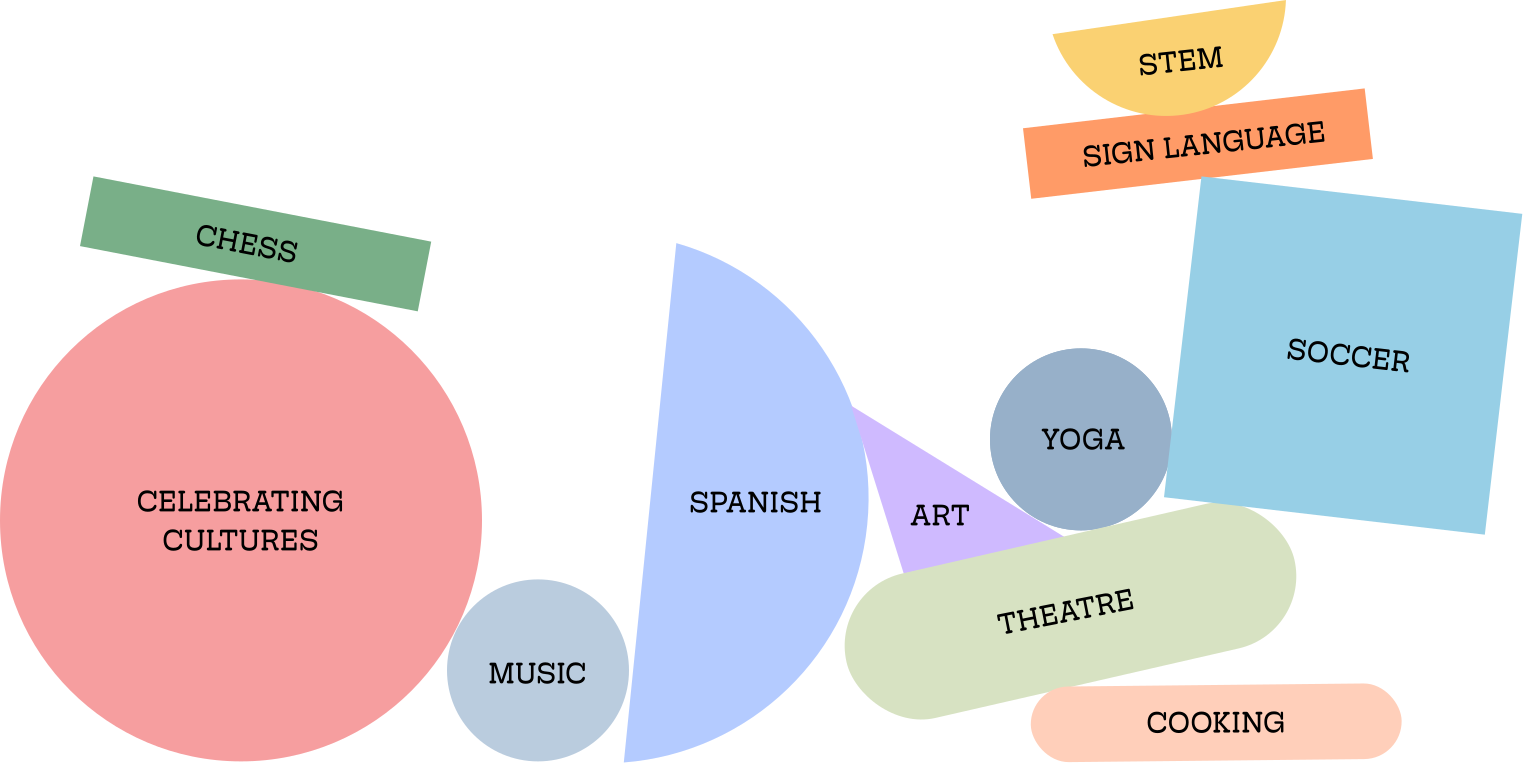
In addition to academics, our students gain exposure to a variety of extracurriculars — all included in our programing.

Where learning goes further

Beyond
graduation

We are here to support you well beyond Sunshine’s graduation. Our commitment to your family continues as you prepare for the next chapter. We will guide and support you through the school selection process, ensuring your next choice is the right fit for your child and your entire family — every step of the way.
I am truly floored by the breadth, depth and true creativity that they used to engage and educate the kids. My daughter entered pre-K with much more knowledge than her classmates had, and it showed. I would never have been able to think of such imaginative projects on my own.
Pia

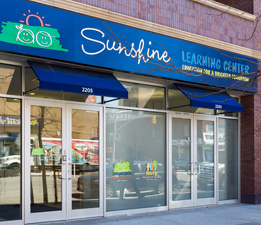
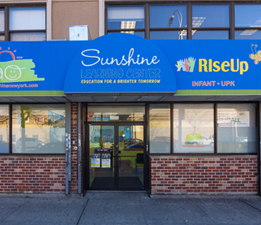
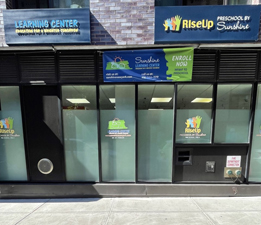
Explore our early childhood education centers in the heart of NYC.

TAKE A 360 VIRTUAL TOUR

It takes
a village.

Parent involvement plays an integral role in your little one’s development.  We partner with you for your child’s success.
OUR APPROACH
01

Parent Teacher Conferences

Throughout the year, we hold Parent-Teacher Conferences to keep you in the loop about your child’s development.
02

Parent Community

Meet with other Sunshine Parents and share in the journey of parenthood together. We host events, days at school, and adults-only socials so you get to know your child’s friends’ families.
03

Monthly Meets

Our monthly Zoom meetings cover the upcoming study unit, current reading materials, school events and projects, and a recap of the previous month. We conclude with an open Q&A session, and everyone in the school is invited to join.

Connect with us
throughout the day

We use the Tadpoles app to stay updated and communicate with our parents directly.

View your daily reports

Our teachers log activities, mealtimes, naps, diaper changes, and potty times.

Review daily activities

Stay updated with class lesson plans.

Get photo and video

Each day you will receive photos and videos of your child engaged in activity.

School Attendance

If your little one is out for the day, you can easily let us know directly on the app.

Hear why parents love Sunshine Learning Center

“The professionalism exhibited by the staff is commendable. They consistently go above and beyond to create a nurturing environment for the children. The curriculum is well-thought-out, promoting both educational and social development. In the short time there, my daughter is already thriving!”
Nathly
“The curriculum at Sunshine Lexington is unmatched. It’s inclusive, celebrating languages, cultures, and religions. Our daughter is bilingual, and the teachers embraced her mix of German and English words like pros. Plus, the amount of sign language she’s learned in such a short time is mind-blowing.”
Cindy
“Our granddaughter attends Sunshine Daycare and we are extremely impressed with both the facility and the staff. Every time we visit and pick up our granddaughter she is extremely happy and engaged.  The staff is ALWAYS warm and professional.  Of all the choices we are so happy to have found Sunshine Daycare.  We can rest assured our grandchild is in good hands. Her well being is their top priority. Thank You!!”
Brian
“I absolutely love this learning center! My daughter who is now 16 started there and my son who’s now 3 and lastly my last born daughter just turned 1 years old while being there! The care and concern they show for the children is immaculate! The ratio of teachers and kids in the classroom is perfect for everyday learning and growing.”
Nakia

Find your center

With eight state-of-the-art centers around New York City, your child can receive quality education close to home.
NCF Filter Reset
Documentation
Reset Filter
New York
Brooklyn
Bronx
Thank you! Your submission has been received!
Oops! Something went wrong while submitting the form.
Bronx
Jackson Avenue
Bronx
Hours
7:30am - 6:30pm
Bronx
Morris Avenue
Bronx
Hours
7:30am - 6:30pm
New York
3rd Avenue
New York
Hours
7:30am - 6:30pm
New York
Lexington
New York
Bronx
Willis Avenue
Bronx
Hours
7:30am - 6:30pm
New York
91st Street
New York
New York
5th Avenue
New York
Hours
7:30am - 6:30pm
Brooklyn
Coney Island
Brooklyn

Dynamic Map Style Guide (Don't Delete)

Please modify your styling elements here to change their appearance on the live website. The styleguide is invisible on the published site.

CMS List Item

Documentation
Default State
List Item Default
Active State
List Item Active

Filter Reset / Empty State

Documentation
There are no items using this filter combination.
Reset Filter
Change Pop-Up style here. Auto-Hiden on Live Site.
Change Tooltip style here. Auto-Hiden on Live Site.
Pop-Up Title
Tooltip Text
Pop-Up Title
Tooltip Text
Pop-Up Title
Tooltip Text
Pop-Up Title
Tooltip Text
Pop-Up Title
Tooltip Text
Pop-Up Title
Tooltip Text
Pop-Up Title
Tooltip Text
Pop-Up Title
Tooltip Text

Filter Address Search

Documentation
Default State
Thank you! Your submission has been received!
Oops! Something went wrong while submitting the form.
Active State [add class "active"]
Thank you! Your submission has been received!
Oops! Something went wrong while submitting the form.

Filter Chip

Documentation
Default State
Filter Chip
Active State
Filter Chip Active

Map Location Pin

Documentation
Default State
Hover State
Active State
Bright futures start here

Experience Sunshine

Apply TODAY
Music
Language
Movement
Culture
Community
Arts
Academics
Social Skills

There’s more
to learn

Being proactive and thinking about your child’s education is a great first step, we applaud you! Learn more to get a feel for our center and see if it’s the right fit for your family.
READ ARTICLES
2
Min
October 16, 2025

Preschool vs Pre Kindergarten: What's the Difference?

Choosing the right early education program is a critical first step for parents as they begin their child’s educational journey. The terms "preschool" and "prekindergarten," often shortened to pre-K, are frequently used interchangeably, which can lead to a great deal of confusion. While both offer valuable early learning experiences, they are fundamentally different in their purpose, structure, and curriculum. Understanding these distinctions is essential for making an informed decision that best suits your child's developmental needs and prepares them for future academic success.

This guide will break down the key differences between preschool and prekindergarten, helping you navigate the options and choose the path that is right for your family. By the end, you'll be well-equipped to make an informed decision for your little one's bright future.

Age Range and Primary Purpose

The first and most significant difference between preschool and prekindergarten lies in the age of the children they serve and their primary educational purpose. Preschool is typically designed for children who are younger, generally between the ages of two and four. The main objective of preschool is to provide a gentle introduction to a structured environment outside of the home. It is a vital first step in a child's social development, helping them learn how to interact with their peers, share toys, and follow simple instructions from an adult who is not a family member. This time is crucial for developing a sense of independence and comfort in a group setting, laying the groundwork for a more formal educational experience later on.

In contrast, prekindergarten is specifically for children who are a year or two away from entering kindergarten, most often those who are four or five years old. The purpose of pre-K is much more academic and readiness-oriented. The goal is to prepare children for the classroom structure of elementary school, giving them a head start on the foundational skills they will need to succeed. It acts as an intentional bridge between home and kindergarten, where the emphasis shifts from general socialization to specific academic and school-readiness goals. The activities and lessons are designed to build a solid base for future learning, ensuring a smoother transition into a K-12 environment.

Curriculum and Educational Focus

The curriculum is where the distinction between these two programs truly shines. A preschool curriculum is often play-based and child-led, embracing a philosophy that children learn best through hands-on exploration and discovery. While teachers guide activities, the learning is primarily centered around a variety of engaging, unstructured play opportunities. The preschool curriculum focuses heavily on social-emotional development, encouraging children to express their feelings, build friendships, and develop empathy. It also prioritizes the development of gross and fine motor skills (like running, jumping, and holding a crayon), and basic cognitive skills such as identifying colors, shapes, and letters through songs, games, and imaginative play. The environment is nurturing and encourages curiosity, without the pressure of meeting specific academic milestones.

A prekindergarten curriculum, on the other hand, usually features a more structured and formalized approach. This curriculum often aligns with state or local educational standards, focusing on key areas that are direct precursors to kindergarten. This includes pre-literacy skills, such as letter recognition, phonics, and storytelling, as well as pre-math skills like counting, number identification, and sequencing. The prekindergarten curriculum also introduces basic science and social studies concepts through thematic units. Pre-K places a strong emphasis on developing classroom routines, such as sitting quietly for story time, listening to instructions, and the ability to follow multi-step directions. This focus on structure helps children become accustomed to the expectations they will face in elementary school.

Program Structure and Scheduling

The flexibility of a program is often a deciding factor for parents, and here again, preschool and pre-K differ. Preschool programs are known for their adaptability. Many centers offer a wide variety of scheduling options to accommodate the needs of diverse families. A child may attend a few mornings a week, a few full days, or even a full-time schedule. The programs may run year-round or follow a more traditional school calendar. This flexibility is a major draw for parents who need part-time care or are looking to ease their child into a school-like environment gradually, making the transition less overwhelming for both child and parent.

In contrast, prekindergarten programs are typically more rigid and structured in their scheduling. They often follow a half-day or full-day schedule that closely mirrors that of an elementary school. Many pre-K programs are designed to run for a full academic year, from September through June, and align with the local school district's calendar. This consistent and predictable schedule is a key part of preparing a child for the routine and structure they will experience in kindergarten and beyond. This structure not only helps with academic readiness but also with building the stamina and focus required for a longer school day.

Cost and Funding Models

The financial aspect of early education is a primary concern for most families, and the funding models for these programs are a significant point of differentiation. For the most part, preschool is a private expense for families. The costs can vary significantly based on location, the quality of the program, and the number of hours a child attends. There are generally no government subsidies or free programs specifically for preschool, although some families may be able to use childcare vouchers to cover the cost if they meet the eligibility requirements. Parents are responsible for finding and funding the program that best fits their budget.

Prekindergarten programs, particularly in larger cities and states, are increasingly becoming a public-funded resource. Many public school districts offer free, universal pre-K programs for children who meet the age requirement and reside within the district. These programs are funded through a combination of state and local government initiatives, making them a more affordable and accessible option for many families. While private pre-K programs still exist, the availability of free public options has made pre-K a more equitable choice for a wider range of socioeconomic backgrounds. This expansion of universal pre-K highlights its recognized importance as a crucial step in a child's academic development.

Making the Right Choice for Your NY Child

When deciding between preschool and pre-K, it is important to consider your child's age, maturity level, and your family's needs. If your child is between the ages of two and three and needs an environment focused on social development, play, and gentle structure, a preschool program is an excellent choice.If your child is four or five and you are looking for a program that will directly prepare them for the academic and social demands of kindergarten, pre-K is likely the better option. 

At Sunshine Learning Center, we offer both top-tier preschool and prekindergarten programs designed to meet the unique needs of every child. Our curriculum is tailored to each age group, ensuring a seamless transition from a play-based environment to one focused on school readiness. We invite you to contact us today to learn more about our programs and schedule a tour to see how we can provide a bright and engaging start for your child's educational journey.

READ ARTICLE
May 15, 2025

Why is Sensory Play Important for Early Age?

We often think of learning as something that happens through books and lessons, but for the youngest among us, the world is a vast landscape to be explored through touch, taste, smell, sight, and hearing. This is the idea of sensory play, and it forms a crucial foundation for development in sensory play for kids of all ages. 

It's more than just letting kids make a mess; it's about building vital neural connections and fostering a deeper understanding of the world around them.

Engaging the Senses for Early Learning

From the moment they are born, children are sensory explorers. An infant reaches out to grasp a finger, a toddler bangs pots and pans together, and a preschooler delights in the squish of playdough. These seemingly simple actions are powerful learning experiences. Sensory play for kids allows them to use their senses to investigate, discover, categorize, and ultimately make sense of their environment. It’s the groundwork upon which more complex learning will be built.

The Foundational Benefits of Sensory Exploration

The benefits of sensory play are far-reaching and impact multiple areas of a child's development. Engaging the senses is a cornerstone of cognitive growth. Through sensory experiences, children learn about cause and effect – what happens when they drop a spoon or mix water and sand. They develop problem-solving skills as they figure out how to stack blocks of different textures or fit shapes into corresponding holes. Understanding spatial relationships also blossoms as they navigate their environment through touch and movement during sensory play activities.

Cognitive and Language Development

Furthermore, sensory exploration is intrinsically linked to language development. As children encounter a variety of textures, smells, and sounds during toddlers and preschool ages, they are exposed to new vocabulary. A rough sponge, a sweet-smelling flower, a loud drum – these experiences provide concrete references for words, helping children build their expressive and receptive language skills.

Emotional Regulation and Social Skills

Beyond cognitive and language development, sensory play for babies and older children plays a vital role in emotional regulation. Calming sensory activities, such as playing with smooth stones or gently kneading dough, can help children manage stress and anxiety. It provides a healthy outlet for expressing feelings and can promote a sense of calm and focus. Moreover, when children engage in sensory play activities together, they learn to share, take turns, and communicate their ideas, fostering crucial social skills.

Age-Appropriate Sensory Experiences

The way children engage in sensory play evolves as they grow. Sensory play for babies often involves simple explorations of textures through touch and mouth. Safe items like soft blankets, textured balls, and crinkly toys provide valuable sensory input. As they develop, toddlers become more active and sensory play involves manipulating materials like sand, water, and playdough. Sensory play for preschoolers engage in more complex and imaginative sensory play, incorporating themes and using sensory materials to represent different objects and ideas.

Indoor and Outdoor Sensory Adventures

Sensory play activities can be seamlessly integrated into both indoor sensory play and outdoor sensory play. Inside, activities like creating discovery bottles filled with colorful liquids and small objects, exploring light and shadows on a light table, or engaging in pretend play with various textured dress-up clothes offer rich sensory experiences. Outdoor sensory play expands these opportunities with the natural world as a giant sensory playground. Digging in the soil, splashing in puddles (water sensory play), collecting leaves of different textures, and feeling the wind on their skin provide invaluable sensory input.

Expanding Sensory Exploration with Materials and Considerations

A wide array of sensory play toys can further enhance a child's exploration. These can range from commercially available items like textured balls and musical instruments to simple household items like containers for scooping and pouring, scarves of different fabrics, and brushes of various sizes. The key is to offer variety and allow children to explore these materials in their own way.

Edible Sensory Play and Safety

Finally, edible sensory play offers a safe way for young children, especially those still exploring with their mouths, to engage their senses. Using taste-safe materials like cooked and cooled pasta, yogurt mixed with food coloring, or pureed fruits allows for exploration without the worry of harmful ingestion. However, constant supervision is crucial during all sensory play, especially with younger children and new materials, to ensure safety.

Building Bright Futures in New York

At Sunshine Learning Center, we understand why sensory play is important for laying the foundation for lifelong learning and development. Our carefully designed environment and creative curriculum incorporate a wide range of engaging sensory play activities to support the unique developmental needs of every child. Visit our site to learn more about our approach and explore our locations to find a center near you.

READ ARTICLE
November 20, 2025

When Can Babies Learn Sign Language? Unlocking Early Communication

Babies are naturally communicative beings, even before they utter their first words. They use gestures, facial expressions, and sounds to express their needs and desires. Introducing sign language can tap into this innate ability and provide a powerful tool for early communication, bridging the gap between a baby's understanding and their ability to verbalize. This reduces frustration for both parent and child, paving the way for a more harmonious and understanding relationship. At Sunshine Learning Center, we believe in nurturing every child's communication potential, and baby sign language is a wonderful way to do just that.

Understanding Baby Development: The Foundation for Sign Language

Early Communication Milestones

From the moment they're born, babies begin to develop communication skills. They listen intently to the sounds around them, recognizing familiar voices and responding to different tones. While they may not be ready to form complex sentences, their cognitive development is rapidly progressing, making them incredibly receptive to visual communication like sign language.

Receptive vs. Expressive Language

One of the most fascinating aspects of language development is that the ability to understand language develops earlier than the ability to produce spoken words. This means babies can often understand and respond to signs before they can say the corresponding words. This receptive understanding is absolutely key to their ability to learn sign language. They grasp the meaning behind the visual cues, even if they can't yet replicate the signs themselves perfectly.

The Optimal Time to Introduce Sign Language: Finding the Right Moment

The Six-Month Mark and Beyond

Most experts agree that babies can begin learning sign language as early as six months old. At this age, they are becoming increasingly aware of their surroundings and are developing better hand-eye coordination. Introducing signs at this stage can be a natural extension of the gestures they already use, like waving "bye-bye" or reaching for "more."

It's Never Too Late to Start!

While six months is a great starting point, it's never too late to introduce sign language. Babies of any age can benefit from learning signs. Even toddlers who are beginning to speak can use sign language to clarify their communication and express more complex ideas. Sometimes, a toddler might know the sign for something before they can pronounce the word, reducing frustration and boosting their confidence.

Benefits of Baby Sign Language: A World of Advantages

Reducing Frustration and Tantrums

Imagine a baby trying to tell you they're thirsty, but they don't yet have the words. Frustration quickly builds, often leading to tears and tantrums. Sign language provides a way for babies to express their needs, wants, and observations before they can speak. This empowers them to communicate effectively, significantly reducing frustration for both babies and their caregivers.

Boosting Cognitive Development and Language Acquisition

Research suggests that baby sign language may also support cognitive development and even enhance language acquisition. By engaging multiple parts of the brain, sign language can create stronger neural connections and lay a solid foundation for future language skills. It’s like giving their brains a head start in the world of communication.

Strengthening the Parent-Child Bond

Learning sign language together can be a wonderful bonding experience for parents and babies. It fosters a deeper understanding and connection, creating a sense of shared communication and mutual respect. It's a way to truly "hear" your baby, even before they can speak.

Getting Started with Baby Sign Language: Simple and Fun!

Choosing Your First Signs

Introducing sign language to your baby can be fun and easy! Start with a few basic signs related to daily routines and common objects, such as "milk," "eat," "sleep," "more," "diaper," and "all done." These are words your baby hears and experiences frequently, making them perfect for early sign language learning.

Consistency is Key

Consistency is absolutely essential when teaching baby sign language. Use the signs regularly and pair them with the spoken word. For example, when you give your baby milk, say "milk" while simultaneously making the sign for "milk." Repetition is key! The more your baby sees the sign paired with the word, the quicker they will learn.

Resources and Support

There are many resources available to help you learn baby sign language, including books, videos, and online tutorials. Focus on learning signs from a reputable source to ensure accuracy. Don't be afraid to adapt or create your own signs if it helps your baby understand better. Every baby is unique, and sometimes a slightly modified sign resonates more effectively.

Nurturing Communication from the Start in NY

At Sunshine Learning Center, with eight locations across New York, including Harlem, the Bronx, and NYC, we understand the importance of early communication. We believe that every child deserves the opportunity to express themselves fully, and we embrace a variety of communication methods, including baby sign language. We provide a nurturing and stimulating environment where children are encouraged to explore and develop their language skills, whether through spoken words, sign language, or a combination of both. We are dedicated to fostering a love of learning and communication in every child. Contact us today to learn more about our enrichment programs and how we can support your child's learning journey. We'd love to welcome your family to the Sunshine Learning Center community!

READ ARTICLE