Why is Sensory Play Important for Early Age?

DATE
May 15, 2025

We often think of learning as something that happens through books and lessons, but for the youngest among us, the world is a vast landscape to be explored through touch, taste, smell, sight, and hearing. This is the idea of sensory play, and it forms a crucial foundation for development in sensory play for kids of all ages. 

It's more than just letting kids make a mess; it's about building vital neural connections and fostering a deeper understanding of the world around them.

Engaging the Senses for Early Learning

From the moment they are born, children are sensory explorers. An infant reaches out to grasp a finger, a toddler bangs pots and pans together, and a preschooler delights in the squish of playdough. These seemingly simple actions are powerful learning experiences. Sensory play for kids allows them to use their senses to investigate, discover, categorize, and ultimately make sense of their environment. It’s the groundwork upon which more complex learning will be built.

The Foundational Benefits of Sensory Exploration

The benefits of sensory play are far-reaching and impact multiple areas of a child's development. Engaging the senses is a cornerstone of cognitive growth. Through sensory experiences, children learn about cause and effect – what happens when they drop a spoon or mix water and sand. They develop problem-solving skills as they figure out how to stack blocks of different textures or fit shapes into corresponding holes. Understanding spatial relationships also blossoms as they navigate their environment through touch and movement during sensory play activities.

Cognitive and Language Development

Furthermore, sensory exploration is intrinsically linked to language development. As children encounter a variety of textures, smells, and sounds during toddlers and preschool ages, they are exposed to new vocabulary. A rough sponge, a sweet-smelling flower, a loud drum – these experiences provide concrete references for words, helping children build their expressive and receptive language skills.

Emotional Regulation and Social Skills

Beyond cognitive and language development, sensory play for babies and older children plays a vital role in emotional regulation. Calming sensory activities, such as playing with smooth stones or gently kneading dough, can help children manage stress and anxiety. It provides a healthy outlet for expressing feelings and can promote a sense of calm and focus. Moreover, when children engage in sensory play activities together, they learn to share, take turns, and communicate their ideas, fostering crucial social skills.

Age-Appropriate Sensory Experiences

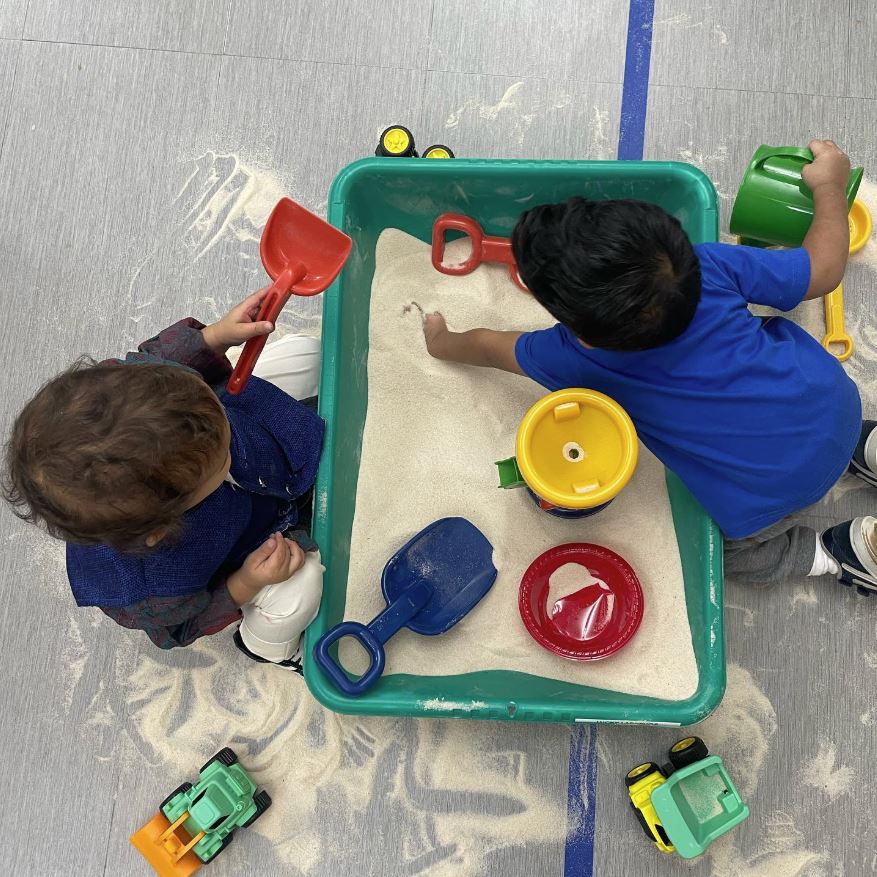
The way children engage in sensory play evolves as they grow. Sensory play for babies often involves simple explorations of textures through touch and mouth. Safe items like soft blankets, textured balls, and crinkly toys provide valuable sensory input. As they develop, toddlers become more active and sensory play involves manipulating materials like sand, water, and playdough. Sensory play for preschoolers engage in more complex and imaginative sensory play, incorporating themes and using sensory materials to represent different objects and ideas.

Indoor and Outdoor Sensory Adventures

Sensory play activities can be seamlessly integrated into both indoor sensory play and outdoor sensory play. Inside, activities like creating discovery bottles filled with colorful liquids and small objects, exploring light and shadows on a light table, or engaging in pretend play with various textured dress-up clothes offer rich sensory experiences. Outdoor sensory play expands these opportunities with the natural world as a giant sensory playground. Digging in the soil, splashing in puddles (water sensory play), collecting leaves of different textures, and feeling the wind on their skin provide invaluable sensory input.

Expanding Sensory Exploration with Materials and Considerations

A wide array of sensory play toys can further enhance a child's exploration. These can range from commercially available items like textured balls and musical instruments to simple household items like containers for scooping and pouring, scarves of different fabrics, and brushes of various sizes. The key is to offer variety and allow children to explore these materials in their own way.

Edible Sensory Play and Safety

Finally, edible sensory play offers a safe way for young children, especially those still exploring with their mouths, to engage their senses. Using taste-safe materials like cooked and cooled pasta, yogurt mixed with food coloring, or pureed fruits allows for exploration without the worry of harmful ingestion. However, constant supervision is crucial during all sensory play, especially with younger children and new materials, to ensure safety.

Building Bright Futures in New York

At Sunshine Learning Center, we understand why sensory play is important for laying the foundation for lifelong learning and development. Our carefully designed environment and creative curriculum incorporate a wide range of engaging sensory play activities to support the unique developmental needs of every child. Visit our site to learn more about our approach and explore our locations to find a center near you.

Explore moreBlogs & Articles

2
Min
March 24, 2026

How NYC's UPK and 3-K Programs Work — A Plain-English Guide for Parents

Children sitting in a circle during group time at an NYC preschool classroom

If you've got a young kid in New York City, you've probably heard the acronyms tossed around at the playground: UPK, 3-K, maybe even Pre-K for All. Parents talk about them like everyone already knows what they mean. But when you actually sit down to figure out how they work, where to apply, and whether your child qualifies — it gets confusing fast.

Here's the straightforward version. No jargon, no bureaucratic runaround. Just what you actually need to know.

What Are UPK and 3-K, Exactly?

UPK stands for Universal Pre-Kindergarten. It's a free, full-day program for four-year-olds run through the NYC Department of Education. Your child gets a seat in a classroom — either at a public school or at a community-based organization (like a daycare or learning center) — at zero cost to you.

3-K is the same concept, but for three-year-olds. NYC launched it in 2017 and has been expanding it district by district ever since. As of the 2025-2026 school year, 3-K is available in all 32 school districts across the city.

Both programs run during the school year on the DOE calendar. That means September through June, with breaks for holidays and school vacations. The school-day hours are typically 6 hours and 20 minutes, but many community-based sites — including centers like Sunshine Learning Center — offer extended day options that cover a full working parent's schedule.

Who Qualifies?

This is the best part: there are no income requirements. UPK and 3-K are universal programs, which means every NYC child who turns the right age by December 31 of the enrollment year is eligible. You don't need to prove income, immigration status, or anything else. If your kid is the right age and you live in New York City, they qualify.

For 3-K, your child must turn 3 by December 31 of the year they'd start. For UPK, they must turn 4 by the same date. So if your child turns 4 in November 2026, they're eligible for UPK starting September 2026.

How the Application Process Works

Applications open through MySchools.nyc, the city's centralized enrollment platform. Here's the typical timeline:

  • November-December: The DOE releases the directory of available programs for the upcoming school year
  • January-February: Applications open on MySchools. You can rank up to 12 programs in order of preference.
  • March-April: Application deadline (exact date varies by year — check MySchools for current dates)
  • Late spring: Offers go out. You'll get matched to one program based on your rankings and available seats.
  • Summer: Waitlist movement happens. If you didn't get your top choice, you might still move up.

You can apply to a mix of DOE school sites and community-based organizations. There's no penalty for mixing — rank them however you want based on what matters to you.

DOE Schools vs. Community-Based Organizations

This is where most parents get tripped up. When you browse MySchools, you'll see two types of programs: ones run directly inside public schools, and ones run at community-based organizations (CBOs). Both are free under UPK/3-K. Both follow DOE standards. But they're not identical.

DOE school sites operate on the strict school calendar and school-day hours. Drop-off is usually around 8:00-8:20 AM and pickup around 2:20-2:40 PM. There's no extended day option at most school sites unless the school has a separate after-school program (which usually costs money).

Community-based organizations — which include licensed daycare centers, Head Start programs, and learning centers — often offer extended hours that cover 8, 9, or even 10+ hours per day. Many CBOs also operate year-round, so your child has continuity through the summer months. If you're a working parent who needs coverage beyond 2:30 PM, a CBO is almost always the better fit.

At Sunshine Learning Center, for example, families enrolled in UPK or 3-K get the full DOE-funded program hours plus extended day coverage — so parents heading to work in East Harlem, Mott Haven, or Coney Island don't have to scramble for afternoon care.

What About Vouchers and HRA Subsidies?

UPK and 3-K are separate from childcare vouchers. But here's what a lot of parents don't realize: you can sometimes use both.

If your child is in a UPK or 3-K program at a community-based site that also offers extended hours, the DOE covers the school-day portion. For the extended hours (before and after the school day), you may be able to use an HRA childcare voucher or ACS subsidy to cover that cost — depending on the site and your eligibility.

HRA vouchers are income-based and available to families receiving public assistance or those who qualify through employment. The application goes through your local HRA office or online through ACCESS HRA. It's a separate process from MySchools, and the two systems don't talk to each other, so you'll need to coordinate on your own.

If your household income is low enough to qualify, combining UPK/3-K with a voucher can mean truly zero-cost childcare for the full day. It takes some legwork to set up, but it's worth investigating.

What Your Child Actually Does All Day

Both UPK and 3-K programs follow developmentally appropriate curricula approved by the DOE. Most community-based sites use the Creative Curriculum, which is research-backed and built around learning through play, exploration, and hands-on activities.

A typical day might look like:

  • Morning meeting/circle time: Songs, calendar, weather, building community
  • Choice time/centers: Kids rotate through blocks, dramatic play, art, sensory, writing
  • Small group instruction: Teacher-led activities targeting specific skills
  • Outdoor play: Gross motor time on the playground or in a play yard
  • Lunch and rest: Family-style meals, followed by quiet time or nap
  • Read-alouds and music: Literacy and creative expression woven throughout

The goal isn't drilling letters and numbers into three-year-olds. It's building the foundation — social skills, curiosity, self-regulation, problem-solving — that makes kindergarten (and everything after) go smoother.

Choosing Between Programs: What Actually Matters

When you're ranking your 12 choices on MySchools, here's what to focus on beyond the basics:

Hours and schedule. Does the program's schedule match your work hours? If you need care before 8 AM or after 3 PM, prioritize CBOs with extended day.

Location and commute. A program ten blocks from your apartment might sound fine until you're doing that walk in January with a reluctant three-year-old. Think about your actual daily route — near home, near work, near the subway stop you use. Parents in neighborhoods like Yorkville or Harlem often find that a center right on their commute line beats one that's technically "closer" on a map.

Classroom ratios. The DOE mandates specific teacher-to-child ratios (1:6 for 3-K, 1:9 for UPK, with assistants), but some programs staff above those minimums. Ask during your tour.

Tour the space. This matters more than any website or rating. Visit during active hours. Watch how teachers interact with kids. Are children engaged or zoned out? Is the room organized? Do the adults seem calm or frazzled? Trust your gut — you'll learn more in 20 minutes of observation than hours of online research.

Outdoor space. Not every program has its own playground. Some use nearby public parks, which is fine — but ask about the plan for rainy or cold days.

Communication with parents. How does the program share updates? Daily reports? An app? Weekly newsletters? You want to know what your kid did today without having to interrogate a three-year-old who will only tell you they "played."

Common Mistakes Parents Make

Only ranking one or two programs. Use all 12 slots. The algorithm works in your favor when you have more options ranked. There's no strategic benefit to ranking fewer — it doesn't make you more likely to get your top choice.

Ignoring CBOs. Some parents assume DOE school sites are "better" because they're in a school building. That's not how it works. Many CBOs have smaller class sizes, more experienced early childhood teachers, and better facilities for young kids than a Pre-K room squeezed into an elementary school hallway.

Missing the deadline. The MySchools deadline is firm. If you miss it, you'll be placed on waitlists for programs with open seats after the main round — and your options shrink dramatically. Set a calendar reminder. Actually, set three.

Not applying for both 3-K and vouchers. These are separate systems. If you qualify for both, apply to both. Don't leave money on the table.

Forgetting about summer. UPK and 3-K run September through June. If you need summer care, you'll need a separate plan — unless your CBO offers year-round enrollment, which many do.

Key Dates and Resources

Bookmark these:

  • MySchools.nyc — The official application portal for 3-K and UPK
  • 311 — Call for help with applications, enrollment questions, or to find programs near you
  • ACCESS HRA (a069-access.nyc.gov) — Apply for childcare vouchers online
  • NYC DOE Family Welcome Centers — In-person help with enrollment, one in each borough

Applications for the 2026-2027 school year typically open in January 2026. If you're reading this and haven't applied yet, go to MySchools right now. Seriously. It takes about 15 minutes.

The Bottom Line

UPK and 3-K are genuinely excellent programs. Free, high-quality early education for every NYC kid — that's not nothing. The application process has some moving parts, but once you understand the timeline and your options, it's manageable.

If you're looking at programs in East Harlem, Harlem, Mott Haven, Yorkville, or Coney Island, Sunshine Learning Center offers UPK and 3-K seats with extended day options that actually work for parents with full-time jobs. You can learn more or schedule a tour at sunshinenewyork.com.

Your kid deserves a great start. These programs exist to make that happen — take advantage of them.

READ ARTICLE
2
Min
March 23, 2026

What to Look for on a Daycare Tour: 15 Things Most Parents Miss

Colorful preschool classroom with children engaged in learning activities

The Daycare Tour That Changes Everything

You've narrowed it down to three places. Now comes the hardest part: the tour itself. You walk through a classroom, see kids laughing, notice the art on the walls—and then what? Most parents leave a daycare tour feeling reassured or uneasy, but they're not sure why.

The thing is, a 30-minute tour doesn't give you time to inspect everything. And the stuff that matters most—like whether kids actually talk to each other or if the bathrooms are sanitary—isn't always visible at first glance.

I'm going to walk you through 15 things worth checking on every daycare tour. These aren't the obvious things. These are the details that separate a place where your kid will thrive from a place that's just okay.

1. Listen for the Sound Level

When you first walk in, close your eyes for five seconds. What do you hear?

A good classroom sounds like controlled chaos. Kids are talking, laughing, sometimes arguing over a toy. Teachers are redirecting and engaging. It's loud, but there's a rhythm to it.

Red flag: Dead silence. If it's too quiet, either the kids are bored and disengaged, or they're being over-controlled. Neither is great for your three-year-old.

Other red flag: Overwhelming noise with no adult voices audible. That usually means the room is understaffed and kids are just... happening without much direction.

2. Count the Adults and Watch What They're Doing

Here's the math you need to know. New York State requires:

  • 1 adult per 3 infants (under 12 months)
  • 1 adult per 4 toddlers (12-24 months)
  • 1 adult per 6 preschoolers (2-5 years old)

Look for that ratio, but also watch what the adults are actually doing. Are they sitting on the floor playing with kids? Are they standing against the wall on their phones? Are they actively teaching?

Good centers—like many of the Sunshine Learning Center locations across the city—have staff that are genuinely engaged with the kids, not just present.

3. Check the Bathrooms

Walk straight to the bathrooms. This is a non-negotiable area of evaluation.

Look for:

  • Are the toilets and sinks clean and at kid height?
  • Is there soap and paper towels?
  • Are there handles or railings kids can actually use?
  • Can you see into the bathroom from the classroom? (You want visibility without the kids losing privacy.)

Bathroom standards tell you everything about how a center prioritizes hygiene and kids' dignity. If the bathrooms are gross, something's wrong with the overall operation.

4. Examine the Toys and Learning Materials

Pull open a toy bin. What's in there?

You want variety: blocks, dolls, cars, play kitchen stuff, art supplies, books. You do NOT want:

  • All toys in one generic basket with no organization
  • Broken toys or toys with missing pieces
  • Plastic junk that doesn't encourage actual play

Look at the books. Are there board books for younger kids? Are there diverse characters in the stories? Are the books actually readable or are half the spines cracked?

Open shelves with labeled bins show that the center has a system. It means kids can choose (independence!) and adults know what they have (preparation!).

5. Look at the Food Area

Ask to see where snacks and meals are stored. Is it refrigerated properly? Are there labels with dates?

Watch a snack time if you can. Are kids sitting together? Are teachers eating with them or just supervising? Is it rushed or relaxed?

In NYC, the DOH rules food handling closely. But beyond the rules, how a center approaches food tells you about their relationship with kids' comfort. If snack time feels warm and social, that's a center getting it right.

6. Check the Windows and Natural Light

Does the classroom have real windows? Can the kids see outside?

This matters more than it sounds. Natural light changes kids' moods. Being able to see outdoors helps them understand the time of day and season. Plus, a room with windows feels different than a basement room without them.

If the room is dark or windowless, ask why. Sometimes space limitations are real, but it should be a known trade-off, not an oversight.

7. Look for Evidence of Kids' Learning

Walk the walls. You should see:

  • Kids' artwork (actual art, not adult-made coloring sheets)
  • Photos of kids doing activities
  • Learning displays that change with the curriculum
  • Labels on things in multiple languages (if the center serves multilingual families)

This tells you the center values documenting kids' growth and making learning visible. It also shows that kids' work is valued and displayed—which matters for their sense of belonging.

Red flag: Blank walls or only generic decorations. Kids should see their own work.

8. Observe How Teachers Talk to Kids

This is big. Listen to how adults speak to children.

Do they get down to eye level? Do they use full sentences? Do they give kids choices or just commands? Do they acknowledge kids' feelings ("I see you're frustrated") or just redirect them?

Good teachers talk to kids like they're people. Bad teachers talk at kids like they're problems.

This one thing—how adults use language with children—predicts a ton about your kid's social and language development over a year.

9. Ask About Screen Time

Don't be shy about asking. How often do kids use screens? Is it educational or just a break for the staff?

A good center uses screens sparingly and intentionally. A mediocre center uses screens to manage the room during challenging times of day.

NYS doesn't have strict screen time rules for daycare (yet), so this is on you to vet. If the answer is "screens all afternoon," your kid is getting a babysitting service, not a learning program.

10. Look at the Outdoor Space

If they have outdoor space, spend a minute there.

Is the area fenced securely? Is the equipment age-appropriate? Is the ground soft (mulch or engineered wood, not concrete)?

Is it just a space to get energy out, or are there learning opportunities? (A sandbox, loose parts, digging tools?)

If the center doesn't have dedicated outdoor space, ask what their plan is. NYC centers without yards often do outdoor play at nearby parks. That's fine, but you want to know the system.

11. Check for Visible Health and Safety Systems

Look for:

  • Hand sanitizer visible (but also sinks for real handwashing)
  • Diaper changing stations that look sanitary
  • No obvious choking hazards or sharp edges
  • Organized storage of cleaning supplies

Ask about their sick policy. Can you pick your kid up immediately if they have a fever? Do they require a doctor's note to return?

These aren't exciting details, but they're the difference between a place that's safe and a place that's lucky it hasn't had an incident yet.

12. Pay Attention to How You're Treated

This matters more than you think. How are you treated during the tour?

  • Are they rushing you through?
  • Are they answering your questions thoughtfully or defensively?
  • Do they seem proud of what they do?
  • Are they transparent about costs, policies, and hours?

You're going to be communicating with this center for months or years. The tour is your preview of how they'll treat you as a parent. If you feel rushed or dismissed on the tour, that energy will continue.

13. Ask About Transitions and Routines

Daycare centers have a daily rhythm. Ask:

  • What's the schedule? (Circle time, outdoor play, snack, nap, etc.)
  • How long are transitions? (A good center has short transitions; a disorganized one has chaos between activities.)
  • What happens when kids are upset? (Do they rush to comfort, or do they let kids "cry it out"?)
  • How do they handle the morning drop-off routine?

Routine and predictability matter enormously for young kids. A center that runs on a clear schedule and handles transitions smoothly is one where your kid will feel secure.

14. Look at the Infant and Toddler Areas Separately

If you have a baby under two, spend extra time observing the infant room.

You're looking for:

  • Calm, low lighting (not chaotic like the preschool room might be)
  • Lots of floor time and one-on-one interaction
  • Clean sleep spaces
  • How often are babies held versus in containers?

The infant room sets the tone for your kid's entire year. It's where attachment to caregivers forms. Don't skim this part.

15. Ask About Parent Involvement and Communication

How do they stay in touch with parents? Is it an app? Daily sheets? A combination?

Do they have volunteer opportunities or parent events? Can you drop by unannounced, or is there a closed-door policy?

The best centers encourage parent involvement and keep communication flowing. It's not about you being in the room all day—it's about knowing your kid's day happened and feeling connected to the people caring for them.

What to Do After the Tour

Take notes immediately. Don't wait until you're home. Write down your gut feelings and the specific things you observed.

If you're torn between two places, visit each one again if possible. Second visits reveal things you miss the first time. Plus, you'll notice different staff and activities depending on the time.

Trust your gut, but ground it in what you actually saw. "The room felt happy" is a feeling. "The kids were playing independently while the teacher was actively engaged, and there were multiple language labels in the classroom" is data.

One More Thing

Choosing a daycare is one of the biggest decisions you'll make as a parent. Take your time with it. Ask tough questions. Notice the small things. And remember: a good center will welcome your scrutiny. They know their program is worth looking at closely.

If you're in New York City and want to tour a place that gets this right, Sunshine Learning Center has locations across the city—in East Harlem, Harlem, Yorkville, Mott Haven, and Coney Island. But wherever you land, use this list. It'll serve you well.


Want to explore your options? Schedule a tour with Sunshine Learning Center or visit sunshinenewyork.com to learn more about how we approach early learning.

READ ARTICLE
2
Min
March 23, 2026

The Real Difference Between Daycare and Preschool — And Why It Matters Less Than You Think

Children in circle time at a Sunshine Learning Center preschool classroom

The Real Difference Between Daycare and Preschool — And Why It Matters Less Than You Think

If you have spent any time searching for childcare in New York City, you have probably noticed the language gets confusing fast. Daycare. Preschool. Pre-K. Early learning center. Nursery school. Everyone seems to use these terms differently, and the distinctions can feel arbitrary — especially when you are a parent trying to make one of the most important decisions of your child's early life.

Here is the truth that most childcare websites will not tell you: the label matters far less than what actually happens inside the classroom. A program calling itself a "preschool" can be nothing more than glorified babysitting with a fancy name. And a "daycare" can deliver a rigorous, research-backed education that prepares your child for kindergarten better than programs charging twice the price.

So let us clear up the confusion — and talk about what you should actually be looking for.

The Traditional Definitions

Historically, the word daycare referred to programs focused primarily on supervision and care. Parents needed a safe place for their child while they worked, and the emphasis was on keeping children fed, rested, and out of harm's way. Learning happened incidentally, not intentionally.

Preschool, on the other hand, typically described a shorter-day program — maybe three or four hours in the morning — with a structured educational curriculum. The assumption was that preschool was where children learned, and daycare was where children waited.

That distinction made sense in the 1980s. It does not make sense in 2026.

Why the Old Labels Are Outdated

Modern early childhood research has fundamentally changed what we know about how young children learn. We now understand that children are building neural pathways from the moment they are born — and that the quality of their experiences during the first five years has a profound impact on everything from language development to emotional regulation to academic readiness.

This research has transformed the best childcare programs into genuine learning environments. At Sunshine Learning Center, for example, every classroom from our infant program through pre-K follows the Creative Curriculum — a nationally recognized, research-backed framework that structures the entire day around intentional learning. When a toddler in our classroom plays with water and measuring cups, that is not free time. That is an introduction to volume, cause and effect, and scientific observation. When an infant's caregiver narrates diaper changes and mealtimes, that is not small talk. That is building the language foundations that will support reading two years from now.

The point is this: a well-run, full-day program does not sacrifice education for convenience. It integrates education into every moment of the day — including meals, transitions, outdoor play, and yes, even nap time routines.

What Actually Matters When Choosing a Program

Instead of asking "Is this a daycare or a preschool?" — which tells you almost nothing about quality — ask these questions instead:

1. What curriculum do they follow?

A strong program will name a specific, research-backed curriculum. The Creative Curriculum, HighScope, Montessori, and Reggio Emilia are all well-established frameworks with decades of evidence behind them. If a program cannot clearly articulate their educational approach, that is a red flag — regardless of what they call themselves.

2. How do teachers plan their days?

In a quality program, the daily schedule is not random. Teachers create lesson plans with specific developmental objectives for each age group. Ask to see a sample weekly plan. It should reference specific skills being targeted — not just a list of activities like "art time" and "circle time."

3. What are the teacher-to-child ratios?

New York City's Department of Health mandates specific ratios for licensed programs: 1:4 for infants, 1:5 for toddlers, and 1:6 for preschoolers. But the best programs often exceed these minimums. Lower ratios mean more individual attention, which directly impacts how much your child learns and how secure they feel.

4. How do they communicate with parents?

Daily communication is non-negotiable. You should know what your child ate, when they napped, what activities they participated in, and how their day went — not in a two-sentence summary at pickup, but in real time. Apps like Tadpoles make this possible by sending parents photos, activity logs, and developmental notes throughout the day.

5. What does kindergarten readiness look like here?

A program that takes education seriously will be able to tell you exactly what skills your child will have when they graduate. That includes academic readiness — letter recognition, number concepts, early writing — but also the social-emotional skills that kindergarten teachers say matter even more: the ability to sit and listen, follow multi-step directions, manage frustration, and work cooperatively with peers.

The NYC Factor

In New York City, the daycare-versus-preschool question gets an extra layer of complexity because of the city's UPK (Universal Pre-K) and 3-K programs. These publicly funded programs provide free preschool for four-year-olds (UPK) and three-year-olds (3-K) at participating centers — including many that also operate as full-day childcare providers.

This means a child enrolled in a full-day program at a center like Sunshine Learning Center can receive a publicly funded preschool education as part of their full-day experience. The "daycare" hours before and after the educational block are not empty time — they are extensions of the learning day, filled with enrichment activities, outdoor play, and social development.

If you are a parent in East Harlem, Mott Haven, Yorkville, Harlem, or Coney Island, understanding how UPK and 3-K integrate with full-day care is essential. Many families do not realize they may qualify for subsidized or fully funded childcare through a combination of city programs and HRA vouchers. Always ask a prospective center about their funding options — a good program will walk you through everything you qualify for.

Signs You Have Found the Right Place

Forget the label. When you walk into a childcare center, pay attention to what you see and feel:

The children are engaged, not just entertained. Are kids actively doing things — building, painting, talking with teachers, exploring materials? Or are they sitting passively watching a screen or wandering aimlessly?

The teachers are on the floor, not on their phones. Quality care is hands-on. Teachers should be at eye level with children, actively participating in play and conversation, not supervising from a chair across the room.

The environment is organized and intentional. Classrooms should have clearly defined learning centers — a reading area, a block area, an art station, a dramatic play space. The materials should be age-appropriate and accessible to children. Clutter and chaos are not signs of creativity. They are signs of poor planning.

The children know the routine. Watch how children transition between activities. In a well-run program, transitions are smooth because children know what comes next. They feel safe and secure in their environment.

You feel welcome. Any program that discourages drop-in visits or makes you feel like you need an appointment to see your child's classroom should raise concerns. Transparency is the hallmark of quality. The best programs want you to see what they do — because they are proud of it.

The Bottom Line

Your child does not care whether the sign on the building says "daycare" or "preschool." What matters is whether the adults in that building are intentional about helping your child grow — cognitively, socially, emotionally, and physically — every single day.

The best programs in New York City have moved far beyond the old daycare-versus-preschool divide. They offer the full package: a safe, nurturing environment with a structured educational curriculum, delivered by trained teachers who know your child by name and care about their individual development.

That is what we strive to deliver at every Sunshine Learning Center location — from our infant rooms to our pre-K classrooms. Not because of what we call ourselves, but because of what we do for children every day.

Sunshine Learning Center operates eight locations across Manhattan, the Bronx, and Brooklyn. To schedule a tour or learn about enrollment options including UPK, 3-K, and HRA vouchers, visit sunshinenewyork.com or call your nearest center.

READ ARTICLE
Become a Sunshine Teacher

Join a team that shares your passion.

Apply TODAY
Music
Language
Movement
Culture
Community
Arts
Academics
Social Skills