There’s more to learn

2
Min
July 21, 2026

Indoor vs Outdoor Play: Why Your Child Needs Both Every Day

Children playing outdoors on a sunny day at a preschool playground

You don't have to choose.

Your child needs both. The question isn't "indoor vs outdoor play" - it's making sure your kid gets enough of each. Here's what actually happens when children spend time in both environments, why Sunshine Learning Center blocks time for both, and how it shapes their development.

Outdoor Play Builds Real Strength

When your child runs on grass, climbs on playground equipment, or kicks a ball, something specific is happening: they're building gross motor skills. These are the big movements - running, jumping, climbing, throwing - that form the foundation for everything else.

Outdoor play forces your child's body to work harder. The uneven ground engages balance and core strength. The sun triggers vitamin D production, which matters for bone development. The fresh air literally changes their nervous system - outdoor time reduces stress hormones and increases focus afterward.

NYC parks like Central Park, Prospect Park, and the Hudson River Greenway aren't just nice to visit. They're part of childhood. Research from the American Academy of Pediatrics shows kids who play outdoors daily develop better coordination, stronger bones, and healthier BMI than kids who don't. That's not a nice-to-have. That's foundational.

Indoor Play Develops Focus and Fine Motor Skills

Now flip the context. Indoors, your child builds puzzles, paints, plays with blocks, and uses scissors. These activities develop fine motor skills - the small, precise movements that matter for writing, feeding themselves, and eventually, school readiness.

Indoor play also teaches focus. When it's raining, the environment is controlled. Your child sits longer, concentrates, and learns that play doesn't always mean running. They build patience. They follow rules. They turn pages in books, stack blocks in specific ways, and learn cause and effect by watching their careful actions produce a result.

Creative Curriculum - the approach Sunshine uses - deliberately schedules both because research shows they activate different parts of brain development.

What the Research Actually Says

Here's what child development experts have found:

Outdoor play correlates with:

  • Better gross motor coordination
  • Improved attention span (yes, even though it's less focused time)
  • Lower anxiety and stress levels
  • Stronger immune systems (exposure to outdoor microbiota)
  • Better eyesight (natural light prevents myopia progression)

Indoor play correlates with:

Both matter. A child who only plays indoors develops anxiety around unstructured movement. A child who only plays outdoors struggles with fine motor tasks and frustrates easily in low-stimulation environments.

Sunshine Learning Center's Schedule

At Sunshine, teachers don't leave it to chance. Every day includes:

Morning outdoor time: 30-45 minutes of unstructured play on our outdoor spaces in East Harlem, Harlem, Yorkville, and across our Mott Haven locations. Kids choose what to do - climb, run, dig, observe. Teachers follow their lead.

Transition time: 15 minutes of movement indoors (sometimes structured, sometimes free).

Focused indoor time: 45-60 minutes of activities like art, puzzles, reading, sensory play, group learning.

Afternoon outdoor time: Another 30-45 minutes before pickup.

This isn't random. It's planned around attention spans, energy levels, and the Creative Curriculum framework.

What You Can Do at Home

You don't need a fancy backyard. You need consistency.

  • Daily outdoor time: Even in winter, bundle up and go outside for 20-30 minutes. A playground, a park, a sidewalk where they can jump in puddles. That counts.
  • Unstructured indoor play: Blocks, art supplies, dress-up clothes, books. Let them choose. Don't overschedule every minute.
  • Limit screens: Indoor time is valuable. Screen time isn't. Set a limit and stick to it. The American Academy of Pediatrics recommends max 1-2 hours of quality content daily for preschoolers.
  • Match the season: Winter in NYC means different playgrounds, but playgrounds still work. Coney Island playgrounds in summer mean sand and water. Adapt, don't give up.

Why Both Matters as Kids Get Older

In kindergarten and beyond, kids who've had both indoor and outdoor play are more confident. They don't get frustrated by transition. They can sit still for lessons because they've learned to alternate between states. They climb confidently because they practiced. They hold a pencil better because they practiced fine motor tasks.

Teachers say the kids who struggle most are the ones who've had too much of one and not enough of the other. A kid who's only played indoors often hesitates on the playground. A kid who's only played outdoors struggles with the fine motor tasks kindergarten requires.

The Bottom Line

Outdoor play builds gross motor strength, confidence, and nervous system regulation. Indoor play builds focus, fine motor skills, and sustained attention. Your child needs both every day. Not as separate "things." As a natural rhythm.

If you want to see this in practice, schedule a tour of Sunshine Learning Center. Watch how teachers move kids between environments and what they do in each. It's the difference between hoping your child develops well and knowing they're in the right environment for it.

Visit sunshinenewyork.com to find a location near you in East Harlem, Harlem, Yorkville, Mott Haven, or Coney Island.

READ ARTICLE
2
Min
June 22, 2026

Screen Time and Young Children: What the Research Actually Says

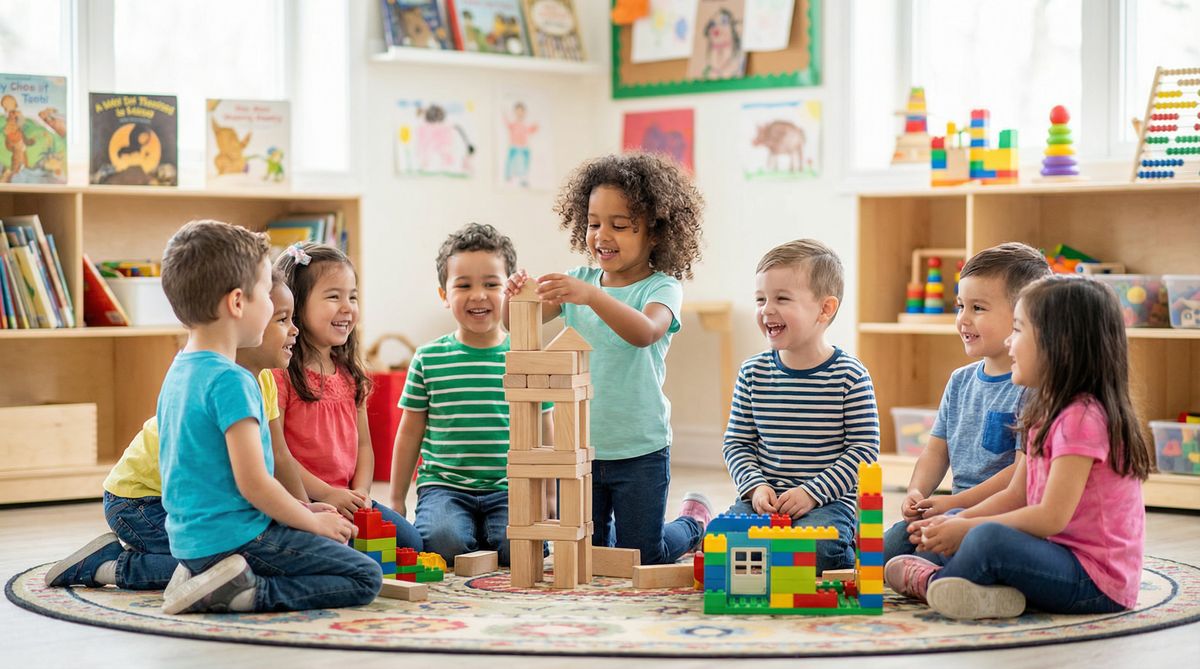
Young children building with colorful blocks in a preschool classroom

The American Academy of Pediatrics has released screen time guidelines at least three times in the last decade. Every update triggers the same panic among parents: "Are we doing this right? Will screens ruin our kids?"

Here's what you actually need to know about screen time and young children, based on research that's not trying to scare you.

What the Research Actually Shows

The AAP's current stance (as of 2023) is: for children 6 and under, background TV doesn't help. Passive screen time, the kind playing in the background while kids do other things, has no developmental benefit. That's the key finding most parents misunderstand.

But here's what matters more: active engagement beats passive viewing every time. If your toddler is watching a parent play with apps together, talking through what they see, asking questions, that's different from parking them in front of YouTube Kids while you shower.

The CDC and AAP recommend limiting screen time for children under 18 months to high-quality content you're watching together. For kids 18 months to 5 years, 1-2 hours of quality programming per day is fine. The word "quality" is doing most of the work in that sentence.

Quality vs. Just... Whatever's on

A quality program has a few markers: it slows down (fast cuts and flashy transitions hurt attention development), uses clear language, repeats concepts, and ideally includes a parent-interaction component. Shows like Daniel Tiger or Sesame Street were designed with child development in mind. An algorithm-recommended patchwork of trending clips was not.

What research actually worries about isn't screen time itself; it's displacement. Every hour on screens is an hour not spent playing, talking with adults, or getting messy with blocks and paint. That's the real loss, not that the screen is inherently toxic.

If your 2-year-old watches 20 minutes of quality TV while you prep dinner, and spends the rest of the day building, climbing, talking, and playing outdoors, the research suggests you're fine. If your 4-year-old is getting 4 hours of total screens daily, you've got a problem. But the problem is displacement, not screens specifically.

What Sleep and Development Research Tells Us

Here's where screens matter most: blue light before bed interferes with melatonin production. No screens 30-60 minutes before sleep. That's one of the firmest findings in pediatric sleep research. It's not that screens are bad; it's that they're activating before bed specifically.

The other solid finding: language development happens through conversation, not video. You can show your toddler educational apps all day, but Sunshine Learning Center teachers will tell you: kids learn to talk by talking with people. Videos don't have a back-and-forth, so they don't build language in the same way.

That's not a judgment call. That's just how the brain works at that age. Screens provide information. Conversations teach your child that communication is interactive.

The Bigger Picture: What Matters More Than Screen Minutes

Research on child development consistently shows these factors matter much more than screen time totals:

  • Adult responsiveness: Parents who respond to their kids' attempts to communicate (even if it's just babbling) accelerate language and social development.
  • Play-based learning: Unstructured play like blocks, dirt, make-believe, and climbing develops problem-solving, creativity, and social skills faster than any app.
  • Physical activity: Kids under 5 need at least 3 hours of movement daily (including running, climbing, dancing). This is non-negotiable for attention, coordination, and emotional regulation.
  • Sleep: An overtired toddler with perfect screen limits is still struggling more than a well-rested kid who watches TV. Quality sleep is the foundation.
  • Outdoor time: Nature exposure specifically improves focus and reduces anxiety in young children. 30 minutes daily makes a measurable difference.

If you nail these five things and your kid watches 90 minutes of quality TV three times a week, the research does not predict problems.

Why Parents Panic (And Why They Shouldn't)

The research on screen addiction in young children is not particularly scary. Unlike older kids and teens, toddlers and preschoolers don't show classic addiction patterns. They won't withdraw. They can't (yet) search for dopamine hits via apps.

What actually happens if screens are overused: less time for other stuff. Less play, less movement, less conversation. That's the causal chain. It's not that screens are poisoning the brain; it's that they're taking up time that could go to development.

This matters because it means the fix is structural, not neurological. You're not undoing damage by cutting screens. You're redirecting time to better stuff.

If you're curious about what actually builds skills faster than screens, check out our post on why play-based learning works better than worksheets. The research backs it up.

Practical Limits That Match the Research

If you want to align with AAP recommendations without stress:

  • For 0-18 months: Background TV off. Screens only with active co-viewing (a parent sitting, pointing, talking).
  • For 18 months-5 years: Max 1-2 hours daily of quality, slower-paced content. Prioritize shows with a parent-interaction tie-in (Daniel Tiger, Bluey, Sesame Street).
  • No screens 30-60 minutes before bed. This is the firmest recommendation in the research.
  • Prioritize live play. If it's a choice between a learning app and blocks, blocks win every time.
  • Co-view when you can. Don't feel guilty if you can't. But when you do, talk about what you see. That's where the benefit actually lives.

Everything else is flexibility. Every family's balance is different.

What About Educational Apps?

Good news and bad news. Good: educational apps designed by child development experts do teach skills faster than passive viewing. Bad: they still don't teach language as well as talking with an adult, and they don't build problem-solving the way unstructured play does.

Apps are useful as supplemental tools; teaching letter sounds, basic numbers, fine motor skills on rainy days. They're not replacements for the foundational stuff. Use them strategically, not as a substitute for the basics.

If you're trying to decide between a month of premium educational apps or a month of outdoor activities, materials for messy play (sand, water, paint), and more time with adults who respond to your kid, the research is clear. The latter wins.

Research also shows that separation anxiety is normal and manageable when schools handle screen time thoughtfully. Context and relationships matter far more than screen minutes.

The Real Issue: Context Matters More Than Numbers

A kid whose parent checks their phone every 15 seconds while they're together? That's a bigger problem than that same kid watching 90 minutes of Daniel Tiger while the parent is fully present for the rest of the day. The research on parental attention and phone use is worse than anything about kid screen time.

An overscheduled family where screens fill every gap because no one has time to play? That's a context problem, not a screen problem. A family with good rhythm, active play, outdoor time, meals together, responsive adults, and good sleep can handle screens without stress.

The worry isn't whether your 4-year-old watches 60 minutes or 90 minutes of TV. The worry is whether screens are displacing the stuff that actually builds healthy development. If they're not, the research says you're okay.

What to Watch For (Real Red Flags)

The actual signs that screen use is a problem:

  • Your child gets aggressive or very upset when screens go away (suggests emotional regulation issues, not screen addiction).
  • Screens are preventing sleep, social time, or outdoor play.
  • Screen time is growing to fill more and more of the day without intention.
  • Your kid is watching unpredictable, algorithmically-driven content (YouTube rabbit holes, not intentional shows).
  • There's no co-viewing or parent involvement when they are on screens.

If none of these apply, you're not looking at a problem. You're looking at normal family life in 2026.

A Practical Reality Check

Most parents trying to apply research on screen time are already being responsible about it. The families with real problems; kids on 6+ hours daily of whatever random content; aren't reading articles like this. You're asking the question, which means you care.

Here's what matters: your kid gets outside most days, gets active play time, hears responsive conversation, sleeps well, and has some screen time that's intentional (not accidental or background). If that's your life, you're way ahead of the research worries.

The apps, the minutes, the optimal ratio; that's the small stuff. The big stuff is whether your child is developing language, problem-solving, and emotional skills through play, conversation, and movement. Screens are a small part of that picture, not the whole thing.

When you visit Sunshine Learning Center's classrooms, you'll see what research actually recommends: kids building, exploring, moving, talking, problem-solving together. Some of them will have watched TV that morning. Most will have. It doesn't undo what happens when they're in an environment built for play-based learning.

That's the real context for screen time: it's fine, as long as it's not replacing the active, responsive, playful time that actually shapes development. Do that, and you're following the research.

READ ARTICLE
2
Min
June 22, 2026

What Parents Should Know About NYC DOH Daycare Licensing

Colorful preschool classroom with children learning and playing

When you're choosing a daycare or preschool for your child in New York City, you'll hear a lot about "licensing." Maybe you've seen a certificate on the wall. Maybe someone mentioned that their kid's center "got violations." But what does licensing actually mean, and why should you care?

Here's the truth: NYC daycare licensing is one of the few official standards protecting your child's safety and development. Unlike hiring a nanny or using informal family care, licensed centers have to meet specific rules set by the New York City Department of Health and Mental Hygiene (DOH). Understanding these rules helps you make better decisions about where your child spends their day.

What Does "Daycare Licensed" Actually Mean?

A licensed daycare center in New York City has been inspected and approved by the DOH to care for children. The center must comply with specific health, safety, and staffing regulations. Licensing is not optional. If a center cares for more than three unrelated children, it legally must be licensed by the DOH.

This distinction matters. Family daycare providers who care for fewer kids (typically 1-6 children) follow different rules and are registered, not licensed. Group centers like Sunshine Learning Center, which operate locations across Harlem, East Harlem, Yorkville, and other NYC neighborhoods, are fully licensed facilities.

Licensing means:

  • Staff meet specific education and training requirements
  • The facility passes health and safety inspections
  • Child-to-staff ratios are legally enforced
  • Records are maintained and inspected by DOH
  • Parents have the right to review inspection reports

NYC DOH Staffing Requirements (What They Actually Mean)

This is where licensing gets specific. The DOH sets staff-to-child ratios depending on the age group.

For infants (birth to 2 years): 1 staff member per 3 children. For toddlers (2-3 years): 1 staff member per 5 children. For preschool (3-5 years): 1 staff member per 8 children. For school-age (5+ years): 1 staff member per 12 children.

These ratios matter because they directly affect how much attention your child gets. More staff per child means more one-on-one time, better response to needs, and safer supervision. When you visit a classroom, you can literally count the adults and children to verify compliance.

All lead teachers must have at least a high school diploma or GED. Directors must have specific early childhood credentials. Most staff require training in child CPR, first aid, and health and safety. Many centers, including Sunshine Learning Center, exceed these minimums by hiring staff with associate or bachelor's degrees in early childhood education.

The Inspection Process (And What You Can See)

Licensed centers receive unannounced inspections by DOH officials. These inspections check:

  • Safety: fire extinguishers, emergency exits, safe storage of hazardous materials, appropriate temperature and lighting.
  • Health: handwashing stations, clean food service, disease prevention procedures, immunization records.
  • Supervision: verifying staff-to-child ratios, trained staff on site.
  • Facilities: age-appropriate equipment, outdoor play space (where applicable), sanitary bathrooms.
  • Records: staff credentials, parent communication logs, incident reports, health inspections.

After an inspection, the center receives a report. Any violations are documented. These violations fall into categories: critical violations (immediate health/safety risks), major violations (failure to meet licensing standards), and minor violations (administrative issues).

A center with a few minor violations isn't necessarily a red flag. It's normal. Violations like "bathroom soap dispenser empty" get fixed immediately. But critical violations like "staff ratios exceeded" or "unlicensed person left alone with children" are serious and must be remedied. Check out our guide to understanding daycare inspection reports for more details on what each violation means.

How to Check a Daycare's License Status

Finding the inspection report for a specific center is easier than most parents realize.

Go to NYC DOH's daycare search portal online. Enter the center's name or address. The database shows license status (active, expired, suspended, revoked), license expiration date, number and date of recent inspections, violations from the last three inspections, and any enforcement actions.

You can also call the DOH directly. Staff can answer questions about a specific license and violations.

When you visit a center, ask to see the current license certificate. It should be posted and current (not expired). Ask about recent inspections and violations. A good center director will explain violations transparently and show you how they addressed them.

If a center is evasive or won't show you the license, that's a warning sign.

UPK is Different (And That's Okay)

Universal Pre-Kindergarten (UPK) programs run by NYC Department of Education in public schools follow different oversight. If you want to understand how UPK works compared to licensed daycare, read our guide to NYC's UPK and 3-K programs. UPK centers are not DOH licensed. Instead, they're overseen by NYC DOE. Standards are similar but the licensing and inspection process is different.

This doesn't mean UPK is worse. Many UPK programs are excellent. But if you're comparing an independent licensed daycare to UPK, understand they follow different regulatory pathways. Sunshine Learning Center accepts UPK vouchers at our licensed locations, which means you get the benefit of DOH licensing standards plus the affordability of UPK.

What Violations Actually Cost You (Spoiler: It's Not What You Think)

Parents often assume violations mean something is deeply wrong. It's not that simple.

Minor violations might include documentation incomplete, a staff member's CPR certification lapsed by a few days (since renewed), a toy stored in the wrong place, or a form filed late. These are easily fixed and very common.

Major violations are more serious: staff acting outside their training, improper supervision, facilities not meeting cleanliness standards, or failure to keep required records. These require a corrective action plan.

Critical violations are emergencies: children left unattended, unlicensed staff caring for children unsupervised, hazardous materials accessible to kids, or active illness outbreak not being managed. These can result in immediate closure or suspension.

One or two minor violations in a three-year history doesn't disqualify a center. Look for patterns. A center with 10+ violations across three inspections, or critical violations that keep reoccurring, is different from a center with a clean record.

The Real-World Check: Beyond the License

Licensing is a baseline. It's the legal minimum. Many of the best centers go beyond. When you visit any preschool or daycare, ask about staff qualifications, curriculum approach, outdoor play space, and parent involvement. If you're curious about specific teaching methods like Creative Curriculum, most quality centers are happy to explain their approach.

Sunshine Learning Center combines full DOH licensing with additional quality markers: Reggio Emilia and Creative Curriculum approaches, outdoor learning spaces at most locations, and staff with degrees in early childhood education.

Licensing tells you if a center meets minimum safety and staffing standards. Your gut tells you if it's the right fit for your child.

Three Things Every NYC Parent Should Do

First: Look up any center you're considering online before you visit. Know their license status and recent violations beforehand. The DOH database is public and free.

Second: Ask to see the license and inspection report in person. A transparent director will hand them over without hesitation. If you don't see them posted on the wall, ask why.

Third: Use licensing as one factor in your decision, but not the only one. Visit the center. Watch how staff interact with kids. Pay attention to how your child feels about the environment. Licensing ensures basics. Your instincts cover everything else.

Understanding NYC DOH licensing doesn't require a legal degree. It just means you know what you're looking for and how to find it. If you're exploring daycare or preschool options in New York, we're happy to answer questions about licensing, our inspection history, or how our centers operate. Visit sunshinenewyork.com to schedule a tour and see firsthand what licensed care looks like.

READ ARTICLE
2
Min
June 2, 2026

How to Transition Your Child from One Daycare Classroom to the Next

Teacher hugging children in classroom during transition

Moving to a new classroom is a big step for young kids. Whether your toddler is moving from the infant room to the young toddler room, or from a mixed-age class to a preschool class, the transition can feel intense for both of you. But it doesn't have to be painful.

After years of caring for kids through these moves, we've seen what works. The key is preparation, consistency, and understanding that emotions are completely normal. Here's what you need to know.

Why This Transition Matters

Your child has spent months or years in their current classroom. They know where everything is, they trust their teachers, and they've built real friendships with other kids. Now they're leaving all of that behind.

For adults, that might sound like a small thing. For a four-year-old, it's genuinely scary. They don't understand why they're being moved. They don't know if their friends will still like them. They're worried about new routines, new teachers, new bathroom locations.

This isn't neediness. This is how growing up works.

Start Talking About It Weeks in Advance

Don't wait until the week of the transition to mention it. Start conversations at least four to six weeks before the move happens. Keep it simple and positive.

Try something like: "Soon you're going to move to the big kid classroom. You'll get to do new activities, and you'll meet new friends. Your teachers will help you learn new things."

Answer questions honestly. If your child asks why they're moving, explain truthfully: "You're getting bigger and learning more, so you're ready for the next classroom." Don't oversell it or make it sound like the old classroom wasn't good.

Read books about transitions. There are several picture books designed for young kids navigating this exact situation. Reading together opens up conversations naturally.

Visit the New Classroom Before Day One

If the daycare offers a pre-transition visit, take it. This is one of the most powerful preparation tools you have. Let your child walk around, see where things are, meet the new teacher, and sit in a chair at their new table.

If the teacher is available, ask her to show your child the playground area, the bathroom, the cubbies, and the classroom library. Familiar spaces feel less scary when you've seen them before.

Take photos during the visit. At home, look through them together and talk about what your child saw. This reinforces the new space in their mind as a real, knowable place, not some abstract scary future.

Expect Some Regression and That's Okay

Transitions trigger stress, and stress often shows up as regression. Your child might start having accidents again after being potty trained, or want a bottle they haven't asked for in months, or become clingy at drop-off when they've been independent for weeks.

This is not permanent. This is not a sign you're doing something wrong. This is how kids process big change.

Give your child grace. If they need to crawl into your lap when they get home, let them. If they're not hungry at their usual snack time, that's fine. Regression is their way of saying, "I need a little help with big feelings right now."

At the same time, keep routines consistent. Bedtime at the same time, breakfast the same way, the same drop-off goodbye ritual. Consistency at home is the anchor while everything else is changing.

Build Excitement About New Teachers

Meet the new teacher. Ask them what your child's new classroom will focus on. What curriculum materials do they use? What's a typical day like? What are their expectations around behavior and learning?

When you're excited about the teacher, your child picks up on that. If you say, "Your new teacher, Ms. Rodriguez, teaches the most amazing science activities," that matters.

We tell parents at Sunshine Learning Center: ask the teacher about their approach to classroom transitions. Good programs have a clear transition protocol. They introduce new routines slowly. They keep the first week pretty predictable. They check in with parents about how the adjustment is going.

The First Week: Patience is Everything

The first few days will be emotional. Your child might cry at drop-off, even if they haven't cried in months. They might come home quiet or cranky. Both are normal.

Send a comfort item if the center allows it. A stuffed animal, a blanket, a photo of your family, something familiar from the old classroom. Many kids need this bridge object during the transition.

After pickup, ask specific questions. Don't just say, "How was your day?" Say: "Who did you play with today? What was your favorite thing you did? Did you figure out where the new bathroom is?"

If your child is struggling, stay in touch with the teacher. Text photos of how the old classroom went. Share information about your child's preferences, fears, and interests. Teachers can't help with something they don't know about.

Watch for Signs Your Child Isn't Adjusting

Most kids adjust to a new classroom within two to four weeks. There will be hard days mixed in, but you should see progress.

Watch for these signs that something deeper is going on:

  • Your child is crying intensely every single day and showing no improvement by week three
  • They're refusing to enter the classroom or running away
  • They're not eating lunch or using the bathroom at school
  • They come home complaining about specific kids or teachers every day
  • They're having regression beyond the first week or two
  • Sleep is severely disrupted, or nightmares start

If any of these happen, talk to the teacher. Ask if they're seeing the same thing. Sometimes the classroom situation really isn't right for your child, and that's worth exploring. Sometimes your child needs a little more time and maybe a small tweak to the routine.

Help Them Build New Friendships

Kids make friends through repeated exposure and play. Help this happen by asking the teacher who your child is playing with and encouraging those friendships outside of school.

If the daycare has a class newsletter with photos or updates, look at it together. "Oh, I see you and Marcus were building with blocks today. Marcus is cool." Recognizing friendships helps them feel real.

Arrange playdates with classmates if possible. Seeing kids outside of the classroom makes the relationships feel more solid and makes the classroom feel like a friendly place, not a scary one.

Don't Sneak Out at Drop-Off

We get it. If you sneak away, there's no crying, no goodbye hug, no drawn-out farewell. It feels easier in the moment.

It's also teaching your child that you disappear without warning. Kids who've been sneaked out on don't trust drop-offs. They worry that you might vanish at any time.

Instead, have a quick, clear goodbye ritual. A kiss, a hand wave, a specific phrase like, "I'll see you after snack time." Keep it the same every day. Tell your child you're leaving, and follow through.

Crying at goodbye is hard, but it's honest. Your child is working through their emotions. Let them. Teachers know what they're doing. They'll help your child transition from goodbye to play.

The Emotional Piece is Just as Important as the Logistics

You can visit the classroom a hundred times, but if your child senses that you're anxious about the transition, they'll absorb that anxiety. Kids are emotional sponges.

If you're feeling nervous about your child moving to a new classroom, that's human. But when you're with your child, project confidence. "Your new teacher is going to love you. You're so ready for this." You probably believe it already; you just need to say it out loud.

Celebrate the Move

When your child has been in the new classroom for a few weeks and is settling in, celebrate it. Take them for their favorite dinner. Tell them how proud you are that they're brave. Let grandparents call to congratulate them.

This isn't materialistic. This is telling your child, "You did a hard thing. You adjusted. We're proud of you." That matters.

Sunshine Supports Smooth Transitions

At Sunshine Learning Center across New York, we think about classroom transitions as a real milestone, not just a logistical move. We gradually introduce routines before the transition happens. We communicate with parents constantly during those first few weeks. We know it matters.

Research from the American Psychological Association confirms what we see every day: children with strong social-emotional skills handle transitions better. Social-emotional learning in preschool isn't a luxury; it's the foundation for handling life's changes.

If you're planning a transition and have questions about how we approach it, schedule a tour at any of our eight locations. We're happy to talk you through our process.

The bottom line: classroom transitions are temporary. Your child will adjust. In a few weeks, they'll love their new teacher, forget where the old bathroom was, and wonder why they were ever nervous. And you'll wonder how they grew up so fast.

Frequently Asked Questions

How long does it take a child to adjust to a new classroom?
Most kids adjust within two to four weeks. The first week is usually the hardest, with emotions easing in weeks two and three. Every child is different, and some take a bit longer.

Should I stay in the new classroom on the first day?
Ask the center what they recommend. Most programs prefer parents to do a full drop-off, but some offer a short visit-and-leave approach. Follow the center's protocol. Teachers have expertise in this.

What if my child has separation anxiety and the transition makes it worse?
Separation anxiety is real. The best approach is consistent, kind, firm goodbyes. Prepare your child with the visit, start talking about it early, and keep home routines stable. If it's severe, talk to the center and your pediatrician.

Is it normal for a potty-trained kid to have accidents during a transition?
Yes. Stress triggers regression. It usually resolves once your child feels secure in the new classroom. Stay calm, don't punish, and gently remind them of the bathroom location.

What if my child says they don't like the new teacher?
Give it time. Kids often say they don't like something new because it's unfamiliar. Ask the teacher how your child is responding and what they're observing. If there's a real personality conflict after three to four weeks, talk to the center about it.

READ ARTICLE
2
Min
May 28, 2026

Summer Childcare in NYC: Your Options Beyond the School Year

Children playing outdoors on a sunny day at summer daycare

Parents in New York City face a unique challenge every June: school ends, summer camp slots fill up fast, and suddenly you need childcare for 10 weeks straight. If you're working full-time and your kids are out of school, summer childcare in NYC becomes your entire summer budget conversation.

The good news? You have real options. The harder part is understanding what actually exists, what's affordable, and what fits your family's schedule.

The Summer Childcare Gap Is Real

Most NYC families with kids in pre-K or elementary school hit the same wall: school ends mid-June. Camp doesn't always start until late June or July. Some camps run morning-only, which doesn't cover your work day. Others are outrageously expensive, or they're full by the time you realize you need them.

Sunshine Learning Center has watched families scramble through this every year. Some parents cobble together three different care options (camp, summer school, and a nanny). Others negotiate WFH time with their employer or shift to part-time. Some rely on family. But if that's not possible for you, knowing your actual options upfront saves weeks of stress.

NYC's Official Summer School Programs (Free or Low-Cost)

New York City Department of Education runs summer school programs for kids going into K-8. This is a real option and it's affordable, but most parents don't know about it until late May.

How Summer School Works

The DOE offers free summer school to most NYC public school students. Sessions typically run 4-6 weeks starting in late June. Academic focus varies: some programs target kids who need to catch up academically; others are general enrichment. Your school sends home notifications in May, and enrollment happens through the school.

For pre-K kids (ages 3-4), the situation is different. UPK programs typically shut down for summer, though some run limited summer sessions. Check with your specific UPK site in June.

The Real Talk

Summer school is cheap (free to $300) and gives you five or six hours of care per day. The trade-off: programs are often crowded, focus is academic, and the schedule is rigid. If your kid struggled with focus during the regular school year, summer school might not be a break for them. It feels like school, because it is.

Day Camp: The Summer Classic (and It's Expensive)

If your budget allows, full-day camp is the most common solution. NYC has hundreds of day camps, and they range from neighborhood YMCA programs to specialized arts, sports, or STEM camps costing upward of $3,000 per month.

What to Know About NYC Day Camps

Most day camps run 9 AM to 3 PM, with optional before-care (8 AM) and after-care (up to 5 PM or 6 PM). Many require full-week enrollment with limited drop-in options. June camps fill faster than August camps because parents book early.

The registration window for popular programs opens in late February or March. If you're reading this in May and thinking "I should look into camp," you might be too late for the best options. Early birds get the good schedules; late registrants get spillover programs or long waitlists.

Different Camp Flavors

  • Neighborhood day camps (YMCA, community centers): $1,200-1,800/week, play-focused, mixed ages
  • Specialty camps (sports, arts, coding): $1,500-3,000/week, skill-building, specific interests
  • Private schools' summer programs: $1,500-2,500/week, academics or enrichment mix

Real Cost Reality

Ten weeks of camp at $1,500/week = $15,000. That's a significant expense for a single income household. Many families negotiate: two weeks of camp (expensive), four weeks with grandparents, and two weeks doing free stuff in the neighborhood.

Preschool Summer Extended Sessions

Some private preschools, including Sunshine Learning Center, offer extended summer programming. If your child already attends preschool, ask your director what's available.

What Sunshine Offers

Sunshine runs summer sessions at select locations, maintaining our Creative Curriculum approach with a lighter, play-focused schedule. It's not a dramatic shift from the school year, so kids stay in a familiar environment with the same teachers (usually). Sunshine families typically find the transition smooth: kids wake up and go to the same place they've been going since September.

The advantage: consistency. Your child isn't adjusting to a new program, new staff, and new kids on top of the summer schedule disruption. They wake up, go to Sunshine, and the routine stays predictable.

Preschool Summer Sessions vs Full-Day Camp

  • Preschool session: shorter days often (some end at 2 PM), familiar environment, Creative Curriculum play-based approach
  • Day camp: longer days, new environment and kids, more field trips and activities, higher cost usually

If your kid thrives on routine and isn't ready for a big new program, a familiar preschool summer session might be smarter than pushing them into a large camp. Talk to your current provider.

Combination Schedules (The Most Common Real-World Solution)

Most NYC families don't use one option for all ten weeks. Instead, they patch together three or four options to cover the gap.

A Typical Combination

  • Weeks 1-2: Summer school (free)
  • Weeks 3-6: Day camp (you booked in March)
  • Weeks 7-8: Grandparents' place or vacation
  • Weeks 9-10: Preschool summer session or light camp

This costs less than full-time camp all summer, spreads the expense, and gives kids variety. It also means more planning and coordination on your end, but for many families it's the most realistic approach.

Another Combination

  • Camp Mon-Wed mornings (9 AM - 12 PM)
  • Nanny or babysitter Wed afternoon-Friday
  • Weekends with family

This works if your job allows three half-days in an office and two work-from-home days. You're spending less on camp (less hours) and filling gaps with flexible childcare. Many families find this balances cost with flexibility.

Summer Camps Without the Price Tag

If the $1,500/week camps are out of reach, NYC has free and low-cost summer options.

Parks Department Summer Programs

NYC Parks runs free and low-cost programs in parks and recreation centers across all five boroughs. They're neighborhood-specific, very affordable ($50-200/week depending on income), and focus on play, sports, and arts. Quality varies by park and location, but it's a real option for outdoor summer activities.

Library Summer Reading Programs

Public libraries run free summer reading programs with activities, storytimes, and occasional field trips. Not childcare (they're 1-2 hours), but they give structure to your summer and get kids out of the house.

Museum and Cultural Institution Programs

Many NYC museums offer affordable or pay-what-you-wish summer programming. The Natural History Museum, Children's Museum of Manhattan, and others have rotating exhibitions designed for summer visitors. Plan for heat and crowds, but it's cheaper than camp.

Neighborhood Walking Tours and Free Activities

Parents in every NYC neighborhood have figured out the best free summer spots: splash pads, neighborhood streets closed for summer play, botanical gardens, outdoor movie nights in parks. These aren't structured childcare, but they're part of most families' summer survival plan.

Remote Work and Summer Care

If you have the flexibility to work from home part or all summer, that changes your equation. You're not looking for full-time childcare; you're looking for programming and activities that keep your kids engaged while you're nearby.

Sunshine's summer programs work well for this scenario. Shorter days (some end at 1 or 2 PM) plus your presence at home means your kids have structured time with peers and teachers, and you're not paying for full-day care you don't need.

Some parents also hire babysitters or nannies part-time during summer when they need a few hours of focused work time. This is often cheaper than full-time care and more flexible than camp. The right arrangement depends on your budget and how much hands-on presence you want.

The Daycare Transition in Summer

If your kid is in daycare full-time during the school year, talk to your provider immediately about summer coverage. Some daycares offer full summer programs; others don't. Knowing this in May, not June, gives you time to plan.

Sunshine operates summer programming at multiple locations and maintains consistent hours and curriculum. If your child already attends Sunshine, you likely don't have a gap, you just confirm the summer schedule with your director.

Questions to Ask Before You Commit

Whatever option you're considering, ask these questions early:

  • What are the actual start and end dates?
  • What hours does the program run, and what are before/after-care options?
  • Is it five days a week, or flexible drop-in?
  • What's the cancellation policy if your work schedule changes?
  • Are field trips included, and how are they funded?
  • What happens on hot days or if the NYC heat triggers emergency closures?
  • Is the program full or is there waitlist availability?

For camp: Ask about the staff-to-child ratio, what activities are planned, and whether your kid can bring a comfort item or favorite book.

For preschool or daycare summer sessions: Ask whether it's the same teachers, the same classroom, and what the day looks like (shorter? different focus?).

The Reality: Plan in April, Not May

Summer childcare is the second-biggest logistical challenge for NYC working parents (the first being school choice in pre-K). If you want options beyond "hope we find something," planning should start in April.

  • March: Research and book camp if you're going that route
  • April: Confirm summer school eligibility and enrollment windows
  • May: Lock in preschool summer sessions, nanny arrangements, or other backup care
  • June: Confirm start dates and do a final walkthrough of each program before your kid attends

The parents who feel the most stress about summer are the ones who start planning in late May. Don't be that parent. The families we see thrive in summer are the ones who decided in April what their solution would be.

Your Next Step

Check with your current childcare provider first. If your child is in Sunshine Learning Center, ask about summer sessions and whether your location is running a program. If they're not, start researching camps in your neighborhood now. And check whether summer school is an option for your child's age.

You don't need one perfect solution for all ten weeks. You need a plan, a budget, and options that fit your family's reality. Once you have that locked, summer feels a lot less stressful.

Summer doesn't last forever, but it does demand your attention right now.

READ ARTICLE
2
Min
July 13, 2026

Social-Emotional Learning in Preschool: Why It Matters More Than ABCs

Preschool children sitting in a circle discussing emotions and feelings

It's 9:15 AM on a Tuesday at a Manhattan preschool. Two kids are fighting over a red truck. A teacher sits down between them and asks, "How are you both feeling right now?" One child says, "Angry. He took MY truck." The other says, "I was playing with it first."

Instead of taking the truck away, the teacher helps them name their emotions, understand each other's perspective, and work together to solve the problem. Fifteen minutes later, they're building a road together.

This isn't just good classroom management. This is social-emotional learning (SEL), and it's one of the most important skills your child will develop in preschool-possibly more important than mastering the alphabet.

What Is Social-Emotional Learning?

Social-emotional learning is the process of developing self-awareness, self-regulation, social awareness, and relationship-building skills. In plain terms: learning to understand your feelings, manage them, understand other people's feelings, and work well with others.

It sounds simple. But for a four-year-old, it's complex work.

SEL breaks down into five core competencies:

Self-awareness: Recognizing your own emotions and how they show up in your body. "My shoulders are tight because I'm worried." "I'm bouncing because I'm excited."

Self-regulation: Calming yourself down when you're upset. Using tools like deep breathing or asking for help instead of hitting.

Social awareness: Understanding how other people feel. Reading facial expressions, tone of voice, body language.

Relationship skills: Cooperating, communicating, making friends, solving conflicts together.

Responsible decision-making: Thinking through choices and their consequences before acting.

These aren't innate. They're learned skills, just like letters and numbers.

Why Preschool Is the Right Time

Neuroscience is clear: the preschool years (ages 3-5) are when the emotional part of your child's brain is developing most rapidly. The prefrontal cortex-the part that handles impulse control and decision-making-is literally still being wired.

This is why preschoolers melt down over small things. Their brain isn't equipped yet to handle big feelings. But with practice, in a consistent, safe environment, they get better at it.

Preschools that prioritize SEL give children thousands of small moments to practice these skills. Circle time for discussing feelings. Conflict resolution when toys are shared. Celebrating each other's wins. Helping a classmate who's upset.

Each moment is a chance to wire these pathways in their brain.

By kindergarten, kids who've had SEL are calmer in transitions, better at listening to teachers, more likely to include other kids, and handle disappointment without falling apart. These aren't soft skills. They're foundational to everything else.

The Research Is Strong

The research on SEL outcomes is consistent. A 2017 meta-analysis of 82 schools found that SEL programs improved academic performance by 11 percentile points. Kids with strong social-emotional skills also had:

- Lower rates of anxiety and depression
- Better attendance at school
- Stronger peer relationships
- Higher graduation rates in high school

The American Psychological Association and the National Association for the Education of Young Children both recommend SEL as a core part of early childhood curriculum.

What Does SEL Look Like in a Good Preschool?

You can see SEL happening in how teachers respond to moments throughout the day.

During conflict: Instead of separating kids or punishing, teachers help them identify the problem, name feelings, and brainstorm solutions. "You both want the same thing. What could we do?"

When a child is upset: Teachers validate the feeling first. "You're really sad that it's time to go home. That's okay. Let's talk about it." Then they offer tools. Breathing exercises. Drawing feelings. Talking to a friend.

In circle time: Teachers read stories about emotions, ask kids about their day, and practice conversations about feelings and social situations.

During play: Teachers narrate what they see. "You shared the blocks with Maya. That made her happy." Or they ask questions that build empathy. "How do you think he felt when that happened?"

In transitions: Instead of rushing from activity to activity, there's time to process. "Tomorrow we're not coming here. That's okay. Tell me what you're thinking."

It's intentional. It's consistent. And it works.

The Creative Curriculum and SEL

If you're researching preschools in NYC, you've probably heard about the Creative Curriculum. That curriculum actually has SEL woven throughout. It's not an add-on. It's built into how teachers are trained to interact with kids.

Teachers are taught to observe children's social interactions, understand the underlying feelings and needs, and respond in ways that help kids practice these skills. It's part of the philosophy, not a checkbox.

At Sunshine Learning Center and other quality preschools using this approach, SEL isn't a separate program. It's how the school operates.

Red Flags: SEL Done Poorly (Or Not At All)

Some preschools talk about SEL but don't actually implement it well. Look for these red flags:

Behavioral consequences without understanding: If a kid hits and they just get a timeout without talking about why or what they're feeling, that's not SEL.

Ignoring feelings: A teacher who dismisses a child's emotions ("Stop crying, you're fine") isn't building emotional awareness.

No follow-up: A conflict happens, the teacher separates the kids, and that's it. No reflection. No learning.

Lecturing instead of guiding: Saying "Be nice" or "Use your words" without helping kids actually figure out how.

When you visit a preschool, ask directly: "How do you handle conflict between kids?" and "What do you do when a child is upset?" Listen to whether they talk about understanding feelings or just stopping behavior.

How to Support SEL at Home

SEL doesn't stop at school. You can reinforce it every day.

Name emotions constantly: "I see you're frustrated that the blocks fell. That's a hard feeling." Not just for big emotions. For everyday ones too.

Validate before you fix: "You're sad your friend can't play today. That's a real feeling" is more powerful than "It's okay, you can play tomorrow."

Coach problem-solving: Instead of solving conflicts for them, ask questions. "What could you do different next time?" "How can you tell her you're sorry?"

Read books about feelings: There are great picture books about emotions, sharing, friendship, and big feelings. Sunshine's teachers probably recommend some.

Model emotional intelligence yourself: Kids are watching. When you're frustrated, talking through it out loud ("I'm annoyed, I'm going to take three deep breaths") teaches them it's normal to have feelings and you can manage them.

The Long-Term Payoff

Kids who develop strong social-emotional skills in preschool don't just do better academically in kindergarten. Studies follow them through elementary school and beyond. They have fewer behavioral problems, better friendships, higher self-esteem, and are more resilient when things get hard.

That four-year-old learning to solve the truck conflict today is learning skills he'll use in team projects in high school, job interviews, and relationships his whole life.

SEL isn't trendy. It's foundational.

What to Look for When Choosing a Preschool

If you're visiting preschools in NYC right now, prioritize programs that take SEL seriously. Ask about their approach, watch how teachers interact with kids, and notice whether emotions are something the school acknowledges and works with or ignores.

A good program doesn't just teach ABCs. It teaches kids how to understand themselves and work with others. That's the skill that actually matters most.

If you'd like to see how Sunshine Learning Center incorporates these practices into their comprehensive curriculum, schedule a tour at sunshinenewyork.com or visit one of their locations across East Harlem, Harlem, Yorkville, and beyond.

You can also read more about school readiness and how quality preschool programs prepare children for their next steps.

READ ARTICLE
2
Min
May 12, 2026

How to Read a Daycare Inspection Report (And What the Violations Actually Mean)

Well-organized, clean preschool classroom with colorful learning areas and proper facilities

What You're Actually Looking At

The NYC DOH publishes detailed inspection records for every licensed and registered childcare facility. These aren't kept secret. They're searchable, findable, and they're yours to review. When a facility is inspected, the inspector documents compliance issues using standardized violation codes. Some violations result in immediate notices or fines. Others are minor record-keeping problems. The trick is knowing which is which.

Sunshine Learning Center, like all NYC daycare centers, is subject to these inspections. Understanding what the inspectors look for helps you ask better questions during daycare tours and makes you a more informed parent.

How to Find Your Facility's Inspection Report

Start at the NYC Department of Health childcare facility search. Visit the Sunshine Learning Center NYC locations page to find which facility you're interested in, then search the DOH database by facility name and zip code. The DOH website returns all inspections from the past three years, organized by date. Recent inspections are at the top.

Each inspection record shows:

  • Inspection Date: When the DOH visited
  • Inspection Type: Initial license, renewal, complaint-driven, or follow-up
  • Violations: Listed by code with brief descriptions
  • Remediation Status: Whether the center fixed the issue and when

Violation Categories: Critical, Major, and Minor

The DOH uses three severity levels. This is where most parents get confused, so pay attention.

Critical Violations are immediate health and safety threats. A critical violation could trigger emergency action, facility closure, or emergency orders. Examples include: improper food storage that allows bacterial growth, unsafe access to chemicals or medications, inadequate supervision leading to a child injury, or operating without a required person on staff. If you see critical violations, that's a reason to ask very specific follow-up questions at your next tour.

Major Violations are serious compliance problems but not immediate emergencies. They show systemic gaps in how the center operates. Examples: inadequate handwashing facilities, missing required health and immunization records for enrolled children, failure to follow proper sick-child protocols, or insufficient staff training documentation. Major violations require the center to file a correction plan with the DOH within a set timeframe.

Minor Violations are record-keeping, documentation, or small procedural issues that don't directly threaten child safety. Examples: missing signatures on required forms, outdated emergency contact information, filing paperwork late, or small gaps in attendance records. These are annoying for the center but don't indicate unsafe conditions.

Inspection reports group violations by category and label the severity. A facility with one or two minor violations from two years ago is normal. A facility with recurring major violations in the same area (like supervision or health screening) suggests a pattern you should investigate.

Red Flags vs. Bureaucratic Noise

Here's where honesty matters. Not all violations are created equal, and the DOH system produces some noise.

Genuine red flags:

  • Multiple critical violations in a single inspection
  • Critical violations in supervision or safety (children getting hurt because of inadequate staffing)
  • Repeat major violations in the same category (e.g., three inspections showing handwashing and hygiene violations)
  • Recent violations that haven't been resolved (you can track remediation status on the report)
  • Violations related to child welfare or abuse/neglect allegations

Bureaucratic noise:

  • Single minor violations for paperwork or documentation
  • Administrative violations that don't affect day-to-day safety (e.g., a form filed two days late)
  • Violations from three years ago that were immediately resolved and haven't recurred
  • One-time violations unrelated to the facility's core operations

Example: A facility cited for "missing emergency contact information for one enrolled child" is a record-keeping problem, probably resolved in days. A facility cited for "children observed playing unsupervised in the kitchen near an operating stove" is a critical safety failure and requires immediate explanation.

Questions to Ask During Your Daycare Tour

If you find violations on the facility's inspection report, write them down and ask about them in person. Good facilities expect this question and have clear answers. Here's how to ask:

"I reviewed your recent inspection reports. I saw [cite the violation] listed on the [date] inspection. Can you walk me through what happened and how you fixed it?"

Listen for:

  • Specific answers, not defensiveness
  • Evidence they actually resolved the problem (new equipment, new training, new process, documentation of the fix)
  • Acknowledgment of what went wrong, not excuses
  • If the violation is recent, a clear remediation timeline

If the center gets defensive, hand-waves, or can't explain a critical violation, that's a real concern. Good facilities own their problems and show how they've fixed them.

Understanding State Law: The Difference Between a Violation and a Law Break

One more important distinction: violation codes don't necessarily mean the facility broke the law. They mean the facility didn't meet the DOH's written compliance standards at the time of inspection. Standards change, interpretations evolve, and facilities can dispute violations. If you see a violation you're concerned about, you can:

  • Ask the facility for their remediation plan (they should have one on file)
  • Request documentation of how they've addressed it
  • Contact the DOH directly to ask for clarification on that specific violation code
  • Ask your pediatrician whether it's a health concern

The DOH publishes clear definitions of each violation code. If you're looking at an unfamiliar one, search the NYC DOH childcare regulations online or call the DOH bureau directly. They're happy to explain what a violation means in plain English.

The Big Picture: What These Reports Actually Tell You

Inspection reports are a data point, not a final verdict. A facility with zero violations in three years is great. A facility with minor violations that get fixed quickly shows it responds to feedback. A facility with a pattern of critical violations or violations it doesn't remediate is a real concern.

The best way to use inspection reports is as a conversation starter. They're a framework for asking smarter questions when you tour a facility. They let you check whether the center operates the way it claims.

When you visit Sunshine Learning Center for a tour, ask about recent inspections, ask about any violations you found, and watch how the staff respond. That combination of objective data and direct conversation gives you real insight into whether a facility is right for your family.

Most NYC daycare centers operate safely and professionally. The inspection process exists to keep oversight consistent and transparent. Reading these reports is your right as a parent, and using them to ask good questions is how you stay involved in your child's care. Learn more about what our holistic approach to child development means, and discover how we support families through evidence-based early learning practices.

READ ARTICLE
2
Min
May 11, 2026

What Kindergarten Teachers Wish Every Parent Knew About School Readiness

Young child reading story book in preschool classroom

Your child's kindergarten teacher isn't checking if they can read or write. Stop worrying about that.

What they're actually assessing on day one is whether your 5-year-old can sit still for 10 minutes, wait their turn, ask for help, and manage the bathroom independently. Those basic self-regulation and social skills matter infinitely more than knowing their ABCs. If your child arrives at kindergarten without them, the first month is chaos for everyone.

I've talked to dozens of kindergarten and pre-K teachers across New York City, and they're remarkably consistent: the kids who struggle aren't the ones missing academic skills. They're the ones who've never been asked to follow a routine, sit in a group, or solve a small problem themselves.

This post is what I wish every parent entering kindergarten knew, based on real feedback from teachers in NYC public schools and private institutions.

Social Skills Matter More Than You Think

The biggest shock for parents is discovering that your kid's ability to share a crayon or wait for their turn is more important than their reading level. Kindergarten teachers will teach letters and numbers. You can't teach patience and cooperation in a classroom of 20 five-year-olds if half of them don't know how to take turns.

Your child doesn't need to be a social butterfly. They just need to understand basic classroom expectations: raise your hand before speaking, wait your turn, listen when someone else is talking, and accept that sometimes they don't get what they want right now.

Preschool teaches this constantly, which is one reason teachers always recommend it. At Sunshine Learning Center, every day is structured around group play, shared activities, and learning to navigate small conflicts without a parent stepping in. Kids who attend preschool show up to kindergarten with these skills already wired in.

If your child hasn't attended preschool, focus on this during the year before kindergarten. Host playdates with other kids. Play games with simple rules (Simon Says, board games). Practice taking turns. It sounds small, but it changes everything on day one.

Independence Doesn't Look Like You Think It Does

Most parents assume independence means being away from them. The real version kindergarten teachers are looking for is different: your child can manage their own bathroom needs (getting to the bathroom, using it, washing hands, returning to class) without constant reminders.

This is it. This is the big independence skill kindergarten requires.

Your child also needs to follow a multi-step direction. "Put your coat in your cubby, wash your hands, and come sit at the table." Not three separate reminders. One direction with three steps, and they do it. If you've been saying "Go get your shoes," "Now go put them on," "Now come to the door," you're the one managing the steps. Your kid isn't practicing.

At preschools like Sunshine, classrooms are designed so kids practice independence constantly. There are picture schedules so kids know what comes next. Materials are at child height so they can grab what they need. The teacher isn't stepping in to help with every coat button. Your child is learning to do it, slowly and imperfectly.

If you're ramping up for kindergarten, back off the scaffolding. Let them struggle with the zipper. Let them figure out which shoe goes on which foot. It feels slow and inefficient, but that's the practice they need.

Emotional Regulation Is The Secret Skill No One Talks About

Here's a hard truth: kids who can't handle disappointment cause real problems in a classroom. When a kindergartener has a meltdown because they wanted the blue marker and the red one was offered instead, the teacher's entire lesson stops.

Kindergarten is full of small frustrations. Waiting for snack. Sitting while someone else reads a book. Not getting picked first. A friend won't sit next to them at lunch.

Kids who've had minimal frustration exposure hit a wall. They fall apart. And in a classroom of 20 kids, the teacher can't troubleshoot one kid's emotional crisis for 15 minutes while the rest wait.

What teachers actually want is for your child to tolerate disappointment without shutting down. That doesn't mean they're happy about it. It means they can handle it without a full meltdown. They can cry and still sit down. They can be mad and still listen to the next direction.

How do you build this? Stop trying to protect them from every frustration. Let them lose at games. Let them hear "not now" without finding a workaround. Play-based preschools are constantly teaching this because kids are negotiating with each other, losing games, waiting for their turn, and learning that disappointment isn't fatal.

Academic Skills Are Secondary (For Real)

I'm going to repeat this because parents spend so much energy on it: your kindergartener doesn't need to read. They don't need to know addition. They don't need to write their name.

Kindergarten teachers in NYC public schools specifically teach these things. These are the benchmarks the school is measured on. The teacher knows exactly how to get your child there.

What you can do is read to them. A lot. Every single day. Not the choppy, I'm-trying-to-teach-letters reads. The story reads. The long picture book reads. The chapter book reads at bedtime. Kids who've been read to extensively show up to kindergarten with bigger vocabularies and genuine interest in books. That matters. Reading skills will follow naturally.

Beyond that, let preschool do its job. If your child has attended preschool like Sunshine, they've had months of exposure to letters, numbers, writing, and early reading concepts through play. That foundation is enough.

Listening and Following Directions

This one separates the kids who cruise through kindergarten from the kids who struggle. Your child needs to listen to an instruction the first time and follow it without reminders.

This isn't natural for five-year-olds. Most require a few verbal redirects. But there's a difference between a kid who needs one "eyes here" reminder before they listen, and a kid who needs seven redirects and still doesn't hear you.

Teachers build this through explicit practice, but your child is ahead if they've already practiced it. At home, give clear, specific directions. "Go put your socks in the hamper and your shoes by the door." Not "clean up." Wait. Do they do it? If yes, move on. If no, don't repeat it 10 times. Say it once, and then help them do it. Repetition teaches that you mean what you say.

Age-Appropriate Attention Span

Five-year-olds can't sit still for 45 minutes. If your child attends kindergarten and the teacher tells you they're struggling to pay attention, it doesn't mean there's a problem. It means they're five.

Real kindergarten includes movement breaks, outdoor play, and transitions between activities. Teachers aren't expecting frozen silence. They're expecting your child to settle into an activity for 15-20 minutes and focus.

How do you build this? Read longer picture books. Let them do activities that require sustained focus (puzzles, drawing, building with blocks). Limit screen time. None of this is surprising, but it does build the neural pathways for attention.

Bathroom Independence and Self-Care

The logistics matter more than you think. Your child needs to use the bathroom safely and independently. This means they understand where the bathroom is, can manage their pants and underwear, can wipe themselves (roughly), and can wash their hands without supervision.

Accidents happen. Some kids don't have the physical maturity for complete reliability at five. That's normal. But your child should be able to attempt it without waiting for an adult to assist with every step.

Schools have specific bathroom protocols. Kids go on a schedule and in pairs for safety. The teacher will build whatever independence your child brings. But if your child has never been to a bathroom without you right there, that's worth practicing before kindergarten.

The Small Things That Actually Get Flagged

Teachers told me they note when kids arrive at kindergarten unable to:

  • Hold a pencil without death-gripping it
  • Operate a backpack or coat zipper
  • Ask for help using words
  • Notice when someone is sad or upset
  • Stand still for a group photo
  • Walk in a line (roughly)
  • Eat lunch without assistance

These aren't judgments about your parenting. They're notes about what the child hasn't practiced yet. And all of them are skills your child will develop in September. Teachers just want a heads up if something is wildly off.

What Sunshine Graduates Look Like on Kindergarten Day One

I've worked with hundreds of parents through this transition, and the ones whose children have attended preschool programs like Sunshine have a very obvious shared advantage: they're calm. Not because they're geniuses. But because they've already done this.

They've been in a classroom with 10-12 other kids. They've had a teacher who isn't their parent. They've followed a schedule that someone else set, negotiated sharing, and learned to navigate transitions. On day one of kindergarten, half of that is already familiar.

If your child hasn't attended preschool, the transition is bigger, but it's not catastrophic. Your job is just to normalize it at home. Create routines. Practice expectations. Read a lot. Let them feel frustrated without solving it.

One More Thing Kindergarten Teachers Wish You Knew

Don't prep your child with worksheets or flashcards thinking it's kindergarten practice. Your child needs play, conversation, reading, and the chance to learn through exploration. That's how kindergarten works. That's how their brain actually learns.

Show up on day one with a kid who can listen, tolerate frustration, manage their own basic needs, and genuinely love stories. Everything else is the teacher's job.

If you want to tour a preschool that intentionally builds these exact skills through play-based learning, schedule a visit to one of Sunshine Learning Center's locations across New York City. We see this transition happen every year, and we're always happy to talk through what kindergarten readiness actually looks like.

READ ARTICLE
2
Min
May 11, 2026

The First Week of Daycare: What to Expect and How to Prepare

Parents dropping off their child at daycare for the first time

The first day of daycare is a big deal. For your child, it's a flood of new faces, sounds, and routines. For you, it's a mix of excitement and worry that you're doing the right thing. The good news: kids are more resilient than you think, and daycare centers are built for this transition.

Here's what to actually expect during that first week, and how to set your child up for success.

Day 1: The Introduction

Your child will likely cry when you leave. This is normal. It doesn't mean daycare is wrong for them. It means they have a strong attachment to you, which is healthy.

Most centers recommend a short first day, 2-3 hours. Your child meets their primary teacher, sees the classroom, and starts to recognize familiar faces. Teachers are watching for cues about your child's comfort level, feeding schedule, and sleep signals.

Come back on time. If you say you're picking up at 11 a.m., pick up at 11 a.m. Consistency builds trust fast.

Days 2-3: Pattern Recognition

By day two, your child knows where they are. The classroom doesn't feel foreign anymore. They may still cry at drop-off, but they're also watching the other kids play. Some might even laugh or try to join an activity.

Teachers are starting to see your child's personality. Are they cautious? Adventurous? Do they prefer parallel play or group play? This information helps them guide the transition and let you know how your child's day went.

If your center provides progress photos or a daily report, you'll start getting those notes. It feels good to know your child ate lunch and played outside.

Days 4-7: Routine Takes Hold

By the end of the first week, drop-off becomes a script. Your child might still fuss, but it's shorter and less intense. You might even notice them getting excited about seeing their new teacher or a favorite toy.

The first week is also when you'll see the payoff of all those prep conversations. If you talked about "going to school with Miss Teacher," your child starts to recognize the routine. They're building neural pathways for this new environment.

This is the week to stick with your plan, even if it's hard. The more consistent you are, the faster your child adjusts.

How to Prepare in the Week Before

Start talking about daycare now, before day one. Use simple language: "You're going to learn and play with other kids. Miss Teacher will take care of you while I'm at work. I'll pick you up after snack time."

Read books about starting school. "The Kissing Hand" and "Llama Llama Misses Mama" are popular, but any book about routine and transition helps. Your child gets to hear the story multiple times and start building a mental model.

Visit the center if you can. Let your child see the classroom, play area, and bathrooms. Familiarity is the antidote to fear.

Practice the drop-off routine at home. You put your child down for a moment, say goodbye, and come back. Make it quick and matter-of-fact. No sneaking out. No long goodbyes that drag out the emotion.

Bring comfort items if the center allows it: a small stuffed animal, a family photo, a blanket. These are anchors to home.

What to Expect Emotionally

You will feel guilty. You will wonder if you made a mistake. You will get a text with a photo of your child laughing and feel a mix of relief and weird sadness that you weren't there.

This is normal. Most working parents feel this. It passes.

Your child might regress a little. More tantrums at home. Trouble sleeping. Clinginess in the evenings. This is their way of processing a big change. It usually settles in 2-3 weeks.

Some kids take longer. If your child is still struggling after a month, talk to their teacher. There might be a specific trigger you can address, or it might just take more time.

Red Flags vs Normal Struggles

Normal first-week stuff: crying at drop-off, not eating much the first day, being tired, wanting extra attention at home.

Things to mention to your teacher: aggressive behavior, extreme withdrawal, not eating or drinking anything, signs of illness (fever, rash, diarrhea).

If your child comes home with unexplained bruises or if you have concerns about their safety, speak up immediately. Good centers welcome questions and take concerns seriously.

Practical Tips for Success

Send labeled items. Spare clothes, diapers (if applicable), any medications. Labels save chaos on busy days.

Don't over-pack. Overwhelming your child with toys from home doesn't help. One comfort item is enough.

Pick up on time. Your child has a clock in their head. Consistency matters.

Ask specific questions at pickup. Instead of "How was your day?", ask "What did you have for snack?" or "Who did you play with outside?" Teachers can answer these better, and you get real information.

Keep home routines steady. Consistent bedtime, consistent meal schedule. When everything else is changing, routine at home is grounding.

Give the first week time. This is not when you judge whether daycare is working. Judge it after a month of data. First week is pure transition shock.

What Your Child Is Learning Right Now

Beyond academics, your child is learning huge things: how to separate from you safely, how to trust other adults, how to navigate a group, how to manage their emotions when they're uncomfortable.

These are life skills. The specific math or letter recognition can wait. The fact that your child is building resilience and confidence? That's the real win.

When you see your child light up during a group activity or show you something they made, you'll understand. This was the right move.

A Gentle Reality

Some children adjust in three days. Others need three weeks. Neither means anything is wrong. Temperament, previous experiences with separation, and the quality of their teacher relationship all affect the timeline.

If you're placing your child in a quality program with consistent, warm caregivers, you're already giving them a gift. Let the first week be what it is: hard, but important. And temporary.

If you're looking for that kind of center in New York City, take a tour. Good centers like Sunshine Learning Center invest in the transition. They know the first week is hard, and they're designed to make it easier.

Your child will be okay. And so will you.

READ ARTICLE
2
Min
May 11, 2026

The First Week of Daycare: What to Expect and How to Prepare

Parents dropping off their child at daycare for the first time

The first day of daycare is a big deal. For your child, it's a flood of new faces, sounds, and routines. For you, it's a mix of excitement and worry that you're doing the right thing. The good news: kids are more resilient than you think, and daycare centers are built for this transition.

Here's what to actually expect during that first week, and how to set your child up for success.

Day 1: The Introduction

Your child will likely cry when you leave. This is normal. It doesn't mean daycare is wrong for them. It means they have a strong attachment to you, which is healthy.

Most centers recommend a short first day, 2-3 hours. Your child meets their primary teacher, sees the classroom, and starts to recognize familiar faces. Teachers are watching for cues about your child's comfort level, feeding schedule, and sleep signals.

Come back on time. If you say you're picking up at 11 a.m., pick up at 11 a.m. Consistency builds trust fast.

Days 2-3: Pattern Recognition

By day two, your child knows where they are. The classroom doesn't feel foreign anymore. They may still cry at drop-off, but they're also watching the other kids play. Some might even laugh or try to join an activity.

Teachers are starting to see your child's personality. Are they cautious? Adventurous? Do they prefer parallel play or group play? This information helps them guide the transition and let you know how your child's day went.

If your center provides progress photos or a daily report, you'll start getting those notes. It feels good to know your child ate lunch and played outside.

Days 4-7: Routine Takes Hold

By the end of the first week, drop-off becomes a script. Your child might still fuss, but it's shorter and less intense. You might even notice them getting excited about seeing their new teacher or a favorite toy.

The first week is also when you'll see the payoff of all those prep conversations. If you talked about "going to school with Miss Teacher," your child starts to recognize the routine. They're building neural pathways for this new environment.

This is the week to stick with your plan, even if it's hard. The more consistent you are, the faster your child adjusts.

How to Prepare in the Week Before

Start talking about daycare now, before day one. Use simple language: "You're going to learn and play with other kids. Miss Teacher will take care of you while I'm at work. I'll pick you up after snack time."

Read books about starting school. "The Kissing Hand" and "Llama Llama Misses Mama" are popular, but any book about routine and transition helps. Your child gets to hear the story multiple times and start building a mental model.

Visit the center if you can. Let your child see the classroom, play area, and bathrooms. Familiarity is the antidote to fear.

Practice the drop-off routine at home. You put your child down for a moment, say goodbye, and come back. Make it quick and matter-of-fact. No sneaking out. No long goodbyes that drag out the emotion.

Bring comfort items if the center allows it: a small stuffed animal, a family photo, a blanket. These are anchors to home.

What to Expect Emotionally

You will feel guilty. You will wonder if you made a mistake. You will get a text with a photo of your child laughing and feel a mix of relief and weird sadness that you weren't there.

This is normal. Most working parents feel this. It passes.

Your child might regress a little. More tantrums at home. Trouble sleeping. Clinginess in the evenings. This is their way of processing a big change. It usually settles in 2-3 weeks.

Some kids take longer. If your child is still struggling after a month, talk to their teacher. There might be a specific trigger you can address, or it might just take more time.

Red Flags vs Normal Struggles

Normal first-week stuff: crying at drop-off, not eating much the first day, being tired, wanting extra attention at home.

Things to mention to your teacher: aggressive behavior, extreme withdrawal, not eating or drinking anything, signs of illness (fever, rash, diarrhea).

If your child comes home with unexplained bruises or if you have concerns about their safety, speak up immediately. Good centers welcome questions and take concerns seriously.

Practical Tips for Success

Send labeled items. Spare clothes, diapers (if applicable), any medications. Labels save chaos on busy days.

Don't over-pack. Overwhelming your child with toys from home doesn't help. One comfort item is enough.

Pick up on time. Your child has a clock in their head. Consistency matters.

Ask specific questions at pickup. Instead of "How was your day?", ask "What did you have for snack?" or "Who did you play with outside?" Teachers can answer these better, and you get real information.

Keep home routines steady. Consistent bedtime, consistent meal schedule. When everything else is changing, routine at home is grounding.

Give the first week time. This is not when you judge whether daycare is working. Judge it after a month of data. First week is pure transition shock.

What Your Child Is Learning Right Now

Beyond academics, your child is learning huge things: how to separate from you safely, how to trust other adults, how to navigate a group, how to manage their emotions when they're uncomfortable.

These are life skills. The specific math or letter recognition can wait. The fact that your child is building resilience and confidence? That's the real win.

When you see your child light up during a group activity or show you something they made, you'll understand. This was the right move.

A Gentle Reality

Some children adjust in three days. Others need three weeks. Neither means anything is wrong. Temperament, previous experiences with separation, and the quality of their teacher relationship all affect the timeline.

If you're placing your child in a quality program with consistent, warm caregivers, you're already giving them a gift. Let the first week be what it is: hard, but important. And temporary.

If you're looking for that kind of center in New York City, take a tour. Good centers like Sunshine Learning Center invest in the transition. They know the first week is hard, and they're designed to make it easier.

Your child will be okay. And so will you.

READ ARTICLE
2
Min
April 21, 2026

Why Play-Based Learning Works Better Than Worksheets for Young Children

Children building with colorful blocks during play-based learning at a preschool classroom

Your three-year-old comes home from preschool with paint on her shirt, sand in her shoes, and zero worksheets in her backpack. You might wonder: did she actually learn anything today? The short answer is yes. She probably learned more than she would have filling in letter tracing sheets for an hour.

Play-based learning isn't a trendy buzzword or a lazy shortcut. It's backed by decades of developmental research, endorsed by the American Academy of Pediatrics, and used in high-performing early childhood programs across the country. Here's why it works, what it looks like in practice, and how to tell if your child's program is doing it right.

What Play-Based Learning Actually Means

Play-based learning is exactly what it sounds like: children learn through play. But "play" in a quality preschool classroom doesn't mean unsupervised chaos. It means carefully designed environments where kids choose activities, explore materials, solve problems, and interact with peers while teachers guide and extend learning moments.

A child stacking blocks isn't just stacking blocks. She's testing gravity, estimating height, counting, comparing sizes, negotiating with the kid next to her who wants the same red block, and developing the fine motor control she'll need to hold a pencil. That's math, science, social skills, and physical development happening simultaneously.

Programs like the Creative Curriculum structure entire days around this approach. Teachers set up interest areas (blocks, dramatic play, art, sensory tables, library corners) and observe what children gravitate toward. Then they build on those interests with questions, challenges, and new materials.

The Problem with Worksheets for Young Children

Worksheets feel productive. Parents can see them, hold them, stick them on the fridge. But for children under five, worksheets are largely a waste of time. Here's why.

Young children learn through their senses and their bodies. Their brains are wired for concrete, hands-on experiences. A worksheet asking a three-year-old to circle the letter B is an abstract task that requires skills most three-year-olds haven't developed yet: sustained attention to a flat page, fine motor precision, and understanding of symbolic representation.

Dr. Nancy Carlsson-Paige, a professor at Lesley University and early childhood researcher, has written extensively about how pushing academic worksheets on young children can actually backfire. Kids who spend preschool doing drills often burn out by first grade. They associate learning with boredom rather than curiosity.

The American Academy of Pediatrics recommends play as a primary vehicle for learning in early childhood, noting that it builds executive function, language, and social-emotional skills more effectively than direct instruction at this age.

What the Research Says

This isn't opinion. Multiple longitudinal studies have compared play-based and academic preschool programs, and the results consistently favor play.

A landmark study published in the journal Developmental Psychology followed children from different types of preschool programs through elementary school. Kids from play-based programs outperformed their peers from academic-focused programs in reading and math by third grade. They also showed better social skills and fewer behavioral problems.

Researchers at the University of Virginia found that kindergarteners who attended play-based preschools demonstrated stronger self-regulation, which is the ability to manage emotions, follow multi-step directions, and stay focused. Self-regulation turns out to be a better predictor of academic success than knowing your ABCs at age four.

Finland, consistently ranked among the top education systems globally, doesn't start formal academics until age seven. Their early childhood programs are almost entirely play-based. The results speak for themselves.

What Play-Based Learning Looks Like in a Real Classroom

Walk into a quality play-based preschool in NYC and you'll see something that looks like organized chaos. That's by design.

In the block area, a group of four-year-olds might be building a "subway station." The teacher asks, "How many blocks tall is your station?" and suddenly it's a math lesson. She hands them paper and markers to make signs, and now it's a literacy activity. Two kids disagree about where the tracks should go, and the teacher coaches them through conflict resolution.

At the art table, children choose their own materials. One kid is painting with a brush. Another discovered that dragging a fork through paint makes interesting lines. The teacher doesn't correct the fork kid. She asks, "What happens when you use the other side?" That's scientific thinking: hypothesis, experiment, observation.

During dramatic play, kids run a pretend restaurant. They take orders (writing practice), count out play money (math), decide who's the chef and who's the waiter (social negotiation), and serve imaginary food to stuffed animals (creativity and empathy).

None of this requires a worksheet. All of it builds skills that worksheets can't touch.

But Will My Child Be Ready for Kindergarten?

This is the question every parent asks, and it's a fair one. If your kid spends preschool playing, will they fall behind the kids who were drilling sight words?

No. In fact, the opposite tends to happen.

NYC's Department of Education defines kindergarten readiness not as knowing the alphabet or counting to 100, but as a combination of social-emotional skills, physical development, language ability, and cognitive skills like problem-solving and curiosity. Play-based programs hit every single one of those benchmarks.

Kids who enter kindergarten from play-based programs typically know how to share materials, follow a classroom routine, express their needs verbally, listen to a story, and attempt to write their name. Those are the skills kindergarten teachers actually care about. The letter recognition and number sense come quickly once those foundations are solid.

If you're wondering whether your toddler is ready for group childcare, play-based readiness signs are actually more reliable than academic ones. Can they play alongside other children? Do they show curiosity about new things? Those matter more than knowing colors.

How to Spot a Program That Does Play-Based Learning Well

Not every program that claims to be "play-based" actually is. Here's what to look for when you visit.

The room setup tells you everything. A quality play-based classroom has distinct interest areas: blocks, dramatic play, art, sensory, library, science. If you walk in and see rows of desks facing a whiteboard, that's not play-based regardless of what the brochure says.

Watch the teachers. In a good play-based program, teachers are on the floor with the kids, not standing at the front of the room lecturing. They're asking open-ended questions ("What do you think will happen if...?"), not giving instructions ("Color this blue").

Ask about assessment. Play-based programs assess children through observation, not tests. Teachers document what children do during play (photos, notes, work samples) and use that to plan next steps. If a program is testing three-year-olds with standardized assessments, that's a red flag.

Check for outdoor time. Play doesn't stop at the classroom door. Quality programs prioritize outdoor play daily, rain or shine. At Sunshine Learning Center, our locations across East Harlem, Yorkville, Mott Haven, and Coney Island all incorporate outdoor exploration as part of the daily routine because physical play is learning too.

What Parents Can Do at Home

You don't need special toys or a teaching degree. You need time, space, and the willingness to let your kid get messy.

Follow their lead. If your child is obsessed with dinosaurs, lean into it. Count dinosaurs. Sort them by size. Read dinosaur books. Draw dinosaurs. The topic doesn't matter as long as the engagement is real.

Resist the urge to "teach." When your kid is building with blocks, don't immediately start quizzing them on colors and shapes. Let them play. If you want to extend the learning, narrate what you see: "You put the big red block on top of two small blue ones." That's modeling vocabulary and mathematical language without turning it into a lesson.

Limit screen time. The AAP recommends minimal screen time for children under five. Screens are passive. Play is active. There's no app that replicates the developmental benefits of building a fort out of couch cushions.

Get comfortable with boredom. When kids say "I'm bored," they're about to get creative. Don't rush to fill every moment with structured activities. Boredom is the birthplace of imagination.

The Bigger Picture

We live in a city that runs on ambition. NYC parents feel enormous pressure to give their kids every advantage, and that pressure trickles down to the preschool years. It's tempting to think that more academics, earlier, equals better outcomes.

But the research doesn't support that. What it supports is giving young children rich, playful environments where they can explore, create, fail, try again, and develop at their own pace. The academic skills follow naturally when the foundation is solid.

At Sunshine Learning Center, our Creative Curriculum approach across all eight NYC locations is built on this principle. We trust the research, and we trust kids to show us what they're ready to learn through their play.

If you're exploring preschool options for your child, we'd love to show you what play-based learning looks like in action. Schedule a tour at any of our locations, or learn more at sunshinenewyork.com.

READ ARTICLE
2
Min
April 14, 2026

Daycare vs Nanny vs Family Care: The Honest Pros and Cons

Young children hugging and playing together at a daycare center

You need childcare. That much is clear. But the options feel like a maze: a daycare center, a nanny, a family member, a home-based family care provider. Each one comes with strong opinions from other parents, and none of them are cheap (except maybe grandma, but she has opinions too).

Here is a straight breakdown of the real pros and cons of each option, based on what NYC families actually deal with. No judgment on what you pick. Every family's situation is different, and the "best" choice is the one that works for yours.

Option 1: Daycare Centers (Group Childcare)

This is the structured, classroom-based model. Your child goes to a licensed facility with trained teachers, a set schedule, and other kids their age. In NYC, this includes both private centers and publicly funded programs like 3-K and UPK.

The Real Pros

Socialization from day one. Your child spends every day with peers. They learn to share, take turns, negotiate, and navigate friendships. By the time kindergarten rolls around, group-care kids tend to have stronger social skills than kids who were home with one adult.

Structure and curriculum. Good centers follow a real educational framework. Programs using the Creative Curriculum, for example, build literacy, math, and problem-solving into daily play. Your child is not just being watched. They are being taught.

Licensing and oversight. In New York City, daycare centers are regulated by the Department of Health. That means mandated teacher-to-child ratios (1:4 for infants, 1:5 for toddlers), background checks, regular inspections, and health and safety standards. You can look up any center's inspection history on the NYC DOH website.

Reliability. Centers do not call in sick. If one teacher is out, another covers. You are not scrambling for backup care on a Tuesday morning because your provider has the flu.

Cost offsets. Many NYC centers accept HRA childcare vouchers, ACS subsidies, and participate in 3-K and UPK (which are free). If you qualify, center-based care can be significantly cheaper than a nanny.

The Real Cons

Illness spreads fast. Put fifteen toddlers in a room and every cold, stomach bug, and hand-foot-mouth outbreak makes the rounds. Your child will be sick more often in the first year of group care. This is not a maybe. It is a guarantee. The upside: their immune system gets a serious workout, and the sickness frequency drops dramatically after that first year.

Less individual attention. Even with good ratios, a teacher managing five toddlers cannot give the same one-on-one focus a nanny provides. If your child needs extra support or has developmental delays, make sure the center has the resources to accommodate that.

Rigid schedules. Drop-off at 8, pickup by 6. Late fees if you are stuck on the 6 train. Most centers close for holidays, professional development days, and sometimes summer weeks. Your work schedule needs to mesh with theirs.

Separation anxiety is real. The transition to group care is rough for many kids, especially between ages 1 and 3. Separation anxiety at drop-off is completely normal, but that does not make it easier to walk away from a crying toddler.

Option 2: Hiring a Nanny

A nanny comes to your home (or you go to theirs, in a nanny-share arrangement) and cares for your child individually or in a small group. This is the most personalized option and, in NYC, often the most expensive.

The Real Pros

One-on-one attention. Your child gets a dedicated caregiver focused entirely on them. For infants and very young toddlers, this level of individual care can be ideal. Feeding schedules, nap times, and activities all revolve around your kid.

Flexibility. A good nanny adapts to your schedule, not the other way around. Early mornings, late evenings, travel days, sick days when daycare would send your kid home. You negotiate the terms.

Your child stays home. No commute to a center, no wrestling a toddler into a stroller in January sleet. Your child is in their own environment with their own toys, their own crib, their own food.

Less illness exposure. Without a room full of other toddlers, your child will get sick less frequently. This matters a lot in that first year, especially for families where both parents have jobs with limited sick leave.

The Real Cons

Cost. In NYC, a full-time nanny runs $18 to $30 per hour, depending on experience and the neighborhood. For a 45-hour week, you are looking at $40,000 to $70,000 per year, before taxes. And yes, you are supposed to pay employment taxes (the "nanny tax"). Many families do not, but the IRS does care.

No backup. When your nanny is sick, on vacation, or quits, you have no childcare. Period. Building a backup plan (a second sitter, a family member, a drop-in daycare) is essential but adds cost and complexity.

Less socialization. A child who spends all day with one adult misses the peer interaction that group care provides. Many nanny families compensate with playgroups, library storytimes, and park meetups, but it takes effort to build that social exposure into the week.

Quality is hard to verify. Nannies are not regulated by the city. There are no mandated inspections, no required credentials, no oversight. You are relying on references, your interview instincts, and maybe a background check you ran yourself. Most nannies are wonderful. But the lack of institutional accountability is a real difference from licensed centers.

Isolation for the caregiver. Nannying is a lonely job. A nanny who spends 10 hours a day alone with a toddler in an apartment can burn out quickly, which affects the quality of care. Good nanny employers build in social time, park outings, and reasonable hours.

Option 3: Family Care (Grandparents, Relatives, Family Friends)

Grandma watches the baby. Auntie takes the toddler three days a week. Your mother-in-law moves in for six months. This is the oldest childcare model in human history, and it is still the most common worldwide.

The Real Pros

Trust. Nobody loves your kid like family. The anxiety that comes with leaving your child with a stranger is largely absent when the caregiver is someone you have known your entire life.

Cost. Often free, or close to it. Some families pay a grandparent a stipend or cover expenses, but it is a fraction of nanny or daycare costs. For families in neighborhoods like Mott Haven, East Harlem, or Coney Island where budgets are tight, family care can be the only realistic option.

Cultural continuity. Family caregivers often speak your home language, cook your food, and pass on traditions. For bilingual families, having a grandparent who speaks the heritage language all day is an enormous advantage for language development.

Flexibility. Family is usually more willing to accommodate odd schedules, last-minute changes, and the unpredictable nature of life with small children.

The Real Cons

Boundary issues. When your mother-in-law is also your childcare provider, every parenting disagreement becomes a family conflict. Screen time limits, discipline approaches, feeding choices. These conversations are harder when the caregiver is family.

No curriculum or structure. Most family caregivers are not trained in early childhood education. Your child may spend the day watching TV, and addressing that without offending someone you love is delicate. If your toddler is showing signs of being ready for group learning, family care alone might not meet their developmental needs.

Physical demands. Chasing a toddler is exhausting. If your family caregiver is older or has health issues, the physical reality of full-time childcare may not be sustainable. A two-year-old has more energy than most adults half their grandparent's age.

Guilt and obligation. It is hard to set expectations (arrive by 7:30, no sugar before lunch) with someone who is doing you a massive favor. And it is hard for the caregiver to say "this is too much" when family loyalty is involved.

No socialization. Like the nanny option, family care typically means your child is not regularly interacting with peers. Supplementing with playgroups or part-time preschool helps.

Option 4: Licensed Family Childcare (Home-Based Programs)

This is the middle ground a lot of parents overlook. A licensed family childcare provider runs a small program out of their home, typically serving 6 to 12 children across mixed ages. In NYC, these providers are licensed by the DOH and must meet specific health, safety, and training requirements.

The Real Pros

Smaller group size. Your child gets more attention than at a large center, but still has peers to interact with. For kids who are overwhelmed by big groups, this can be the sweet spot.

Home-like environment. The setting feels like a home because it is one. For young toddlers transitioning out of exclusive home care, this can ease the adjustment.

Mixed ages. Older kids model behavior for younger ones. Younger kids get nurturing from older peers. Research shows mixed-age settings can accelerate social and language development.

Often more affordable. Family childcare tends to cost less than both centers and nannies. Many accept childcare vouchers and subsidies.

The Real Cons

One provider, limited backup. If the provider is sick or on vacation, you need a backup plan. Some providers have assistants; many do not.

Variable quality. The range is wide. Some family childcare providers are former teachers running exceptional programs. Others are well-meaning but lack training. Visit, observe, and check inspection reports before committing.

Less structured curriculum. While some providers follow formal curricula, many do not have the same educational framework as center-based programs.

The Hybrid Approach: Why Many NYC Families Mix and Match

Here is what a lot of families actually do, and nobody talks about it: they combine options.

Grandma watches the baby three days a week. The child goes to a part-time daycare program the other two days for socialization and structure. Or a nanny covers the infant year, and then the family transitions to a center at age two when the child is ready for peers and curriculum.

This is not indecisive. It is smart. Different stages of your child's development call for different things. An infant who needs constant one-on-one care at six months may be a toddler craving peer interaction at 18 months. Your childcare setup can evolve as your child does.

The Cost Breakdown for NYC Families

Let us talk numbers, because in New York City, childcare costs rival rent.

Daycare center (full-time): $1,500 to $3,000+ per month for private pay. Free if you get a 3-K or UPK seat (ages 3 and 4). Subsidized if you qualify for HRA vouchers or ACS.

Nanny (full-time): $3,500 to $5,500+ per month, plus taxes if you are doing it right. Nanny shares (splitting a nanny with another family) cut costs roughly in half.

Family childcare (full-time): $800 to $1,800 per month. Many accept vouchers.

Family/relative care: Free to low-cost, but factor in the hidden costs of boundary strain and potentially supplementing with part-time programs.

For families earning under the income threshold, NYC's childcare voucher program can cover most or all of the cost at participating centers and family childcare providers. The application process through HRA is bureaucratic but worth the effort.

How to Decide: Questions That Actually Help

Skip the pros-and-cons list you have been staring at for three weeks. Instead, answer these:

What does your child need right now? An infant who needs constant holding and feeding has different needs than a two-year-old who is bored at home and desperate for friends.

What does your budget actually allow? Be honest. A nanny you cannot afford creates financial stress that affects the whole family. A free option that makes you miserable is not actually free.

What does your schedule require? If you work unpredictable hours, a center with rigid drop-off and pickup times may not work. If you need rock-solid reliability, family care with one provider may not either.

What is your gut telling you? You have toured the daycare. You have interviewed the nanny. You have talked to your mother about watching the baby. Which option made you feel most at ease? Trust that feeling. It is usually right.

One More Thing

Whatever you choose, you can change it. Childcare is not a life sentence. If the nanny is not working out, switch to a center. If daycare is too much too soon, pull back to family care for a few months. If grandma is burning out, it is okay to find a different arrangement.

The best childcare setup is one where your child is safe, stimulated, and cared for by people who genuinely like kids. That can happen in a classroom, a living room, or a brownstone apartment with a patient grandmother and a bin of Duplos.

If you are leaning toward a center and want to see what quality group care looks like, visit any of Sunshine Learning Center's eight locations across East Harlem, Harlem, Yorkville, Mott Haven, and Coney Island. Schedule a tour and bring your questions. All of them.

READ ARTICLE
2
Min
April 7, 2026

How to Know If Your Toddler Is Ready for Group Childcare

Toddlers sitting in a circle during group time at a preschool classroom

You've been thinking about it for a while now. Maybe your toddler needs more stimulation than you can provide at home. Maybe you're heading back to work. Maybe you just have a gut feeling that your kid is ready for something bigger. But how do you actually know?

There's no magic age that works for every child. Some 18-month-olds walk into a room full of kids and light up. Some three-year-olds still need another six months before group care clicks. What matters isn't the number on their birthday cake — it's a handful of specific developmental signals that tell you they're ready to thrive with other children.

The Developmental Signs That Actually Matter

Forget the generic advice about "when they can walk and talk." Those are baseline motor milestones, not readiness indicators. Here's what early childhood educators actually look for.

They Show Interest in Other Kids

This is the big one. Watch your toddler at the playground, at a friend's house, or even at the grocery store. Do they stare at other children? Try to approach them? Offer toys or food (even if the "offer" is really just shoving a cracker at someone's face)? That social curiosity is the clearest sign that group care could be a good fit.

Toddlers who are genuinely disinterested in peers — who actively avoid other kids or get distressed around them — may need more time. That's not a failure. It's just where they are right now.

They Can Handle Short Separations from You

Notice the word "short." Nobody expects a 20-month-old to cheerfully wave goodbye for eight hours. But if your toddler can stay with a grandparent, a babysitter, or a friend's parent for 30 to 60 minutes without a full meltdown, that's a solid foundation. They've started building the mental framework that says "my parent leaves, but my parent comes back."

If separations still trigger intense panic every single time, that doesn't mean group care is off the table — but it does mean the transition will need more scaffolding. A good program knows how to handle that.

They're Starting to Follow Simple Routines

Group childcare runs on routines. Circle time, snack, outdoor play, nap, repeat. Your toddler doesn't need to follow a rigid schedule at home, but if they can handle basic sequences — shoes on before going outside, wash hands before eating, books before bed — they'll adjust to a classroom rhythm faster.

Kids who resist any structure at all can still succeed in group care, but expect a longer adjustment period. The routine itself often becomes the thing that helps them feel secure.

They Have Some Basic Communication

This doesn't mean full sentences. It means they can express basic needs — pointing at a cup when thirsty, pulling at a diaper when uncomfortable, saying "no" when they don't want something. Teachers in toddler rooms are experts at reading nonverbal cues, but a child who can signal their needs (even crudely) will feel less frustrated in a group setting.

They're Physically Mobile and Curious

Toddler classrooms are designed for kids who move. If your child is walking steadily, exploring spaces on their own, and getting into everything at home, they're physically ready for the kind of environment a childcare center provides. That restless energy you're trying to manage at home? A well-designed classroom channels it into purposeful exploration.

Age Ranges: What's Typical in NYC

In New York City, most childcare centers accept children starting at around 6 weeks for infant care, but the toddler transition — moving from a home setting or nanny to a group program — typically happens between 12 and 24 months.

NYC's publicly funded programs have specific age cutoffs. 3-K for All starts at age three, and UPK (Universal Pre-K) begins at four. Both are free and available citywide, though seats in popular programs fill fast. If you're looking at group care before age three, you're typically looking at private daycare centers, some of which accept HRA childcare vouchers or ACS subsidies to offset costs.

At centers that serve the toddler age range — places like Sunshine Learning Center, which operates across East Harlem, Harlem, Yorkville, Mott Haven, and Coney Island — classrooms are specifically designed for the 1-to-3 age group. The teacher-to-child ratios are tighter (NYC DOH requires 1:5 for toddlers), the furniture is lower, and the activities are geared toward emerging language and motor skills.

The Myths You Can Ignore

"They Need to Be Potty Trained First"

No. Most toddler programs handle diapers daily. In fact, many centers actively help with potty training as part of their curriculum. If a program tells you your 18-month-old must be potty trained to enroll, that's a red flag about the program — not about your child.

"They Should Be Able to Share"

True sharing — understanding that another person wants the toy and voluntarily giving it — doesn't reliably emerge until age three or later. Toddler teachers know this. They use strategies like having duplicates of popular toys, modeling turn-taking language, and redirecting. Your child doesn't need to arrive knowing how to share. That's literally what they'll learn there.

"If They Cry at Drop-Off, They're Not Ready"

Almost every toddler cries at drop-off during the first week or two. Many cry at drop-off for months — and then stop crying 30 seconds after you leave. Drop-off tears are about the transition moment, not about overall readiness. Ask the teachers what happens after you walk away. That's the real data point.

"Home Care Is Always Better for Babies and Toddlers"

Research doesn't support this as a blanket statement. High-quality group care — with trained teachers, low ratios, and a real curriculum — produces outcomes that are as good as or better than home care for most children, particularly for language development and social skills. The key word is "high-quality." A mediocre daycare with overwhelmed staff and no curriculum is worse than a stimulating home environment. But a strong program? That's a genuine developmental advantage.

Questions to Ask Yourself (Honestly)

Before you tour a single center, sit with these questions:

Is this about my child's needs or my anxiety? Sometimes parents delay group care because they're not ready, not because the child isn't. That's valid — your comfort matters too. But name it for what it is.

What does my child need that they're not getting right now? If your toddler is bored at home, understimulated, or clearly craving peer interaction, group care addresses that directly. If they're thriving and engaged in their current setup, there's less urgency.

Can I commit to the adjustment period? The first two to four weeks of group care are rough for most families. Early pickups, extra clinginess at home, maybe some sleep disruption. If you're starting a demanding new job the same week your child starts daycare, the timing might compound stress unnecessarily.

Do I have a center I actually trust? Readiness isn't just about the child — it's about finding a program where you genuinely believe the teachers will care for your kid well. If you haven't found that place yet, keep looking. The right environment makes a massive difference.

What "Ready" Looks Like in Practice

Here's a composite picture of a toddler who's likely to adjust well to group childcare:

They notice other kids and want to be near them, even if they don't know how to play together yet. They can tolerate brief separations from their primary caregiver without sustained distress. They follow simple one- or two-step directions at least some of the time. They communicate basic needs through words, signs, or gestures. They're mobile and physically active. And — this one's underrated — they eat and sleep with some degree of predictability, even if the schedule isn't perfect.

That's it. They don't need to be independent. They don't need to be social butterflies. They don't need to sit still for 20 minutes or recite the alphabet. They need to be developing, curious, and starting to orient toward the world beyond their immediate family.

What If They're Not Ready Yet?

Then you wait. There's no penalty for starting group care at 18 months instead of 12, or at two instead of 18 months. Every child's timeline is different, and pushing a kid into group care before they're developmentally ready can create negative associations that make the eventual transition harder.

In the meantime, you can build readiness at home. Arrange playdates (even short, parallel-play ones). Practice brief separations with trusted adults. Build simple routines into your day. Read books about going to school. Visit a center and walk around the playground even before enrollment.

When You're Ready to Take the Next Step

If the signs are there and you've found a program that feels right, trust your instincts. Schedule a tour. Most NYC centers — including Sunshine's locations across the Bronx, Manhattan, and Brooklyn — welcome walk-throughs so you can see the toddler rooms in action, ask teachers questions, and get a feel for the environment your child would be entering.

Your toddler doesn't need to be perfect to start group care. They just need to be ready enough — and the right program will meet them exactly where they are.

READ ARTICLE
2
Min
March 31, 2026

What Is the Creative Curriculum? A Parent's Guide to How Your Child Actually Learns

Preschool children building with colorful blocks during a Creative Curriculum activity

You're reading through daycare brochures and one keeps mentioning something called "the Creative Curriculum." Sounds nice. But what does it actually mean for your kid's day? What are they doing at 10 AM on a Tuesday — and why?

Here's the straightforward version: what the Creative Curriculum is, how it works in real classrooms, and why thousands of preschool and daycare programs across the country (including plenty right here in NYC) use it.

The Creative Curriculum in 60 Seconds

The Creative Curriculum is a research-based framework for early childhood education, developed by Teaching Strategies. It covers children from birth through age five and gives teachers a structured way to plan activities that match where each child actually is developmentally — not where a textbook says they should be.

It's built around one core idea: young children learn best through exploration and play, guided by teachers who know what to look for and how to nudge things forward.

That probably sounds obvious. But the difference between "we let kids play" and "we use intentional, observation-based play to build specific skills" is enormous. The Creative Curriculum is the second one.

How It Actually Works in the Classroom

Walk into a Creative Curriculum classroom and you'll notice something right away: interest areas. Instead of rows of desks (this isn't elementary school), the room is divided into defined spaces — a block area, a dramatic play corner, an art station, a library nook, a discovery table, a sand and water area.

Each area is deliberately set up with materials that invite specific kinds of learning. The block area isn't just blocks — it's spatial reasoning, physics, cooperation, and early math. The dramatic play corner isn't just dress-up — it's language development, social skills, and emotional regulation.

Teachers rotate materials based on what they call "studies" — deep dives into topics that emerge from what kids are curious about. If the class is fascinated by construction trucks they saw on Lexington Ave, the teacher might build a whole study around buildings and construction. Blocks become skyscrapers. Art becomes blueprints. Books become stories about architects and builders.

The Daily Flow

A typical day in a Creative Curriculum classroom follows a predictable routine — and that predictability is intentional. Young kids feel safer when they know what's coming next. A morning might look like:

  • Morning meeting: Songs, calendar, discussing the day's plan
  • Choice time: Children pick which interest areas to explore (this is the big block — usually 45-60 minutes)
  • Small group: Teacher-led activity targeting specific skills with 4-5 kids
  • Outdoor play: Gross motor, fresh air, social interaction
  • Read-aloud: Book connected to the current study
  • Meals and rest: Built into the rhythm naturally

The magic is in choice time. Kids aren't told "today we're doing blocks." They choose. And that choice — that sense of agency — is a huge part of how they develop motivation and self-regulation.

The 38 Objectives: What Teachers Are Actually Tracking

Behind the scenes, Creative Curriculum teachers are observing like hawks. The framework includes 38 objectives for development and learning, organized into areas like:

  • Social-emotional: Manages feelings, follows limits, makes friends
  • Physical: Travels around obstacles, uses writing tools, coordinates hand movements
  • Language: Listens and understands, uses expanding vocabulary, tells stories
  • Cognitive: Solves problems, thinks symbolically, connects new experiences to prior knowledge
  • Literacy: Recognizes letters, engages with books, writes name
  • Math: Counts, compares quantities, recognizes shapes and patterns

Teachers document what they see — photos, notes, work samples — and use a platform called GOLD to track each child's progress along these objectives. It's not grading. It's mapping. Where is this child right now, and what's the next step?

This is where the Creative Curriculum earns its reputation. A teacher might notice that Marcus can sort objects by color but not by size yet. So she'll set up a small-group activity with different-sized containers at the water table. It's targeted, it's play-based, and Marcus has no idea he's being taught — he just thinks he's pouring water.

Why Play-Based Doesn't Mean Unstructured

This is the biggest misconception parents have. "Play-based" doesn't mean kids are just messing around for six hours while teachers scroll their phones. (If that's what you see on a tour, leave.)

In a well-implemented Creative Curriculum classroom, every material is placed with intention. Every teacher interaction during play has a purpose. When a teacher sits down in the block area and asks, "How many more blocks do you think you'll need to make it as tall as you?" — that's math instruction. When she says, "Tell me about what you're building" — that's language development.

The research backs this up consistently. The National Institute for Early Education Research has found that high-quality play-based programs produce better outcomes in literacy, math, and social skills than direct-instruction programs — especially for children from lower-income families. Kids don't just learn more; they retain more, because they built the knowledge themselves instead of having it poured in.

How This Compares to Other Approaches

NYC parents shopping for preschool will run into several curriculum names. Here's how they stack up:

Montessori emphasizes individual work with specific materials in a mixed-age classroom. It's more self-directed and less teacher-guided than Creative Curriculum. Beautiful method, but some kids (especially very social ones) thrive more with the collaborative, project-based structure of CC.

Reggio Emilia is project-based and child-led, with heavy emphasis on documentation and the arts. It shares DNA with Creative Curriculum but is less standardized — how it looks depends entirely on the school.

HighScope is the closest cousin to Creative Curriculum. Both are research-based, both use plan-do-review cycles, both track developmental indicators. The main difference is implementation: Creative Curriculum is more widely adopted in community-based programs and Head Start centers.

Academic/direct instruction programs focus on worksheets, letter drills, and sit-down learning. Research consistently shows these produce short-term gains that fade by first grade, while also increasing anxiety in young children. For three- and four-year-olds, this approach asks them to do things their brains aren't wired for yet.

What to Ask When a Daycare Says "We Use the Creative Curriculum"

Here's the catch: saying you use the Creative Curriculum and actually implementing it well are two different things. Some programs buy the books and hang a poster. Others invest in training, coaching, and fidelity checks.

When you tour a center that claims to use CC, ask:

  • "Can you show me your current study?" Teachers should be able to tell you what topic the class is exploring and why.
  • "How do you use GOLD?" If they're using Creative Curriculum properly, they're using the GOLD assessment tool. Ask how often they update it.
  • "What does choice time look like?" If kids don't get meaningful free-choice periods, the curriculum isn't being followed.
  • "How do you handle kids at different levels?" The whole point of CC is individualization. Teachers should describe how they differentiate.
  • "Can I see the interest areas?" Walk the room. Are the areas well-defined, stocked with rich materials, and labeled? Or is it a room with some toys scattered around?

A strong Creative Curriculum classroom feels alive. You'll see children's work on the walls (not Pinterest-perfect teacher projects). You'll hear conversations between kids and teachers. You'll notice materials that connect to a theme. Trust your gut — the energy of a good classroom is unmistakable.

What This Means for Your Child's Kindergarten Readiness

NYC parents worry about kindergarten readiness — understandably, since the DOE's expectations have ratcheted up over the years. Here's the good news: the Creative Curriculum's 38 objectives align directly with the NYC DOE's Pre-K for All standards and the Head Start Early Learning Outcomes Framework.

By the time a child completes a well-run Creative Curriculum preschool program, they typically can:

  • Recognize most letters and the sounds they make
  • Write their first name
  • Count to 20 and understand one-to-one correspondence
  • Sit for a group activity for 15-20 minutes
  • Express their needs verbally
  • Take turns, share, and resolve basic conflicts
  • Follow multi-step directions

But beyond the checklist, these kids walk into kindergarten with something harder to measure: confidence. They've spent years making choices, solving problems, and learning that their ideas matter. That mindset carries them further than any flashcard drill ever could.

Where to Find Creative Curriculum Programs in NYC

The Creative Curriculum is used widely across NYC's publicly funded programs. Most 3-K and UPK sites in the five boroughs use it, along with many Head Start and Early Head Start centers. Community-based organizations — including Sunshine Learning Center, which operates eight locations across East Harlem, Harlem, Yorkville, Mott Haven, and Coney Island — often use Creative Curriculum as their foundation because it's flexible enough to serve diverse communities while maintaining high standards.

If you're applying through MySchools for 3-K or Pre-K seats, you can ask individual programs about their curriculum during tours. It's always worth asking — not every program lists it on their profile.

The Bottom Line

The Creative Curriculum isn't magic. It's a well-designed system that gives teachers a roadmap and gives children the freedom to learn the way their brains actually work — through hands-on exploration, social interaction, and play that looks fun because it is fun.

When it's implemented well, your child spends their days building, creating, questioning, and growing. They don't sit at desks filling in worksheets. They don't memorize facts they'll forget. They develop the skills and the confidence to figure things out — which, when you think about it, is the whole point.

Want to see the Creative Curriculum in action? Schedule a tour at Sunshine Learning Center and watch how it works in a real classroom.

READ ARTICLE
2
Min
March 26, 2026

Separation Anxiety at Daycare: What's Normal and What Actually Helps

Parent dropping off child at daycare — a moment that gets easier with time

Your kid is screaming. Snot everywhere. Arms locked around your leg like a baby octopus. The teacher is gently trying to peel them off while you stand there wondering if you're a terrible person for leaving.

Sound familiar? You're not alone. Separation anxiety at daycare drop-off is one of the most common — and most gut-wrenching — experiences parents deal with. The good news: it's completely normal, it's actually a sign of healthy attachment, and it does get better.

Here's what's really going on, what's normal versus what's not, and the strategies that actually work — based on what we've seen with hundreds of families, not just what sounds nice on a parenting blog.

Why Separation Anxiety Happens (And Why It's a Good Sign)

Between about 8 months and 3 years old, kids go through a developmental stage where they become acutely aware that you exist even when you're not in the room. Psychologists call it "object permanence." Your child calls it absolute panic.

Here's the thing: separation anxiety means your child has a strong, secure attachment to you. That's exactly what you want. Kids who don't react at all to a parent leaving — that can actually be more concerning from a developmental standpoint.

The anxiety peaks between 10-18 months and again around 2 years old. If your kid just started daycare during one of these windows, you're getting hit with a double whammy: new environment plus peak clinginess. It's not your fault, and it's not the daycare's fault. It's just biology doing its thing.

What's Normal vs. What's Worth a Conversation

Totally Normal

  • Crying at drop-off for the first 2-4 weeks (sometimes longer)
  • Clinging to you, hiding behind your legs, refusing to walk in
  • Regression in other areas — sleep disruptions, extra tantrums at home, wanting a bottle again
  • Being fine all day at daycare but melting down the second they see you at pickup
  • Having good days and bad days with no obvious pattern

Worth Talking to the Teacher About

  • Crying that continues throughout the entire day, not just drop-off, after 4-6 weeks
  • Refusing to eat or drink at daycare consistently
  • Physical symptoms like repeated vomiting or diarrhea that only happen on daycare days
  • Extreme behavioral changes at home that aren't improving over time
  • Your child seeming genuinely afraid (not just sad) about going

The key word is "over time." Most kids settle in within 2-6 weeks. Some take longer, especially if they've never been in group care before. If you're at week 8 and things aren't improving at all, that's when to have a deeper conversation with the teachers and possibly your pediatrician.

The Drop-Off: What Actually Works

Build a Goodbye Ritual

Kids live for routine. A predictable goodbye ritual gives them a sense of control over an otherwise overwhelming moment. It doesn't have to be complicated:

  • Two hugs, a high-five, and "See you after snack time"
  • A special handshake
  • Looking out the window together and waving
  • Drawing a heart on each other's hands (the "kissing hand" trick actually works for a lot of kids)

The ritual should take under a minute. Longer goodbyes don't help — they give anxiety more room to build.

Keep It Short and Confident

This is the hardest part. Your kid is crying and every cell in your body is screaming "STAY." But dragging out the goodbye — coming back for one more hug, hovering by the door, looking through the window with tears in your own eyes — makes it worse.

Kids read your energy like a book. If you seem nervous or unsure, they think: "Wait, should I be worried? Mom looks worried. THIS MUST BE DANGEROUS." If you seem calm and matter-of-fact, they get the message that this is safe, even if they don't love it.

Say goodbye, tell them when you'll be back in terms they understand ("after nap time" beats "at 5:30"), and walk out. The teachers have this. That's literally their job.

Never Sneak Out

We get it — it's tempting. They're distracted by the train table, you could just... slip away. Don't. When your child realizes you disappeared without warning, it doesn't prevent a meltdown. It creates a bigger one, plus it erodes their trust. Now they're not just sad you left — they're anxious you might vanish at any moment.

Always say goodbye, even if it triggers tears. Predictability builds security.

What Teachers Do After You Leave

Here's a secret that might help: most kids stop crying within 5-10 minutes of drop-off. Seriously. Ask any daycare teacher and they'll tell you the same thing. The transition moment is the hard part. Once you're gone and the classroom routine kicks in, kids get pulled into activities pretty quickly.

Good teachers have a whole toolkit for this:

  • Redirecting to a favorite activity immediately
  • Offering comfort items (a special stuffed animal that lives at school)
  • Pairing anxious kids with a confident buddy
  • Giving them a "job" — being the helper who feeds the fish or passes out napkins
  • Sitting with them one-on-one until they're ready to join the group

At Sunshine Learning Center, our teachers in the toddler and twos classrooms are especially tuned into this. They've seen every flavor of separation anxiety and they know how to meet each kid where they are. But this is true at any quality daycare — experienced teachers aren't rattled by tears at drop-off. They expect them.

What You Can Do at Home

Practice Short Separations

If daycare is your child's first time away from you, the adjustment is going to be steeper. Before starting — or even during the first few weeks — practice separations in low-stakes environments. Leave them with a grandparent for an hour. Drop them at a friend's house for a playdate. Go to the grocery store alone while your partner stays home.

Each time you leave and come back, you're proving the most important lesson: you always come back.

Talk About Daycare Positively (But Don't Overdo It)

Mention daycare casually and positively. "Tomorrow you get to see your friend Marcus!" or "I wonder what you'll build in the block area today." Don't turn it into a sales pitch — kids can smell desperation. Just weave it into normal conversation so it feels like a regular part of life, not a big scary event.

Read the Room on Comfort Objects

Some daycares allow a small comfort item from home — a family photo, a little stuffed animal, a blanket. If yours does, use it. A transitional object gives kids a tangible piece of "home" to hold onto. Check with your center's policy first — NYC DOH regulations mean some items may need to stay in cubbies rather than nap areas.

Don't Interrogate at Pickup

"What did you do today? Did you cry? Were you sad? Did you miss me? Did you eat? Who did you play with?" Chill. Your kid just had a full day of stimulation and social interaction. Give them a hug, tell them you missed them, and let the details come out naturally — usually at the most random times, like in the bath three days later.

The Pickup Meltdown: Why They Lose It When They See You

You walk in. Your child was happily playing. They see you and immediately burst into tears. What gives?

This is actually a compliment, even though it doesn't feel like one. Your child held it together all day — used their coping skills, followed the routine, managed their emotions. The second they see you — their safe person — all that effort releases. It's like how you hold it together during a stressful work day and then fall apart on the couch at home.

It doesn't mean they had a bad day. It means they feel safe enough with you to finally let go. Give them a few minutes. They'll regulate.

When One Parent Has It Harder

In a lot of families, drop-off is dramatically worse with one parent than the other. Usually (not always) it's harder with the primary caregiver — the person the child spends the most time with. This doesn't mean the other parent is less loved. It means the child has identified their "safe base" and separating from that base is harder.

If this is your situation, try having the "easier" parent do drop-off for a while. It's not a failure — it's a strategy. Use whatever works.

A Realistic Timeline

Every kid is different, but here's what a typical adjustment looks like:

  • Week 1: Rough. Lots of tears, possibly at drop-off AND throughout the day. This is peak hard.
  • Weeks 2-3: Crying at drop-off but recovering faster. Starting to engage with activities and other kids. Still clingy at pickup.
  • Weeks 3-4: More good days than bad. Might still cry at drop-off but it's shorter. Teachers report they're participating and even laughing.
  • Weeks 4-6: Drop-off tears are rare or brief. They have a routine, maybe a friend. Walking in on their own.
  • Occasional regressions: After weekends, holidays, sick days, or big changes at home. This is normal and temporary.

Some kids breeze through in a week. Some take two months. Neither timeline means anything about your child's temperament, your parenting, or the quality of the daycare.

What to Ask the Daycare

You don't have to white-knuckle this alone. Good daycares expect these questions and are happy to answer them:

  • "How long does the crying typically last after I leave?"
  • "Can you send me a photo or update mid-morning for the first week?"
  • "What's your approach when a child is really struggling to settle?"
  • "Is there anything I can do differently at drop-off?"
  • "How will you let me know if the anxiety isn't improving?"

Any center that gets defensive about these questions is a red flag. Transparency about how your child is doing — especially during the transition period — is a baseline expectation.

The Part Nobody Talks About: Your Anxiety

Let's be honest for a second. Separation anxiety isn't just a kid thing. Plenty of parents — especially first-time parents — are dealing with their own version of it. Guilt about going back to work. Fear that something will happen. Worry that your child will feel abandoned. Comparison with other parents whose kids "adjusted right away."

All of that is valid. And all of it is worth talking about — with your partner, a friend, a therapist, whoever. The transition to daycare is a big deal for the whole family, not just the kid. Give yourself the same grace you'd give your child.

If you're looking for a daycare that takes the adjustment period seriously — where teachers actually know your kid's name and communicate with you daily — you can schedule a tour at any of Sunshine Learning Center's NYC locations at sunshinenewyork.com. We've walked hundreds of families through this exact transition, and we'll walk yours through it too.

READ ARTICLE
2
Min
March 26, 2026

What Is the Creative Curriculum (And Why Does It Matter for Your Child)?

You're touring preschools. A teacher mentions: "We use the Creative Curriculum."

You nod knowingly. But internally, you're wondering: What is that? Is it better than other curriculums? Should I care?

Here's the truth: Yes, you should care. Not all curriculums are created equal. And understanding what your child will be learning - and HOW they'll learn - is one of the most important decisions you make as a parent.

At Sunshine Learning Center, we use the Creative Curriculum. Today, we're breaking down what it is, why it works, and what you can expect when your child learns this way.

The Short Answer

The Creative Curriculum is a play-based, child-directed approach to early childhood education.

Instead of teachers lecturing or drilling facts, children learn through:

  • Play (structured and free play)
  • Exploration (hands-on discovery)
  • Problem-solving (figuring things out)
  • Following their interests (what excites them)
  • Social interaction (learning WITH other kids)

The teacher's job isn't to deliver information. It's to create an environment where learning happens naturally.

The Longer Explanation (Because It's Interesting)

Where Did Creative Curriculum Come From?

The Creative Curriculum was developed in the 1980s by Diane Trister Dodge, an early childhood education expert. She was frustrated with how many preschools taught kids - mostly with worksheets, rote memorization, and sitting still.

She asked a revolutionary question: What if we let kids learn the way kids actually learn?

Kids learn by doing, experimenting, playing, and exploring. They don't learn by sitting at a desk copying letters for 45 minutes.

Dodge created a framework that put this principle into practice. And decades later, it's still one of the most respected, research-backed approaches to early childhood education.

What Makes It Different From Other Curriculums?

Traditional approach (older model):

  • Teacher decides what everyone learns today
  • Everyone does the same activity
  • Focus: academic skills (letters, numbers, colors)
  • Assessment: can they recite the ABC song?

Creative Curriculum approach:

  • Children's interests drive the learning
  • Multiple activities simultaneously (kids choose)
  • Focus: whole child development (academic, social, emotional, physical)
  • Assessment: can they APPLY what they learned in real situations?

Example:

  • Traditional: "Today we're learning about bugs. Everyone color this ant worksheet."
  • Creative Curriculum: Set up a bug exploration station (real bugs, magnifying glasses, bug books). Let kids explore. When they ask questions ("Why do ants work together?"), THAT's when you teach about insects, social structures, teamwork - through their curiosity.

The kid who wasn't interested in bugs yesterday? They might become fascinated when they discover a real ant trail. The same worksheet wouldn't have hooked them.

The Four Pillars of Creative Curriculum

Creative Curriculum is built on four foundational ideas. Understanding these helps you see what your child is actually learning every day.

1. Children Develop Holistically (Not Just Academically)

Your child isn't just a brain in a small body. They're:

  • Physical learners (building gross/fine motor skills)
  • Emotional beings (learning to express and manage feelings)
  • Social creatures (figuring out friendships and empathy)
  • Cognitive thinkers (solving problems, asking questions)
  • Creative minds (expressing ideas through art, music, movement)

A preschool that only focuses on ABCs is ignoring 80% of your child's development.

In the Creative Curriculum classroom, a simple play scenario teaches ALL of this:

Example: Sand and water table

  • Physical: Pouring, scooping, hand-eye coordination (fine motor)
  • Cognitive: "If I pour faster, does it flow differently?" (problem-solving, cause-and-effect)
  • Social: "Can we build a sandcastle together?" (sharing, collaboration)
  • Emotional: Managing frustration when the sand castle collapses, celebrating when it works
  • Creative: "What if we add shells and make a mermaid world?" (imagination)

One activity. Multiple kinds of learning. That's the power of Creative Curriculum.

2. Play Is the Primary Vehicle for Learning

You might think: "Preschool is for learning. Shouldn't they spend more time on academic skills?"

Here's what neuroscience says: Play IS how young kids learn best.

When a child plays, their brain is:

  • Making neural connections (building brain pathways)
  • Practicing problem-solving (what happens if I do this?)
  • Developing impulse control (taking turns, waiting)
  • Building memory (repeating behaviors, learning patterns)
  • Processing emotions (acting out scenarios safely)

A child who spends 2 hours playing in a preschool classroom learns more than a child doing worksheets for 2 hours.

In a Creative Curriculum classroom:

  • Block building teaches spatial reasoning, planning, collaboration
  • Dramatic play (playing house, store, doctor) teaches social skills and language
  • Art teaches creative expression, fine motor skills, decision-making
  • Outdoor play teaches risk assessment, physical confidence, scientific observation

3. Teachers Are Facilitators, Not Lecturers

This is a big shift from traditional school models.

Traditional teacher role: "I teach. You learn."

Creative Curriculum teacher role: "I create the environment. I observe. I ask questions that help you discover."

A teacher using Creative Curriculum:

  • Watches what children are interested in
  • Asks open-ended questions ("What would happen if...?" "How could we...?")
  • Suggests materials or ideas (without directing)
  • Follows the child's lead in conversations
  • Documents learning through observation
  • Adjusts the classroom based on children's interests

Example:

A child builds a tall tower with blocks. It topples.

  • Directive teacher: "You knocked it down. Let's sit down for circle time."
  • Creative Curriculum teacher: "Your tower fell! What made it topple? What could make it stronger? Would wider blocks help? Want to try again?"

The second approach teaches problem-solving, persistence, and scientific thinking.

4. Assessment Is Ongoing and Observational (Not Test-Based)

You won't see your preschooler taking tests in a Creative Curriculum classroom. There's no "final exam" for knowing the alphabet.

Instead, teachers are constantly:

  • Observing what children do and say
  • Taking notes on skills they see developing
  • Photographing/recording learning moments
  • Identifying interests and strengths
  • Planning next steps based on individual children

What this means for you as a parent:

  • You get detailed, narrative descriptions of your child's learning (not just "doing well")
  • Teachers know YOUR child, not a checklist
  • Learning is personalized to your child's pace

What Your Child Actually Learns in a Creative Curriculum Preschool

Parents often worry: "If they're just playing, will my child learn their ABCs?"

The answer is yes - and so much more.

By age 4-5, children in Creative Curriculum classrooms typically have:

Academic Skills

  • Letter recognition and phonemic awareness
  • Counting, number concepts, basic math
  • Early writing skills (scribbles, letters)
  • Vocabulary expansion

Social-Emotional Skills

  • Ability to follow classroom routines
  • Cooperation and turn-taking
  • Expressing emotions verbally
  • Making friends and resolving conflicts
  • Confidence and self-regulation

Cognitive Skills

  • Problem-solving abilities
  • Cause-and-effect thinking
  • Memory and recall
  • Following multi-step directions
  • Creative and flexible thinking

Physical Skills

  • Coordination, balance, strength
  • Fine motor skills (holding pencils, using scissors)
  • Body awareness and confidence

Important note: The Creative Curriculum isn't just academic prep. It's whole-child development. Your child will be smarter, more confident, more emotionally intelligent, and more creative. The ABCs are just one small part of that growth.

Is Creative Curriculum Right for Your Child?

The short answer: Yes, probably.

Creative Curriculum works for most children. It's flexible enough to accommodate different learning styles and paces.

Your child might particularly thrive if:

  • They're naturally curious and ask lots of questions
  • They learn best by doing (hands-on kids)
  • They have a strong personality and opinions
  • They're creative or artistic
  • They've shown independence or self-direction
  • They need movement and active play to stay engaged

Your child needs careful implementation if:

  • They struggle with unstructured environments (need more boundaries)
  • They have sensory sensitivities (classrooms can be overstimulating)
  • They have autism or ADHD (Creative Curriculum CAN work, but needs thoughtful structure + communication with teachers)
  • They're extremely shy or anxious (they may need smaller group transitions)

Reality check: Even if your child "needs more structure," Creative Curriculum classrooms DO have structure. It's just not rigid. Structure comes from routines, clear boundaries, and predictable patterns - not from sitting at desks. Good Creative Curriculum teachers know how to balance open-ended learning with enough structure that all kids feel secure.

Questions to Ask When You Visit a Creative Curriculum Preschool

If you're touring a school that uses Creative Curriculum, ask:

1. How is the day structured?

  • What's the balance of free play vs. directed activities?
  • What are your daily routines?
  • How much time outside?

2. How do you assess learning?

  • Do you take observations/photos?
  • Do parents get regular updates on learning?
  • How do you identify when a child needs help?

3. What happens with children who struggle with play-based learning?

  • How do you support kids who need more structure?
  • How do you handle anxious kids?
  • Do you modify activities for different learning styles?

4. How do parents stay involved?

  • How often do we get updates?
  • Can we volunteer or observe?
  • How do you communicate about our child's day?

5. What about academics?

  • How do kids learn letters and numbers?
  • When do you introduce writing/reading?
  • Do you send home worksheets or homework?

The Bottom Line

The Creative Curriculum isn't a shortcut or a "just play" approach. It's a research-backed, intentional framework for how young children develop.

Your child WILL learn their ABCs, count to 20, and recognize their name. But they'll also develop confidence, creativity, social skills, and a love of learning.

That's not just preschool. That's the foundation for a lifetime learner.

A Note on Implementation

Here's the important part: Creative Curriculum is only as good as the teachers implementing it.

A poorly executed Creative Curriculum classroom looks like chaos. A well-executed one looks like organized learning disguised as play.

When you visit a preschool, observe:

  • Do the teachers interact with kids or just supervise?
  • Do kids have choices and agency?
  • Is there a balance of structure and freedom?
  • Do kids look engaged and happy?
  • Do teachers ask questions or give commands?

The curriculum is important. But great teachers matter more.

About Sunshine Learning Center

We've designed our classrooms around Creative Curriculum principles because we believe in whole-child development. Your child won't just learn facts here. They'll develop curiosity, confidence, and a genuine love of learning.

Ready to experience our Creative Curriculum classroom? Schedule a tour at your neighborhood location →

READ ARTICLE
2
Min
March 26, 2026

Your Child Has Separation Anxiety (And That's Completely Normal)

You drop your kid at preschool. They cry. They hold onto your leg. A teacher gently pries them away. You feel like the world's worst parent as you walk out.

Stop. You're not a bad parent. Your kid isn't broken.

What you're witnessing is separation anxiety - one of the most normal, universal experiences of early childhood.

At Sunshine Learning Center, we've watched thousands of parents navigate this exact moment. And we've learned something important: separation anxiety isn't a problem to solve. It's a feeling to understand and work through.

Today, we're talking about what separation anxiety actually is, why it happens, and what you can do to help your child (and yourself) through it.

What Separation Anxiety Actually Is

Separation anxiety is the fear that something bad will happen if you're apart from your child.

Wait, no. Let me rephrase.

Separation anxiety is the fear YOUR CHILD has that something bad will happen if they're apart from YOU.

It's not rational. It's not because they're clingy or spoiled or unprepared. It's because, developmentally, your child's brain is learning:

  1. Object permanence (you still exist when they can't see you)
  2. Cause and effect (if I cry, my parent comes back)
  3. Time and waiting (how long until they return?)

All of this is NORMAL brain development. In fact, if your toddler doesn't show some separation anxiety between 8-24 months, that's unusual.

The peak? Ages 2-3. Right when many families are considering preschool.

Timing is cruel.

The Separation Anxiety Timeline

Here's what's developmentally normal at each age:

6-8 months: Your baby realizes you're a separate person. Stranger anxiety begins. Babies cry when you leave the room.

12-18 months: Full-blown separation anxiety. Your toddler follows you everywhere. Bedtime battles. Drop-offs are rough.

18-24 months: Anxiety peaks. Your child may start understanding simple time concepts ("Mommy back soon?"). Some anxiety begins to ease.

2-3 years: Still anxious about separation, but increasingly able to:

  • Understand you're coming back
  • Accept comfort from another caregiver
  • Self-soothe or distract themselves
  • Use words: "Come back?" "You sad?" "Miss you?"

3-4 years: Anxiety usually significantly decreases. Many kids transition to preschool smoothly during this window (though not all).

Why does this matter? Because understanding where your child is developmentally helps you know: Is this anxiety normal? Or is something else going on?

Red Flags vs. Normal Anxiety

Normal separation anxiety looks like:

  • Cries when you leave
  • Takes 5-15 minutes to calm down
  • Engages with activities once distracted
  • Recovers quickly when you return
  • Progressively gets easier over weeks/months

Possible red flags (talk to your pediatrician):

  • Panic-level distress that lasts hours
  • Never engages with activities or caregivers
  • Physical symptoms (refusing to eat, regression, nightmares)
  • Doesn't improve after weeks of consistent preschool
  • Anxiety shows up in all separations (not just preschool)

Real talk: Most kids fall into the "normal anxiety" category. But if your kid falls into the red flags, that's not a failure - that's important information to share with your pediatrician.

What *Actually* Helps (Evidence-Based Strategies)

1. Practice Separations Before Preschool

Your kid's first preschool experience shouldn't be their first experience being away from you.

Practice:

  • Playdates (short, then progressively longer)
  • Babysitter (start with 30 min, build up)
  • Grandparent visits (even if you're in the next room)
  • Library storytimes, music classes, gym

Why? Each small separation gives your child data: "I was separated. Mom came back. It was okay."

The more data points they have, the calmer the actual preschool transition.

2. Develop a Goodbye Ritual (And Stick to It)

The ritual:

  • Hug and kiss
  • Specific phrase ("Mommy is going to work. I'll be back after snack time.")
  • Wave goodbye
  • Leave (don't sneak out!)

Make it consistent. Same words. Same ritual. Every single time.

Why? Predictability is calming. Your child learns: "Goodbye means Mom comes back. Always."

Pro tip: Avoid:

  • Extended goodbyes ("One more kiss! One more hug!")
  • Returning because they cry (teaches them: cry = parent returns)
  • Sneaking out (teaches them: people disappear without warning)

3. Use Simple Language About Time

Your 2-year-old has no concept of "I'll pick you up at 1:00 PM." But they DO understand:

  • "After snack time"
  • "After playground"
  • "After three songs"
  • "When the sun is in a different spot"

Using these landmarks: "I leave now. You have snack time. Then playground. Then Mommy comes back."

Your child can visualize: snack, playground, return. That's manageable.

4. Bring a Comfort Item (But Use It Strategically)

A stuffed animal, special blanket, or photo of you can help. But here's the key:

Don't use it as a substitution. Use it as a bridge.

Instead of: "Teddy will make you feel better," try:

"When you miss Mommy, you can hug Teddy and remember: Mommy always comes back."

The goal is to help your child self-soothe - not to replace you with an object.

5. Make Preschool Positive (No Pressure)

Before preschool:

  • Read books about preschool
  • Talk about the fun things ("You'll paint! You'll play outside!")
  • Never use preschool as a threat ("If you don't listen, you're going to time-out at preschool!")

After preschool:

  • Ask open-ended questions ("What did you do?" not "Did you have fun?")
  • Listen without judgment
  • Validate feelings ("You missed Mommy? That's okay.")
  • Celebrate small wins ("You played with blocks! That's great!")

What NOT to Do (Even Though It's Tempting)

Don't Sneak Out

I know. Your child is playing happily. You think: "If I just slip out, they won't cry."

This backfires. Your child learns: People disappear without warning. Trust erodes. Next time, they cling harder.

Do the goodbye ritual instead. They cry. It's rough. But they learn: separations have a ritual, and I come back.

Don't Give Extended Reassurance

"It's okay, sweetie. You're safe. Mommy is coming back. I promise. You're so brave. You're going to have fun. Don't cry. It'll be okay."

This teaches: Your child should be anxious (why else would you reassure so much?).

Instead: Brief, confident goodbye. "Mommy is leaving. See you after snack. Bye!"

Don't Delay Going Back to Preschool

If preschool is a bad experience, obviously pause. But if it's just normal separation anxiety?

Consistency matters more than comfort. The more days your child goes, the faster anxiety decreases.

Missing weeks resets the progress.

Don't Compare Your Child to Others

"Jessica doesn't cry at drop-off. Why does mine?"

Because every kid is different. Some have temperament that makes separation harder. Some have experienced trauma. Some are just wired more anxiously.

Your child's anxiety is real. It's valid. And with consistency, it will improve.

How Preschools Can Help

When you're touring preschools, ask:

How do you handle separation anxiety?

  • Do you have a transition period?
  • Can parents stay for a few minutes?
  • Do you call if kids are still distressed after drop-off?

What's your philosophy on goodbyes?

  • Do you encourage quick goodbyes or extended ones?
  • Do you allow "sneak-outs" or insist on rituals?

What do you do when a child is crying?

  • How quickly do you distract/engage them?
  • Do you comfort with words, activities, or both?
  • Do you pressure them to "be brave" or validate their feelings?

Red flag: A school that says, "Just leave. Don't say goodbye. They cry less if you sneak out."

Green flag: A school that has a goodbye ritual, engages your child quickly after you leave, and gives you updates throughout the day.

The Light at the End of the Tunnel

Here's what we tell every parent in the throes of separation anxiety:

This phase ends.

It might take weeks. It might take a few months. But separation anxiety is not permanent. Your child will eventually understand:

  • You come back
  • They survive without you
  • Preschool is safe
  • Other adults can care for them

The first drop-off is the hardest. The second is slightly easier. By week three, you'll see a shift.

And one day - maybe in 6 weeks, maybe in 6 months - you'll drop them off and they'll wave goodbye without crying. They might even be excited to go.

That moment will sneak up on you. And you'll feel oddly sad and proud at the same time.

A Note for Parents

Separation anxiety is your child's anxiety. But if we're being honest, it triggers your anxiety too.

You feel:

  • Guilty for "leaving" them
  • Worried they're suffering
  • Second-guessing whether preschool is right
  • Frustrated at drop-off drama

This is normal. Your feelings are valid.

But here's the secret: Your child is more resilient than you think. And staying calm at drop-off (even if you're spiraling inside) helps them stay calm too.

Fake it till you make it:

  • Confident tone ("I'll be back soon!")
  • Smile (they read your face)
  • Don't linger (extended goodbyes = extended anxiety)
  • Trust the teachers (they know what they're doing)

Your child will be okay. Better than okay. They'll thrive.

And you'll survive drop-off. Each time gets easier.

Bottom Line

Separation anxiety is one of the most universal experiences of early childhood. It's not a problem with your parenting. It's not a sign your child isn't ready for preschool (usually).

It's just a phase.

With consistency, predictability, and patience, your child will learn the most important lesson: You always come back.

And one day - sooner than you think - they'll be the one saying goodbye to you.

About Sunshine Learning Center

Sunshine Learning Center supports families through every transition, including separation anxiety. Our experienced teachers know how to help children feel safe while learning independence. Every child's emotional needs matter to us.

Ready to visit? Schedule a tour at your neighborhood location and talk to our teachers about separation anxiety →

READ ARTICLE
2
Min
March 25, 2026

Is Your Toddler Ready for Preschool? Signs to Watch (And Why Age Isn't Everything)

You've been scrolling through preschools online. Your 2.5-year-old is getting bigger every day. And somewhere between the baby phase and the big-kid phase, you're asking yourself: Is it actually time?

The answer isn't on a birthday cake.

At Sunshine Learning Center, we've worked with hundreds of parents navigating this exact question. And the truth is: toddler readiness for preschool is about much more than age. A three-year-old isn't automatically "ready" just because they're three. A two-and-a-half-year-old might be totally prepared. And some kids need an extra six months, and that's okay.

Today, we're breaking down the real signs your toddler might be ready - the ones that actually matter - and what to do if you see some but not all of them.

What "Readiness" Actually Means

Before we dive into the checklist, let's get clear on something: preschool readiness isn't about being "smart." It's not about knowing letters or counting to twenty. It's not even about being potty trained (though that's nice).

Readiness is about independence, emotional regulation, and the ability to handle a new environment without completely falling apart.

That's it. That's the core skill set.

The Big Three: Signs Your Toddler Is Ready

1. They Can Separate From You (Without Screaming for an Hour)

This is the heavyweight champion of readiness signs.

When you drop your toddler at preschool, they're going to be in a room with 10-15 other kids, a couple of teachers, and not their parent. If your child dissolves into full panic mode every single time you step out of the room, they're probably not ready yet.

But here's what "ready" actually looks like:

  • They cry for 5-10 minutes, then move on
  • They can be distracted by a toy or activity
  • They trust that you'll come back (even if they don't love that you're leaving)
  • They warm up to teachers over a few visits

What doesn't count: They're not crying at all. Some kids cry less, some more. Crying at drop-off is normal. Hysteria that lasts the entire school day is different.

The reality check: If your toddler screams for 45 minutes straight, stays upset the whole morning, and never engages with activities or teachers, they might need another 6 months at home. That's not a failure - it's just their developmental timeline.

2. They Follow Simple Directions (Most of the Time)

Preschool teachers need to be able to say, "Please sit on the carpet," or "It's time to wash hands," and have kids actually do those things.

Not immediately. Not every time. But sometimes.

Your toddler should be able to:

  • Understand a two-step instruction ("Go get your shoes and put them by the door")
  • Transition between activities with a warning ("We're going to play outside in five minutes, then come back for snack")
  • Respond to their name
  • Attempt to follow group directions, even if they need help

What's normal: They forget halfway through. They get distracted. They need reminders. All of that is age-appropriate.

Red flags: They consistently ignore directions, don't respond to their name, or can't hold a thought long enough to follow a two-part request.

3. They Can Express Basic Needs With Words (Or Signs, Or Sounds)

Toddlers don't need to speak in full sentences. But they need some way to communicate when they're hungry, tired, need to use the bathroom, or are upset.

This could look like:

  • Single words ("more," "help," "bathroom")
  • Short phrases ("I hungry," "go outside")
  • Sign language, picture boards, or sounds that have meaning
  • A mix of talking, pointing, and gesturing

Why this matters: If a teacher can't understand what your child needs, your child gets frustrated. Frustrated toddlers act out, shut down, or have emotional meltdowns.

What's okay: Speech delays. Shyness around new people. Taking longer to warm up. Those are all normal.

Not okay: Zero attempts to communicate. No response to their name. No words, sounds, or gestures with meaning.

The Secondary Signs (Nice to Have)

Beyond the big three, here are some things that make preschool smoother but aren't absolute dealbreakers:

Bathroom training: Not required. Many preschools expect pull-ups and diapers. But if your toddler can stay dry during the day and communicate bathroom needs, it helps with dignity and independence.

Sitting still for short periods: They don't need to sit for a 30-minute story time. But they should be able to sit on a carpet for 5-10 minutes without needing to physically escape or constantly interrupt.

Eating independently: Using utensils is nice. Using their hands is fine. But they should be able to eat some food without constant feeding help.

Playing alongside other kids: They don't need to share toys perfectly or play with other kids in a cooperative game. But they should be able to exist in a room with other toddlers without immediately hitting, biting, or melting down.

Curiosity about activities: The more interested your toddler is in exploring toys, books, play dough, and art materials, the easier preschool will be. But a shy observer will also do fine.

What About Kids Who Aren't There Yet?

Let's say you're reading this and thinking, "My toddler doesn't hit two of the three big ones. Are we doomed?"

Absolutely not.

Separation anxiety: This usually improves with practice and maturity. Gradual exposure helps - short outings to music classes, playdates, time with other caregivers. Some kids just need more runway.

Following directions: Toddlers are still learning impulse control and language comprehension. This develops rapidly between 2.5 and 3.5 years old.

Communication: Speech development varies wildly at this age. A child who's not talking much at 2.5 might explode with language by 3. But if you're concerned, talk to your pediatrician about an evaluation. Early speech therapy (if needed) is incredibly effective.

Real Talk: Timing Matters Less Than Fit

Here's what we tell every parent who walks through our doors: the perfect preschool for a non-ready toddler is way worse than the right preschool for a ready three-year-old.

A gentle, small-group setting might work for a slightly younger child. A structured classroom with lots of routine might help a kid with separation anxiety. A music or movement-focused program might engage a child who's quieter with words.

The point: don't force an exact deadline. Watch your toddler. Talk to your pediatrician. Look at what preschools are actually like and imagine your kid in that room. And when something clicks - when you see readiness and the right environment - that's your moment.

Questions to Ask Your Preschool

When you tour preschools, bring readiness in mind. Ask:

  • How do you handle separation anxiety? Do you have a transition period? Can parents do a soft start?
  • What's your class size and ratio? Smaller groups = better for less-ready kids.
  • What happens if my child isn't ready yet? Do you offer a "wait list" option? Could we start part-time?
  • How do you communicate with parents about their day? You'll want regular updates early on.
  • What's your discipline approach? For toddlers, it should be positive redirection, not punishment.

These answers tell you a lot about whether a school can meet your toddler where they are, not where they "should" be.

The Bottom Line

Your toddler doesn't need to be perfect. They don't need to be potty trained or bilingual or able to recite the alphabet. They just need to be able to function in a group, communicate with teachers, and trust that separation is temporary.

If they have those three things? They're ready. Pick a great school, do a transition period, and know that the crying-at-drop-off phase will pass.

And if they're not quite there yet? That's not a deficiency. That's just their timeline. In six months, everything will look different.


About Sunshine Learning Center: We serve 8 neighborhoods across New York City with individualized attention and developmentally appropriate programming. Every child moves at their own pace - and we celebrate that.

Ready to visit? Schedule a tour at your neighborhood location →

READ ARTICLE
2
Min
May 12, 2026

How NYC's UPK and 3-K Programs Work — A Plain-English Guide for Parents

Children sitting in a circle during group time at an NYC preschool classroom

If you've got a young kid in New York City, you've probably heard the acronyms tossed around at the playground: UPK, 3-K, maybe even Pre-K for All. Parents talk about them like everyone already knows what they mean. But when you actually sit down to figure out how they work, where to apply, and whether your child qualifies — it gets confusing fast.

Here's the straightforward version. No jargon, no bureaucratic runaround. Just what you actually need to know.

What Are UPK and 3-K, Exactly?

UPK stands for Universal Pre-Kindergarten. It's a free, full-day program for four-year-olds run through the NYC Department of Education. Your child gets a seat in a classroom — either at a public school or at a community-based organization (like a daycare or learning center) — at zero cost to you.

3-K is the same concept, but for three-year-olds. NYC launched it in 2017 and has been expanding it district by district ever since. As of the 2025-2026 school year, 3-K is available in all 32 school districts across the city.

Both programs run during the school year on the DOE calendar. That means September through June, with breaks for holidays and school vacations. The school-day hours are typically 6 hours and 20 minutes, but many community-based sites — including centers like Sunshine Learning Center — offer extended day options that cover a full working parent's schedule.

Who Qualifies?

This is the best part: there are no income requirements. UPK and 3-K are universal programs, which means every NYC child who turns the right age by December 31 of the enrollment year is eligible. You don't need to prove income, immigration status, or anything else. If your kid is the right age and you live in New York City, they qualify.

For 3-K, your child must turn 3 by December 31 of the year they'd start. For UPK, they must turn 4 by the same date. So if your child turns 4 in November 2026, they're eligible for UPK starting September 2026.

How the Application Process Works

Applications open through MySchools.nyc, the city's centralized enrollment platform. Here's the typical timeline:

  • November-December: The DOE releases the directory of available programs for the upcoming school year
  • January-February: Applications open on MySchools. You can rank up to 12 programs in order of preference.
  • March-April: Application deadline (exact date varies by year — check MySchools for current dates)
  • Late spring: Offers go out. You'll get matched to one program based on your rankings and available seats.
  • Summer: Waitlist movement happens. If you didn't get your top choice, you might still move up.

You can apply to a mix of DOE school sites and community-based organizations. There's no penalty for mixing — rank them however you want based on what matters to you.

DOE Schools vs. Community-Based Organizations

This is where most parents get tripped up. When you browse MySchools, you'll see two types of programs: ones run directly inside public schools, and ones run at community-based organizations (CBOs). Both are free under UPK/3-K. Both follow DOE standards. But they're not identical.

DOE school sites operate on the strict school calendar and school-day hours. Drop-off is usually around 8:00-8:20 AM and pickup around 2:20-2:40 PM. There's no extended day option at most school sites unless the school has a separate after-school program (which usually costs money).

Community-based organizations — which include licensed daycare centers, Head Start programs, and learning centers — often offer extended hours that cover 8, 9, or even 10+ hours per day. Many CBOs also operate year-round, so your child has continuity through the summer months. If you're a working parent who needs coverage beyond 2:30 PM, a CBO is almost always the better fit.

At Sunshine Learning Center, for example, families enrolled in UPK or 3-K get the full DOE-funded program hours plus extended day coverage — so parents heading to work in East Harlem, Mott Haven, or Coney Island don't have to scramble for afternoon care.

What About Vouchers and HRA Subsidies?

UPK and 3-K are separate from childcare vouchers. But here's what a lot of parents don't realize: you can sometimes use both.

If your child is in a UPK or 3-K program at a community-based site that also offers extended hours, the DOE covers the school-day portion. For the extended hours (before and after the school day), you may be able to use an HRA childcare voucher or ACS subsidy to cover that cost — depending on the site and your eligibility.

HRA vouchers are income-based and available to families receiving public assistance or those who qualify through employment. The application goes through your local HRA office or online through ACCESS HRA. It's a separate process from MySchools, and the two systems don't talk to each other, so you'll need to coordinate on your own.

If your household income is low enough to qualify, combining UPK/3-K with a voucher can mean truly zero-cost childcare for the full day. It takes some legwork to set up, but it's worth investigating.

What Your Child Actually Does All Day

Both UPK and 3-K programs follow developmentally appropriate curricula approved by the DOE. Most community-based sites use the Creative Curriculum, which is research-backed and built around learning through play, exploration, and hands-on activities.

A typical day might look like:

  • Morning meeting/circle time: Songs, calendar, weather, building community
  • Choice time/centers: Kids rotate through blocks, dramatic play, art, sensory, writing
  • Small group instruction: Teacher-led activities targeting specific skills
  • Outdoor play: Gross motor time on the playground or in a play yard
  • Lunch and rest: Family-style meals, followed by quiet time or nap
  • Read-alouds and music: Literacy and creative expression woven throughout

The goal isn't drilling letters and numbers into three-year-olds. It's building the foundation — social skills, curiosity, self-regulation, problem-solving — that makes kindergarten (and everything after) go smoother.

Choosing Between Programs: What Actually Matters

When you're ranking your 12 choices on MySchools, here's what to focus on beyond the basics:

Hours and schedule. Does the program's schedule match your work hours? If you need care before 8 AM or after 3 PM, prioritize CBOs with extended day.

Location and commute. A program ten blocks from your apartment might sound fine until you're doing that walk in January with a reluctant three-year-old. Think about your actual daily route — near home, near work, near the subway stop you use. Parents in neighborhoods like Yorkville or Harlem often find that a center right on their commute line beats one that's technically "closer" on a map.

Classroom ratios. The DOE mandates specific teacher-to-child ratios (1:6 for 3-K, 1:9 for UPK, with assistants), but some programs staff above those minimums. Ask during your tour.

Tour the space. This matters more than any website or rating. Visit during active hours. Watch how teachers interact with kids. Are children engaged or zoned out? Is the room organized? Do the adults seem calm or frazzled? Trust your gut — you'll learn more in 20 minutes of observation than hours of online research.

Outdoor space. Not every program has its own playground. Some use nearby public parks, which is fine — but ask about the plan for rainy or cold days.

Communication with parents. How does the program share updates? Daily reports? An app? Weekly newsletters? You want to know what your kid did today without having to interrogate a three-year-old who will only tell you they "played."

Common Mistakes Parents Make

Only ranking one or two programs. Use all 12 slots. The algorithm works in your favor when you have more options ranked. There's no strategic benefit to ranking fewer — it doesn't make you more likely to get your top choice.

Ignoring CBOs. Some parents assume DOE school sites are "better" because they're in a school building. That's not how it works. Many CBOs have smaller class sizes, more experienced early childhood teachers, and better facilities for young kids than a Pre-K room squeezed into an elementary school hallway.

Missing the deadline. The MySchools deadline is firm. If you miss it, you'll be placed on waitlists for programs with open seats after the main round — and your options shrink dramatically. Set a calendar reminder. Actually, set three.

Not applying for both 3-K and vouchers. These are separate systems. If you qualify for both, apply to both. Don't leave money on the table.

Forgetting about summer. UPK and 3-K run September through June. If you need summer care, you'll need a separate plan — unless your CBO offers year-round enrollment, which many do.

Key Dates and Resources

Bookmark these:

  • MySchools.nyc — The official application portal for 3-K and UPK
  • 311 — Call for help with applications, enrollment questions, or to find programs near you
  • ACCESS HRA (a069-access.nyc.gov) — Apply for childcare vouchers online
  • NYC DOE Family Welcome Centers — In-person help with enrollment, one in each borough

Applications for the 2026-2027 school year typically open in January 2026. If you're reading this and haven't applied yet, go to MySchools right now. Seriously. It takes about 15 minutes.

The Bottom Line

UPK and 3-K are genuinely excellent programs. Free, high-quality early education for every NYC kid — that's not nothing. The application process has some moving parts, but once you understand the timeline and your options, it's manageable.

If you're looking at programs in East Harlem, Harlem, Mott Haven, Yorkville, or Coney Island, Sunshine Learning Center offers UPK and 3-K seats with extended day options that actually work for parents with full-time jobs. You can learn more or schedule a tour at sunshinenewyork.com.

Your kid deserves a great start. These programs exist to make that happen — take advantage of them.

READ ARTICLE
2
Min
May 12, 2026

What to Look for on a Daycare Tour: 15 Things Most Parents Miss

Colorful preschool classroom with children engaged in learning activities

The Daycare Tour That Changes Everything

You've narrowed it down to three places. Now comes the hardest part: the tour itself. You walk through a classroom, see kids laughing, notice the art on the walls—and then what? Most parents leave a daycare tour feeling reassured or uneasy, but they're not sure why.

The thing is, a 30-minute tour doesn't give you time to inspect everything. And the stuff that matters most—like whether kids actually talk to each other or if the bathrooms are sanitary—isn't always visible at first glance.

I'm going to walk you through 15 things worth checking on every daycare tour. These aren't the obvious things. These are the details that separate a place where your kid will thrive from a place that's just okay.

1. Listen for the Sound Level

When you first walk in, close your eyes for five seconds. What do you hear?

A good classroom sounds like controlled chaos. Kids are talking, laughing, sometimes arguing over a toy. Teachers are redirecting and engaging. It's loud, but there's a rhythm to it.

Red flag: Dead silence. If it's too quiet, either the kids are bored and disengaged, or they're being over-controlled. Neither is great for your three-year-old.

Other red flag: Overwhelming noise with no adult voices audible. That usually means the room is understaffed and kids are just... happening without much direction.

2. Count the Adults and Watch What They're Doing

Here's the math you need to know. New York State requires:

  • 1 adult per 3 infants (under 12 months)
  • 1 adult per 4 toddlers (12-24 months)
  • 1 adult per 6 preschoolers (2-5 years old)

Look for that ratio, but also watch what the adults are actually doing. Are they sitting on the floor playing with kids? Are they standing against the wall on their phones? Are they actively teaching?

Good centers—like many of the Sunshine Learning Center locations across the city—have staff that are genuinely engaged with the kids, not just present.

3. Check the Bathrooms

Walk straight to the bathrooms. This is a non-negotiable area of evaluation.

Look for:

  • Are the toilets and sinks clean and at kid height?
  • Is there soap and paper towels?
  • Are there handles or railings kids can actually use?
  • Can you see into the bathroom from the classroom? (You want visibility without the kids losing privacy.)

Bathroom standards tell you everything about how a center prioritizes hygiene and kids' dignity. If the bathrooms are gross, something's wrong with the overall operation.

4. Examine the Toys and Learning Materials

Pull open a toy bin. What's in there?

You want variety: blocks, dolls, cars, play kitchen stuff, art supplies, books. You do NOT want:

  • All toys in one generic basket with no organization
  • Broken toys or toys with missing pieces
  • Plastic junk that doesn't encourage actual play

Look at the books. Are there board books for younger kids? Are there diverse characters in the stories? Are the books actually readable or are half the spines cracked?

Open shelves with labeled bins show that the center has a system. It means kids can choose (independence!) and adults know what they have (preparation!).

5. Look at the Food Area

Ask to see where snacks and meals are stored. Is it refrigerated properly? Are there labels with dates?

Watch a snack time if you can. Are kids sitting together? Are teachers eating with them or just supervising? Is it rushed or relaxed?

In NYC, the DOH rules food handling closely. But beyond the rules, how a center approaches food tells you about their relationship with kids' comfort. If snack time feels warm and social, that's a center getting it right.

6. Check the Windows and Natural Light

Does the classroom have real windows? Can the kids see outside?

This matters more than it sounds. Natural light changes kids' moods. Being able to see outdoors helps them understand the time of day and season. Plus, a room with windows feels different than a basement room without them.

If the room is dark or windowless, ask why. Sometimes space limitations are real, but it should be a known trade-off, not an oversight.

7. Look for Evidence of Kids' Learning

Walk the walls. You should see:

  • Kids' artwork (actual art, not adult-made coloring sheets)
  • Photos of kids doing activities
  • Learning displays that change with the curriculum
  • Labels on things in multiple languages (if the center serves multilingual families)

This tells you the center values documenting kids' growth and making learning visible. It also shows that kids' work is valued and displayed—which matters for their sense of belonging.

Red flag: Blank walls or only generic decorations. Kids should see their own work.

8. Observe How Teachers Talk to Kids

This is big. Listen to how adults speak to children.

Do they get down to eye level? Do they use full sentences? Do they give kids choices or just commands? Do they acknowledge kids' feelings ("I see you're frustrated") or just redirect them?

Good teachers talk to kids like they're people. Bad teachers talk at kids like they're problems.

This one thing—how adults use language with children—predicts a ton about your kid's social and language development over a year.

9. Ask About Screen Time

Don't be shy about asking. How often do kids use screens? Is it educational or just a break for the staff?

A good center uses screens sparingly and intentionally. A mediocre center uses screens to manage the room during challenging times of day.

NYS doesn't have strict screen time rules for daycare (yet), so this is on you to vet. If the answer is "screens all afternoon," your kid is getting a babysitting service, not a learning program.

10. Look at the Outdoor Space

If they have outdoor space, spend a minute there.

Is the area fenced securely? Is the equipment age-appropriate? Is the ground soft (mulch or engineered wood, not concrete)?

Is it just a space to get energy out, or are there learning opportunities? (A sandbox, loose parts, digging tools?)

If the center doesn't have dedicated outdoor space, ask what their plan is. NYC centers without yards often do outdoor play at nearby parks. That's fine, but you want to know the system.

11. Check for Visible Health and Safety Systems

Look for:

  • Hand sanitizer visible (but also sinks for real handwashing)
  • Diaper changing stations that look sanitary
  • No obvious choking hazards or sharp edges
  • Organized storage of cleaning supplies

Ask about their sick policy. Can you pick your kid up immediately if they have a fever? Do they require a doctor's note to return?

These aren't exciting details, but they're the difference between a place that's safe and a place that's lucky it hasn't had an incident yet.

12. Pay Attention to How You're Treated

This matters more than you think. How are you treated during the tour?

  • Are they rushing you through?
  • Are they answering your questions thoughtfully or defensively?
  • Do they seem proud of what they do?
  • Are they transparent about costs, policies, and hours?

You're going to be communicating with this center for months or years. The tour is your preview of how they'll treat you as a parent. If you feel rushed or dismissed on the tour, that energy will continue.

13. Ask About Transitions and Routines

Daycare centers have a daily rhythm. Ask:

  • What's the schedule? (Circle time, outdoor play, snack, nap, etc.)
  • How long are transitions? (A good center has short transitions; a disorganized one has chaos between activities.)
  • What happens when kids are upset? (Do they rush to comfort, or do they let kids "cry it out"?)
  • How do they handle the morning drop-off routine?

Routine and predictability matter enormously for young kids. A center that runs on a clear schedule and handles transitions smoothly is one where your kid will feel secure.

14. Look at the Infant and Toddler Areas Separately

If you have a baby under two, spend extra time observing the infant room.

You're looking for:

  • Calm, low lighting (not chaotic like the preschool room might be)
  • Lots of floor time and one-on-one interaction
  • Clean sleep spaces
  • How often are babies held versus in containers?

The infant room sets the tone for your kid's entire year. It's where attachment to caregivers forms. Don't skim this part.

15. Ask About Parent Involvement and Communication

How do they stay in touch with parents? Is it an app? Daily sheets? A combination?

Do they have volunteer opportunities or parent events? Can you drop by unannounced, or is there a closed-door policy?

The best centers encourage parent involvement and keep communication flowing. It's not about you being in the room all day—it's about knowing your kid's day happened and feeling connected to the people caring for them.

What to Do After the Tour

Take notes immediately. Don't wait until you're home. Write down your gut feelings and the specific things you observed.

If you're torn between two places, visit each one again if possible. Second visits reveal things you miss the first time. Plus, you'll notice different staff and activities depending on the time.

Trust your gut, but ground it in what you actually saw. "The room felt happy" is a feeling. "The kids were playing independently while the teacher was actively engaged, and there were multiple language labels in the classroom" is data.

One More Thing

Choosing a daycare is one of the biggest decisions you'll make as a parent. Take your time with it. Ask tough questions. Notice the small things. And remember: a good center will welcome your scrutiny. They know their program is worth looking at closely.

If you're in New York City and want to tour a place that gets this right, Sunshine Learning Center has locations across the city—in East Harlem, Harlem, Yorkville, Mott Haven, and Coney Island. But wherever you land, use this list. It'll serve you well.


Want to explore your options? Schedule a tour with Sunshine Learning Center or visit sunshinenewyork.com to learn more about how we approach early learning.

READ ARTICLE
2
Min
May 12, 2026

The Real Difference Between Daycare and Preschool — And Why It Matters Less Than You Think

Children in circle time at a Sunshine Learning Center preschool classroom

The Real Difference Between Daycare and Preschool — And Why It Matters Less Than You Think

If you have spent any time searching for childcare in New York City, you have probably noticed the language gets confusing fast. Daycare. Preschool. Pre-K. Early learning center. Nursery school. Everyone seems to use these terms differently, and the distinctions can feel arbitrary — especially when you are a parent trying to make one of the most important decisions of your child's early life.

Here is the truth that most childcare websites will not tell you: the label matters far less than what actually happens inside the classroom. A program calling itself a "preschool" can be nothing more than glorified babysitting with a fancy name. And a "daycare" can deliver a rigorous, research-backed education that prepares your child for kindergarten better than programs charging twice the price.

So let us clear up the confusion — and talk about what you should actually be looking for.

The Traditional Definitions

Historically, the word daycare referred to programs focused primarily on supervision and care. Parents needed a safe place for their child while they worked, and the emphasis was on keeping children fed, rested, and out of harm's way. Learning happened incidentally, not intentionally.

Preschool, on the other hand, typically described a shorter-day program — maybe three or four hours in the morning — with a structured educational curriculum. The assumption was that preschool was where children learned, and daycare was where children waited.

That distinction made sense in the 1980s. It does not make sense in 2026.

Why the Old Labels Are Outdated

Modern early childhood research has fundamentally changed what we know about how young children learn. We now understand that children are building neural pathways from the moment they are born — and that the quality of their experiences during the first five years has a profound impact on everything from language development to emotional regulation to academic readiness.

This research has transformed the best childcare programs into genuine learning environments. At Sunshine Learning Center, for example, every classroom from our infant program through pre-K follows the Creative Curriculum — a nationally recognized, research-backed framework that structures the entire day around intentional learning. When a toddler in our classroom plays with water and measuring cups, that is not free time. That is an introduction to volume, cause and effect, and scientific observation. When an infant's caregiver narrates diaper changes and mealtimes, that is not small talk. That is building the language foundations that will support reading two years from now.

The point is this: a well-run, full-day program does not sacrifice education for convenience. It integrates education into every moment of the day — including meals, transitions, outdoor play, and yes, even nap time routines.

What Actually Matters When Choosing a Program

Instead of asking "Is this a daycare or a preschool?" — which tells you almost nothing about quality — ask these questions instead:

1. What curriculum do they follow?

A strong program will name a specific, research-backed curriculum. The Creative Curriculum, HighScope, Montessori, and Reggio Emilia are all well-established frameworks with decades of evidence behind them. If a program cannot clearly articulate their educational approach, that is a red flag — regardless of what they call themselves.

2. How do teachers plan their days?

In a quality program, the daily schedule is not random. Teachers create lesson plans with specific developmental objectives for each age group. Ask to see a sample weekly plan. It should reference specific skills being targeted — not just a list of activities like "art time" and "circle time."

3. What are the teacher-to-child ratios?

New York City's Department of Health mandates specific ratios for licensed programs: 1:4 for infants, 1:5 for toddlers, and 1:6 for preschoolers. But the best programs often exceed these minimums. Lower ratios mean more individual attention, which directly impacts how much your child learns and how secure they feel.

4. How do they communicate with parents?

Daily communication is non-negotiable. You should know what your child ate, when they napped, what activities they participated in, and how their day went — not in a two-sentence summary at pickup, but in real time. Apps like Tadpoles make this possible by sending parents photos, activity logs, and developmental notes throughout the day.

5. What does kindergarten readiness look like here?

A program that takes education seriously will be able to tell you exactly what skills your child will have when they graduate. That includes academic readiness — letter recognition, number concepts, early writing — but also the social-emotional skills that kindergarten teachers say matter even more: the ability to sit and listen, follow multi-step directions, manage frustration, and work cooperatively with peers.

The NYC Factor

In New York City, the daycare-versus-preschool question gets an extra layer of complexity because of the city's UPK (Universal Pre-K) and 3-K programs. These publicly funded programs provide free preschool for four-year-olds (UPK) and three-year-olds (3-K) at participating centers — including many that also operate as full-day childcare providers.

This means a child enrolled in a full-day program at a center like Sunshine Learning Center can receive a publicly funded preschool education as part of their full-day experience. The "daycare" hours before and after the educational block are not empty time — they are extensions of the learning day, filled with enrichment activities, outdoor play, and social development.

If you are a parent in East Harlem, Mott Haven, Yorkville, Harlem, or Coney Island, understanding how UPK and 3-K integrate with full-day care is essential. Many families do not realize they may qualify for subsidized or fully funded childcare through a combination of city programs and HRA vouchers. Always ask a prospective center about their funding options — a good program will walk you through everything you qualify for.

Signs You Have Found the Right Place

Forget the label. When you walk into a childcare center, pay attention to what you see and feel:

The children are engaged, not just entertained. Are kids actively doing things — building, painting, talking with teachers, exploring materials? Or are they sitting passively watching a screen or wandering aimlessly?

The teachers are on the floor, not on their phones. Quality care is hands-on. Teachers should be at eye level with children, actively participating in play and conversation, not supervising from a chair across the room.

The environment is organized and intentional. Classrooms should have clearly defined learning centers — a reading area, a block area, an art station, a dramatic play space. The materials should be age-appropriate and accessible to children. Clutter and chaos are not signs of creativity. They are signs of poor planning.

The children know the routine. Watch how children transition between activities. In a well-run program, transitions are smooth because children know what comes next. They feel safe and secure in their environment.

You feel welcome. Any program that discourages drop-in visits or makes you feel like you need an appointment to see your child's classroom should raise concerns. Transparency is the hallmark of quality. The best programs want you to see what they do — because they are proud of it.

The Bottom Line

Your child does not care whether the sign on the building says "daycare" or "preschool." What matters is whether the adults in that building are intentional about helping your child grow — cognitively, socially, emotionally, and physically — every single day.

The best programs in New York City have moved far beyond the old daycare-versus-preschool divide. They offer the full package: a safe, nurturing environment with a structured educational curriculum, delivered by trained teachers who know your child by name and care about their individual development.

That is what we strive to deliver at every Sunshine Learning Center location — from our infant rooms to our pre-K classrooms. Not because of what we call ourselves, but because of what we do for children every day.

Sunshine Learning Center operates eight locations across Manhattan, the Bronx, and Brooklyn. To schedule a tour or learn about enrollment options including UPK, 3-K, and HRA vouchers, visit sunshinenewyork.com or call your nearest center.

READ ARTICLE
2
Min
November 20, 2025

When Can Babies Learn Sign Language? Unlocking Early Communication

Babies are naturally communicative beings, even before they utter their first words. They use gestures, facial expressions, and sounds to express their needs and desires. Introducing sign language can tap into this innate ability and provide a powerful tool for early communication, bridging the gap between a baby's understanding and their ability to verbalize. This reduces frustration for both parent and child, paving the way for a more harmonious and understanding relationship. At Sunshine Learning Center, we believe in nurturing every child's communication potential, and baby sign language is a wonderful way to do just that.

Understanding Baby Development: The Foundation for Sign Language

Early Communication Milestones

From the moment they're born, babies begin to develop communication skills. They listen intently to the sounds around them, recognizing familiar voices and responding to different tones. While they may not be ready to form complex sentences, their cognitive development is rapidly progressing, making them incredibly receptive to visual communication like sign language.

Receptive vs. Expressive Language

One of the most fascinating aspects of language development is that the ability to understand language develops earlier than the ability to produce spoken words. This means babies can often understand and respond to signs before they can say the corresponding words. This receptive understanding is absolutely key to their ability to learn sign language. They grasp the meaning behind the visual cues, even if they can't yet replicate the signs themselves perfectly.

The Optimal Time to Introduce Sign Language: Finding the Right Moment

The Six-Month Mark and Beyond

Most experts agree that babies can begin learning sign language as early as six months old. At this age, they are becoming increasingly aware of their surroundings and are developing better hand-eye coordination. Introducing signs at this stage can be a natural extension of the gestures they already use, like waving "bye-bye" or reaching for "more."

It's Never Too Late to Start!

While six months is a great starting point, it's never too late to introduce sign language. Babies of any age can benefit from learning signs. Even toddlers who are beginning to speak can use sign language to clarify their communication and express more complex ideas. Sometimes, a toddler might know the sign for something before they can pronounce the word, reducing frustration and boosting their confidence.

Benefits of Baby Sign Language: A World of Advantages

Reducing Frustration and Tantrums

Imagine a baby trying to tell you they're thirsty, but they don't yet have the words. Frustration quickly builds, often leading to tears and tantrums. Sign language provides a way for babies to express their needs, wants, and observations before they can speak. This empowers them to communicate effectively, significantly reducing frustration for both babies and their caregivers.

Boosting Cognitive Development and Language Acquisition

Research suggests that baby sign language may also support cognitive development and even enhance language acquisition. By engaging multiple parts of the brain, sign language can create stronger neural connections and lay a solid foundation for future language skills. It’s like giving their brains a head start in the world of communication.

Strengthening the Parent-Child Bond

Learning sign language together can be a wonderful bonding experience for parents and babies. It fosters a deeper understanding and connection, creating a sense of shared communication and mutual respect. It's a way to truly "hear" your baby, even before they can speak.

Getting Started with Baby Sign Language: Simple and Fun!

Choosing Your First Signs

Introducing sign language to your baby can be fun and easy! Start with a few basic signs related to daily routines and common objects, such as "milk," "eat," "sleep," "more," "diaper," and "all done." These are words your baby hears and experiences frequently, making them perfect for early sign language learning.

Consistency is Key

Consistency is absolutely essential when teaching baby sign language. Use the signs regularly and pair them with the spoken word. For example, when you give your baby milk, say "milk" while simultaneously making the sign for "milk." Repetition is key! The more your baby sees the sign paired with the word, the quicker they will learn.

Resources and Support

There are many resources available to help you learn baby sign language, including books, videos, and online tutorials. Focus on learning signs from a reputable source to ensure accuracy. Don't be afraid to adapt or create your own signs if it helps your baby understand better. Every baby is unique, and sometimes a slightly modified sign resonates more effectively.

Nurturing Communication from the Start in NY

At Sunshine Learning Center, with eight locations across New York, including Harlem, the Bronx, and NYC, we understand the importance of early communication. We believe that every child deserves the opportunity to express themselves fully, and we embrace a variety of communication methods, including baby sign language. We provide a nurturing and stimulating environment where children are encouraged to explore and develop their language skills, whether through spoken words, sign language, or a combination of both. We are dedicated to fostering a love of learning and communication in every child. Contact us today to learn more about our enrichment programs and how we can support your child's learning journey. We'd love to welcome your family to the Sunshine Learning Center community!

READ ARTICLE
2
Min
April 2, 2025

Why is Art Important for Kids? More Than Just Messy Fun

Art. The word often conjures images of colorful creations, perhaps a bit of mess, and happy, engaged children. While the fun and engagement are certainly present, the importance of art for kids extends far beyond a simple pastime. From the earliest interactions of infants with textures to the elaborate projects of kindergarteners, art plays a crucial role in their overall development. Understanding these benefits can help parents and educators appreciate the profound impact of artistic exploration on young minds.

More Than Just Messy Fun

Art is often relegated to play, a way to keep little hands busy. However, this perspective overlooks its fundamental contribution to a child's growth. Engaging with art, in its various forms, nurtures essential skills that lay the groundwork for future success in academics, social interactions, and emotional well-being. This article will explore the multifaceted reasons why art is important for kids, exploring its impact on cognitive abilities, emotional expression, social skills, and physical development.

Boosting Cognitive Development: Thinking Outside the Box

Art encourages children to think creatively and approach problems from unique angles. When preschoolers are presented with a blank sheet of paper and a box of crayons, they become decision-makers. They choose colors, decide on shapes, and experiment with different strokes. This process of making choices and seeing the results strengthens their cognitive flexibility and their ability to think outside the box – a crucial skill for problem-solving in all areas of life.

Fostering Critical Thinking

Engaging in art also enhances memory and concentration. Whether a toddler is carefully placing stickers on a page or a kindergartener is following instructions for a painting technique, they are learning to focus their attention. They must remember the steps involved in their creative process and visualize the final outcome. This strengthens their attention span and their ability to follow directions, skills that are directly transferable to academic learning.

Fostering Emotional Expression: A Window to the Soul

Art provides children with a powerful and safe outlet for expressing their emotions. For toddlers and preschoolers who are still developing their verbal communication skills, art becomes a vital language. A child feeling happy might choose bright, vibrant colors, while one experiencing sadness might opt for darker hues or softer lines. This non-verbal communication allows them to process and release emotions in a healthy way.

Therapeutic Benefits of Creation

Creating art can also be incredibly therapeutic for children. The act of manipulating materials, whether it's squishing playdough or swirling paint, can be calming and provide a sense of control. Completing a piece of artwork, no matter how simple, can boost a child's self-esteem and provide a tangible sense of accomplishment. 

Enhancing Social Skills: Collaboration and Communication

Art can naturally foster social interaction and collaboration among children. When kindergarteners work together on a mural or a group sculpture, they learn essential teamwork skills. They must share ideas, listen to their peers, compromise on artistic choices, and work together to achieve a common goal. These experiences build their ability to collaborate effectively and understand different perspectives.

Sharing and Connecting Through Art

Even individual art projects can enhance social skills. Children often eagerly share their creations with their peers and adults. This sharing can spark conversations, build connections, and foster a sense of community. Explaining their artwork helps children develop their communication skills and learn to articulate their ideas and intentions.

Developing Fine Motor Skills: Hands-On Learning

Engaging in various art activities is a fantastic way for children of all ages, including infants exploring textures and preschoolers learning to cut with scissors, to develop their fine motor skills. Activities like drawing, painting with brushes, manipulating clay, stringing beads, and even tearing paper require precise movements of the hands and fingers.

Building Essential Physical Foundations

The development of fine motor skills is crucial for a child's overall physical development and lays the foundation for many essential life skills. Strong fine motor control makes tasks like writing, buttoning clothes, using utensils, and tying shoes easier. Art provides a fun and engaging way to strengthen these muscles and improve hand-eye coordination. 

Give Your Child the Gift of Creativity

In conclusion, why is art important for kids? Because it is a powerful catalyst for holistic development. It nurtures cognitive abilities, provides an outlet for emotional expression, enhances social skills, and develops crucial fine motor skills. From the earliest scribbles of a toddler to the intricate creations of a kindergartener, art enriches their lives in countless ways, preparing them for future learning and success. At Sunshine Learning Center, we witness firsthand how our creative curriculum allows children to explore and understand their feelings through artistic expression.

Give your child the gift of creativity! Explore the enriching creative curriculum and enrichment programs offered at Sunshine Learning Center, with 8 convenient locations across New York. Contact us today to learn how we can help your child shine through the power of art and learning!

READ ARTICLE
2
Min
February 11, 2026

Sunshine Learning Center Launches the Bridge School: A New Premier NYC Private Preschool

New York, NY - January 2025 - Building on a legacy of excellence in early education, Sunshine Learning Center is proud to announce the launch of its sister institution, The Bridge School. This elite, advanced private preschool program is scheduled to open its doors for the 2026/2027 academic year, offering a sophisticated nyc preschool curriculum designed for families seeking an accelerated educational foundation for their children.

The Bridge School distinguishes itself by providing a rigorous, research-based academic environment. While Sunshine Learning Center remains the community’s trusted home for foundational early childhood development, The Bridge School is specifically engineered as an advanced private preschool. The program focuses on high-level literacy, mathematical reasoning, and specialized enrichment that prepares students for the most competitive primary education environments.

“The Bridge School was born out of a demand for a higher level of preschool academic engagement,” said Dr. Spence, Head of School. “As an advanced private nyc preschool, we are bridging the gap between standard early care and elite primary schooling. We have taken the nurturing spirit of Sunshine Learning Center and paired it with a robust, advanced academic framework to ensure our students are not just ready for kindergarten—they are ahead of the curve.”

To introduce this premier program to the community, The Bridge School will host a series of Open House events all next week, providing an exclusive look at the advanced curriculum and state-of-the-art facilities.

Open House Schedule:

  • Monday, January 12th
    • 9:00AM - 11:00AM
    • 3:30PM - 5:00PM
  • Wednesday, January 14th
    • 9:00AM - 11:00AM
    • 1:00PM - 3:00PM
  • Friday, January 16th
    • 9:00AM - 11:00AM
    • 3:30PM - 5:00PM
  • Location: 316 E 91st St, New York, NY 10128

During the Open House, prospective families will:

  • Explore the advanced "Bridge to Excellence" curriculum modules.
  • Engage with our specialized lead instructors who hold advanced degrees in early education.
  • Preview the 2026/2027 enrollment tiers and selective admission process.
  • Tour the high-tech, sensory-rich classrooms designed for accelerated learning.

Due to the exclusive nature of the program and limited class sizes for the 2026/2027 year, families are encouraged to RSVP  for the Open House on our website or by calling 646-757-4138.

About Sunshine Learning Center: Sunshine Learning Center has served the NY community for years, providing a warm, nurturing foundation for young learners.

About The Bridge School: The Bridge School is an advanced private preschool program dedicated to academic excellence, cognitive development, and the cultivation of lifelong leadership skills in young children.

READ ARTICLE
Become a Sunshine Teacher

Join a team that shares your passion.

Apply TODAY
Music
Language
Movement
Culture
Community
Arts
Academics
Social Skills